


























Views
Downloads


Printable Compound Words Matching Worksheet | Grade 3 ELA
Paste this activity's link or code into your existing LMS (Google Classroom, Canvas, Teams, Schoology, Moodle, etc.).
Students can open and work on the activity right away, with no student login required.
You'll still be able to track student progress and results from your teacher account.
This essential compound words worksheet helps Grade 3 students master the art of word building through a series of structured matching and completion exercises. By breaking down complex terms into their original root words, learners develop a deeper understanding of how English vocabulary is constructed and expanded for better reading fluency.
At a Glance
- Grade: 3 · Subject: ELA
- Standard:
CCSS.ELA-LITERACY.L.2.4.D— Use knowledge of the meaning of individual words to predict the meaning of compound words- Skill Focus: Compound Word Formation & Analysis
- Format: 4 pages · 18 problems · Answer key included · PDF
- Best For: Vocabulary building and independent literacy centers
- Time: 20–30 minutes
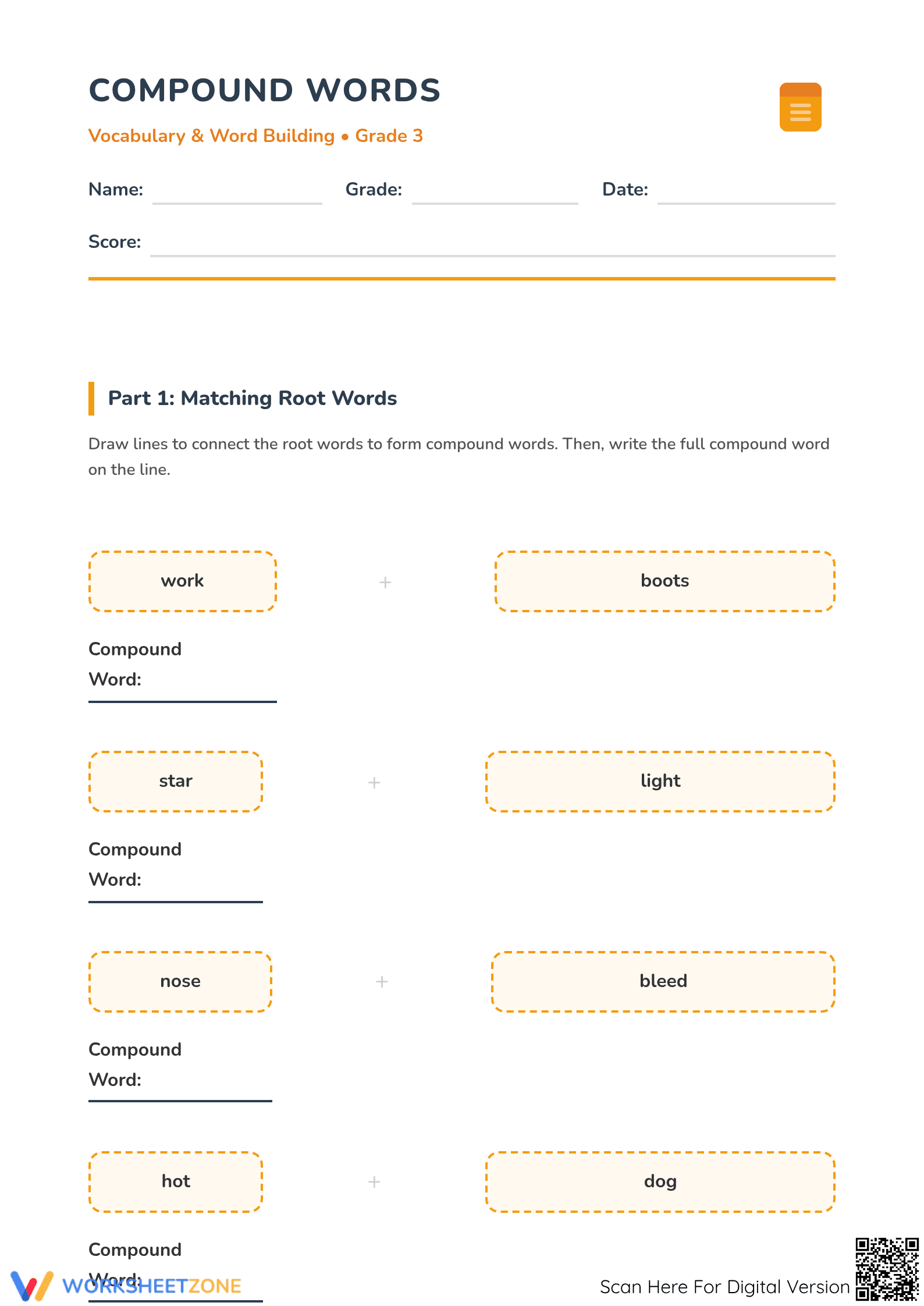
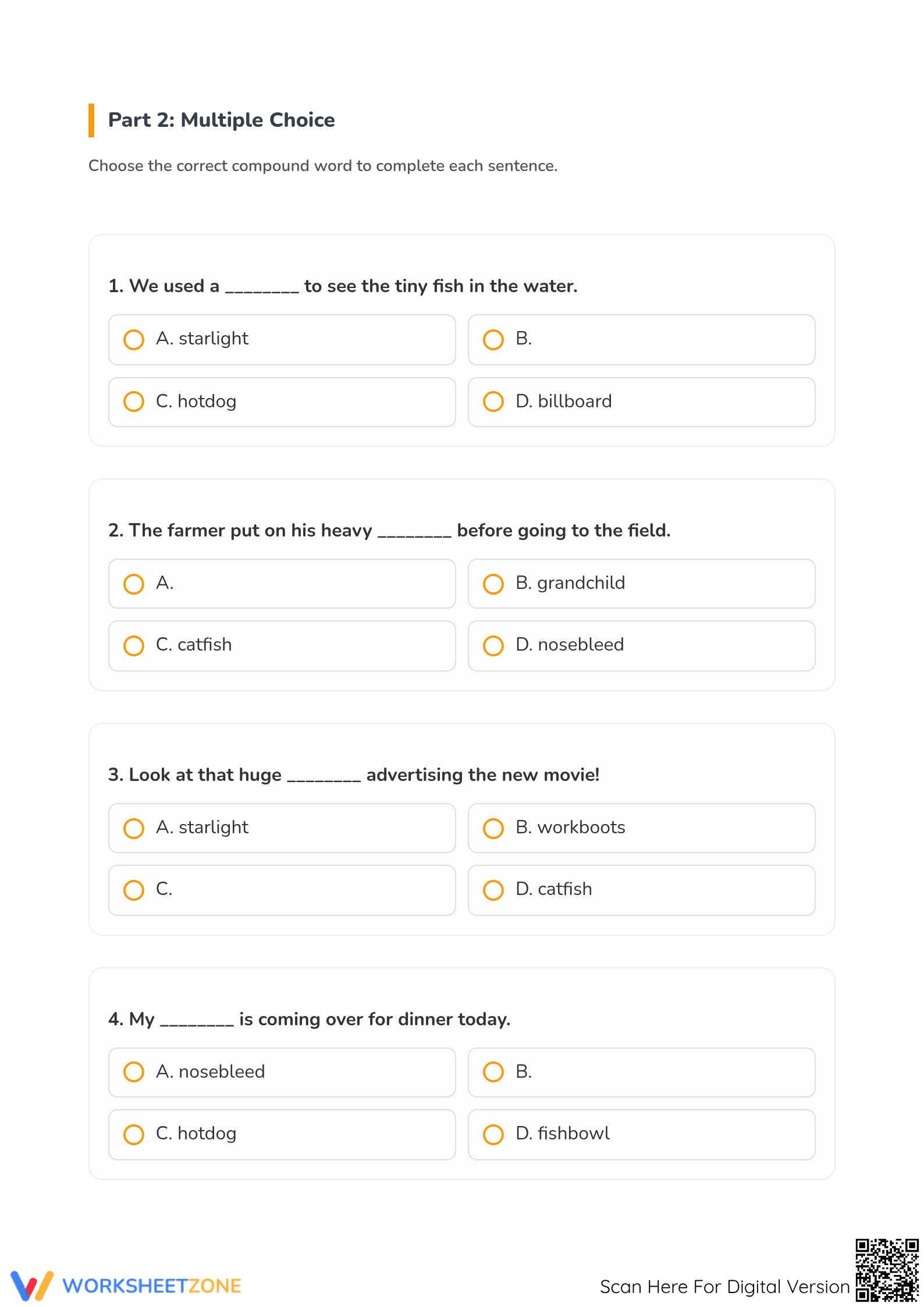
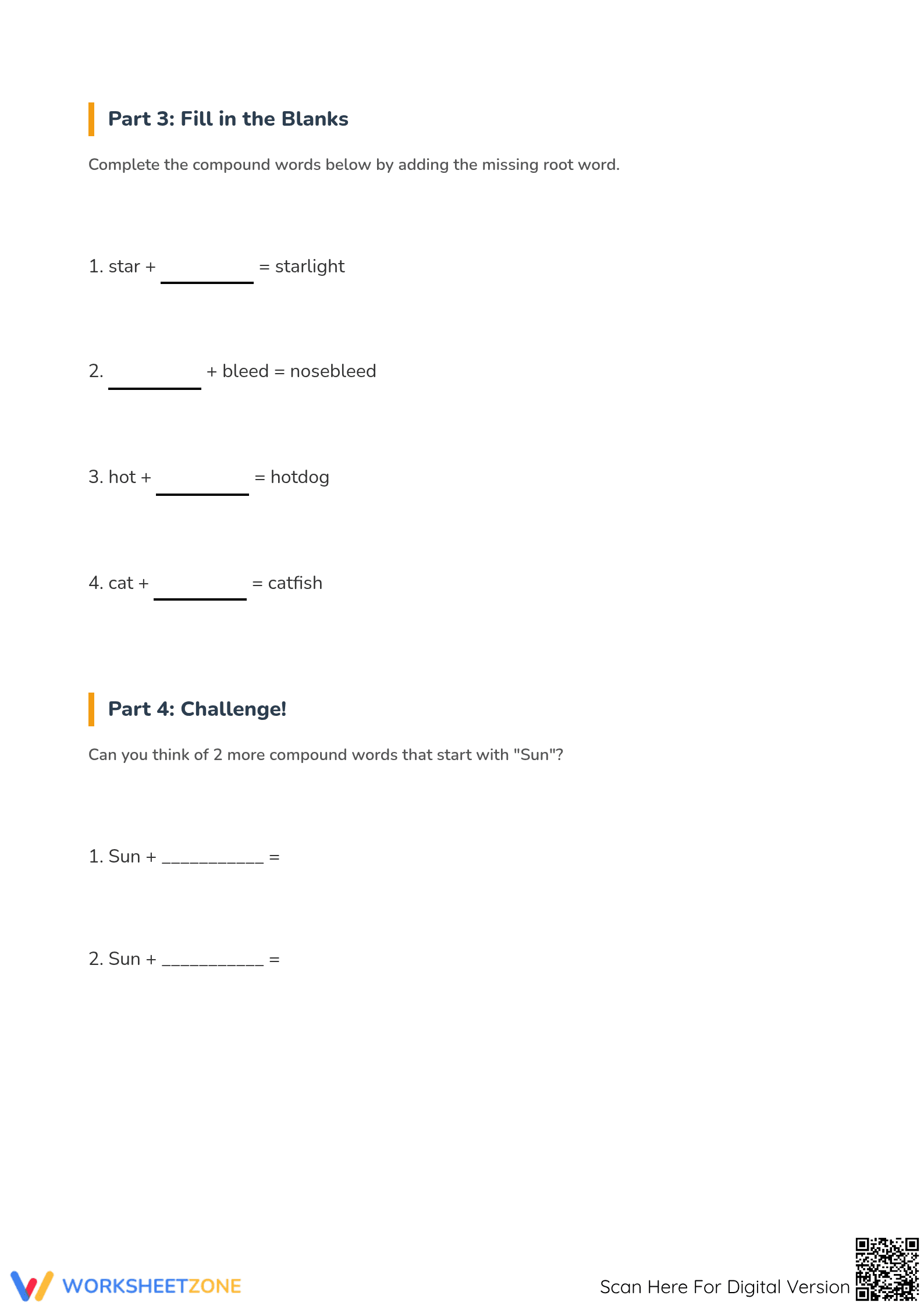
This comprehensive four-page PDF resource contains eighteen targeted tasks designed to strengthen lexical skills. Students begin by matching eight pairs of root words, such as "work" and "boots" or "hot" and "dog," to create familiar compound terms. The packet continues with multiple-choice sentence completion, fill-in-the-blank root word identification, and a creative challenge section where students must generate new words starting with the root "sun." A full answer key is provided for efficient grading.
The instructional design follows a clear progression to ensure student success:
- Guided Practice: Eight visual matching tasks provide heavy scaffolding as students connect root words in dashed boxes to see the physical transformation of language.
- Supported Practice: Four multiple-choice sentence problems require students to apply their knowledge within a narrative context, selecting the most appropriate compound term.
- Independent Practice: Six completion and challenge tasks demand independent retrieval and generation of compound terms, demonstrating complete mastery of word structures.
This scaffolded approach aligns with the I Do, We Do, You Do model of gradual release instruction, ensuring every student reaches independent proficiency.
This resource is strictly aligned to `CCSS.ELA-LITERACY.L.2.4.D`, which requires students to use the meaning of individual words to determine the meaning of compound words. It also supports `CCSS.ELA-LITERACY.L.3.4`, helping students acquire and accurately use grade-appropriate conversational, general academic, and domain-specific words. Both standard codes can be copied directly into lesson plans, IEP goals, or district curriculum mapping tools.
Integrate this worksheet during the independent practice phase of a gradual release lesson on morphology. For a formative assessment observation, check student responses during the challenge section to see if they can generalize the "sun" root to terms like "sunflower" or "sunburn." The entire packet typically takes 20 to 30 minutes to complete depending on individual student pace.
This worksheet is ideal for third-grade general education students, as well as second graders ready for enrichment or fourth graders needing a quick review of foundational lexical concepts. It pairs naturally with a classroom anchor chart displaying common compound word examples or a short informational passage where these terms frequently appear in context to provide a complete learning experience.
This Grade 3 English Language Arts worksheet focuses on the morphological structure of compound words, specifically targeting the ability to decode and understand how two independent root words combine to form a new lexical unit with a distinct meaning. Aligned with CCSS.ELA-LITERACY.L.2.4.D, the activities require students to use knowledge of the meaning of individual words to predict the meaning of the resulting compound word. According to Fisher & Frey (2014), the use of scaffolded word-building tasks, such as matching root words and completing sentence-level contexts, is essential for developing robust vocabulary acquisition and linguistic fluency in elementary students. By engaging with 18 distinct problems across four formats, learners move from basic identification to generative application. This resource serves as a foundational tool for literacy development, ensuring that students can accurately parse complex word structures during independent reading and writing sessions.


