































Complete Thermal Transfer Worksheet | Grade 6 Science

Paste this activity's link or code into your existing LMS (Google Classroom, Canvas, Teams, Schoology, Moodle, etc.).
Students can open and work on the activity right away, with no student login required.
You'll still be able to track student progress and results from your teacher account.
This thermal energy transfer worksheet helps Grade 6 science students master conduction, convection, and radiation. Through targeted conceptual questions and quantitative lab analysis, learners explain particle motion, trace thermal currents, and analyze heat flow across different materials to build lasting physical science understanding.
At a Glance
- Grade: 6 · Subject: Science
- Standard: Middle School Physical Science — Track thermal energy transfer via conduction, convection, and radiation within closed systems
- Skill Focus: Conduction, Convection & Radiation: Thermal-Transfer Check
- Format: 5 pages · 12 problems · Answer key included · PDF
- Best For: Mid-unit mastery, formative review, and assessment prep
- Time: 45–60 minutes
This 5-page printable packet contains 12 structured tasks supported by a vocabulary reference box. The student pages feature a comparison table, scenario-based physics items, and a 4-chamber thermal conductivity data experiment with temperature readings taken over 20 minutes. A comprehensive 3-page teacher answer key provides complete scientific explanations, data calculations, and sample CER responses.
Skill Progression
- Guided practice (Part A, 3 problems): Students define thermal terms and complete a structured mechanism chart with definition scaffolds.
- Supported practice (Part B, 6 problems): Learners examine everyday phenomena, including spoons in hot water and convection currents, applying particle concepts.
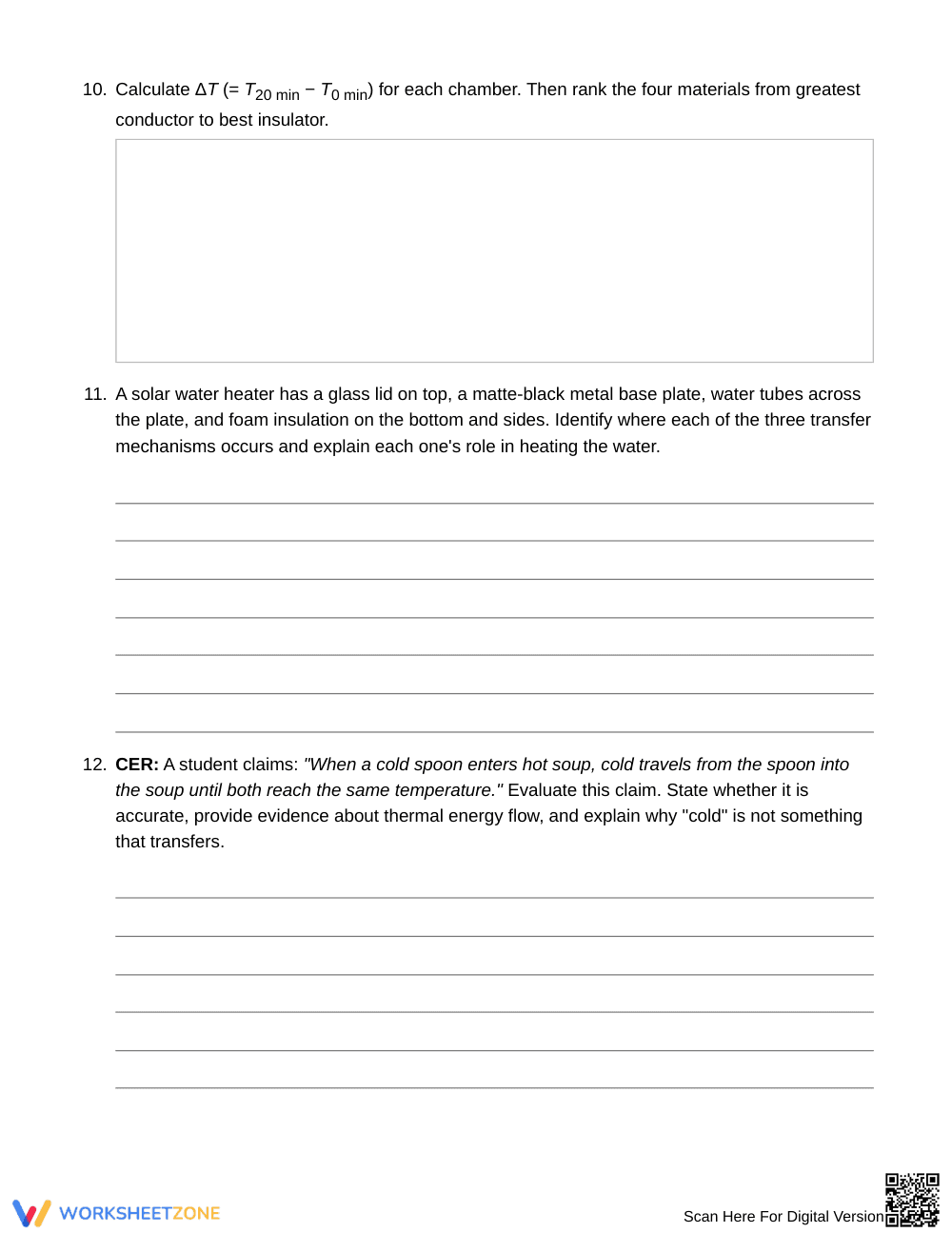
- Independent practice (Part C, 3 problems): Students analyze multi-chamber lab data, rank thermal insulators, and write an evidence-based CER refuting cold transfer.
This gradual-release model guides students systematically from initial concept recall to rigorous, independent scientific argumentation.
Standards Alignment
This worksheet aligns with middle school physical science standards requiring students to model and explain thermal energy transfer via conduction, convection, and radiation. It also supports engineering design goals by prompting learners to evaluate insulator performance. Both standard codes can be copied directly into lesson plans, IEP goals, or district curriculum mapping tools.
How to Use It
Assign this worksheet after direct instruction on kinetic theory and heat transfer. Use Parts A and B for guided partner practice, then administer Part C as an independent check for understanding. As students work, check whether they describe heat moving into cold objects rather than "cold" escaping. Expect completion within 45 to 60 minutes.
Who It's For
This resource serves Grade 6 science classrooms exploring thermal physics. Provide the built-in vocabulary box and sentence frames to support developing readers and multilingual learners. Provide the solar water heater analysis as an extension for advanced students. Pair this activity with a physical convection beaker demonstration or interactive heat anchor chart.
According to educational research by Fisher & Frey (2014) on the gradual release of responsibility, structuring science tasks from foundational definitions to complex data analysis significantly enhances conceptual retention and analytical reasoning. This Grade 6 physical science worksheet provides a rigorous 12-task framework focused on analyzing thermal energy transfer through conduction, convection, and radiation. Students explore particle kinetics, compare temperature with total thermal energy, evaluate rates of conduction using a multi-chamber quantitative experiment, and craft an evidence-based scientific claim refuting the misconception that cold transfers between objects. By transitioning from structured concept tables to open-ended investigation analysis, the instructional sequence guides middle school students toward deep mechanistic understanding of thermodynamics. Educators can utilize this comprehensive five-page resource to assess student mastery of spontaneous energy flow from warmer to cooler matter while establishing rigorous scientific argumentation routines in modern STEM classrooms.


