




























Views
Downloads

Complete Thermal Insulation Worksheet | Grade 6 Science

Paste this activity's link or code into your existing LMS (Google Classroom, Canvas, Teams, Schoology, Moodle, etc.).
Students can open and work on the activity right away, with no student login required.
You'll still be able to track student progress and results from your teacher account.
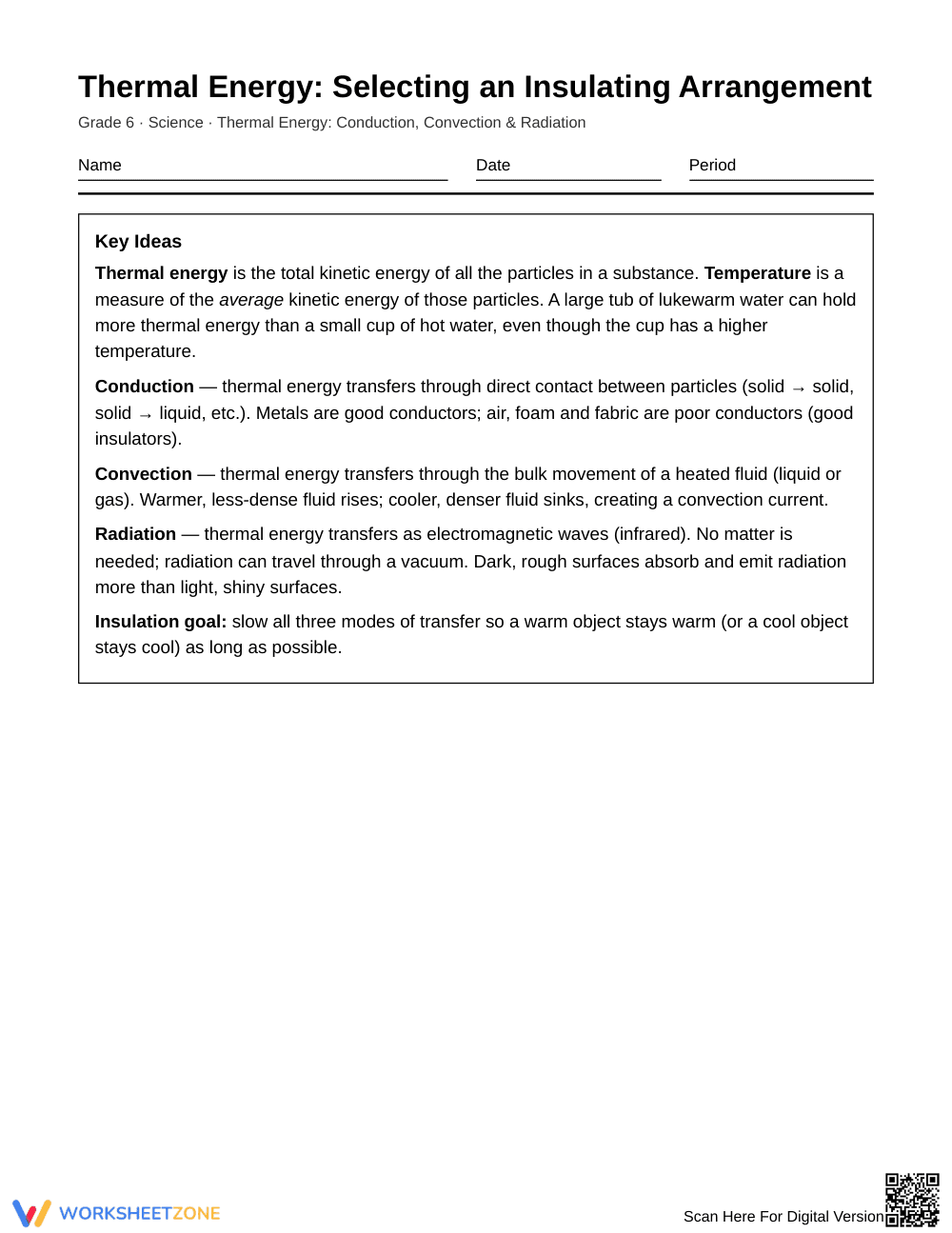
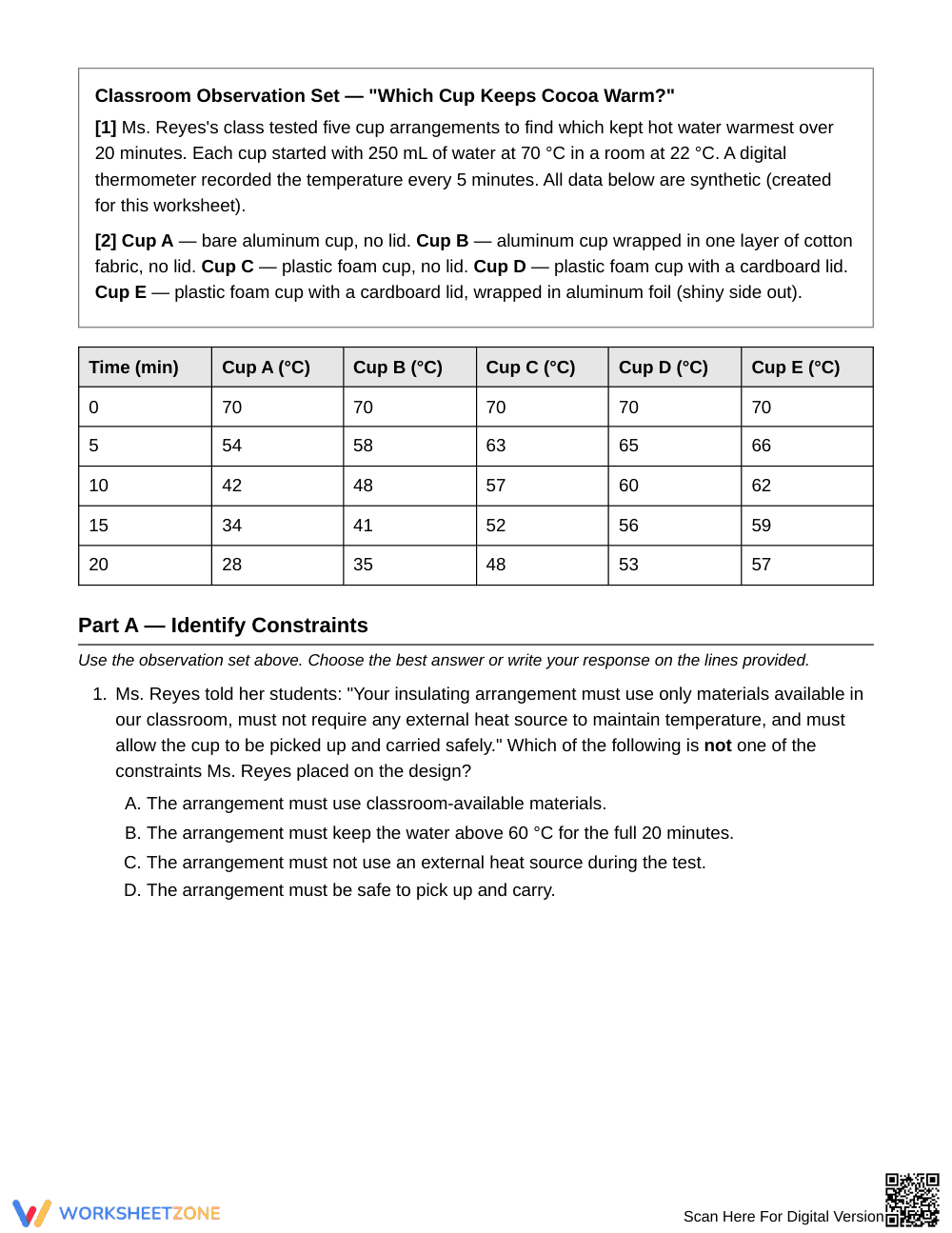
This thermal energy worksheet guides sixth-grade science students through analyzing heat transfer mechanisms to select and evaluate insulating arrangements. Working from an experimental dataset, learners analyze how conduction, convection, and radiation affect temperature change over time while evaluating practical engineering design constraints and scientific conclusions.
At a Glance
- Grade: 6 · Subject: Science
- Skill Focus: Conduction, Convection & Radiation in Insulation Design
- Format: 5 pages · 10 problems · Answer key included · PDF
- Best For: Data analysis and concept mastery practice
- Time: 35–45 minutes
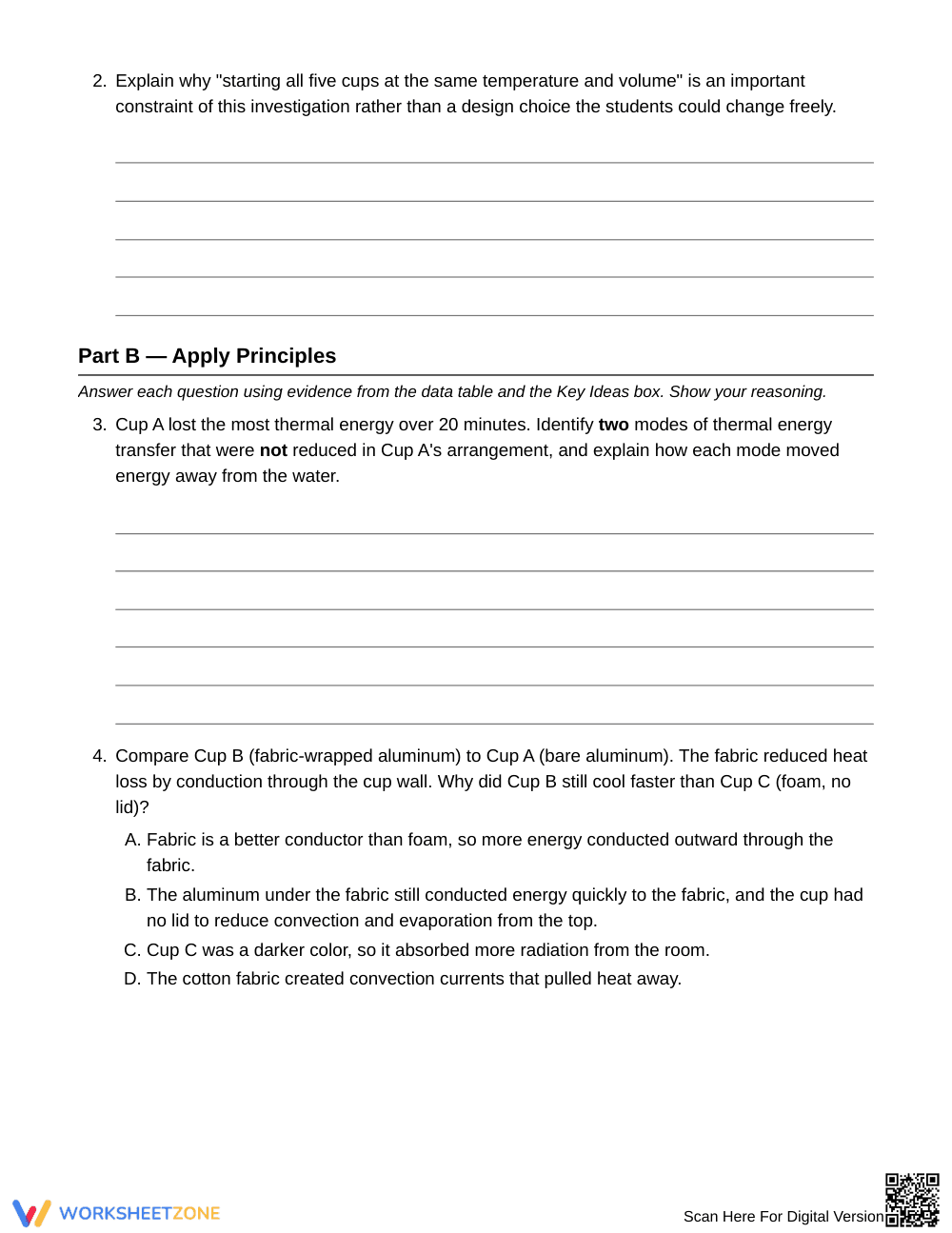
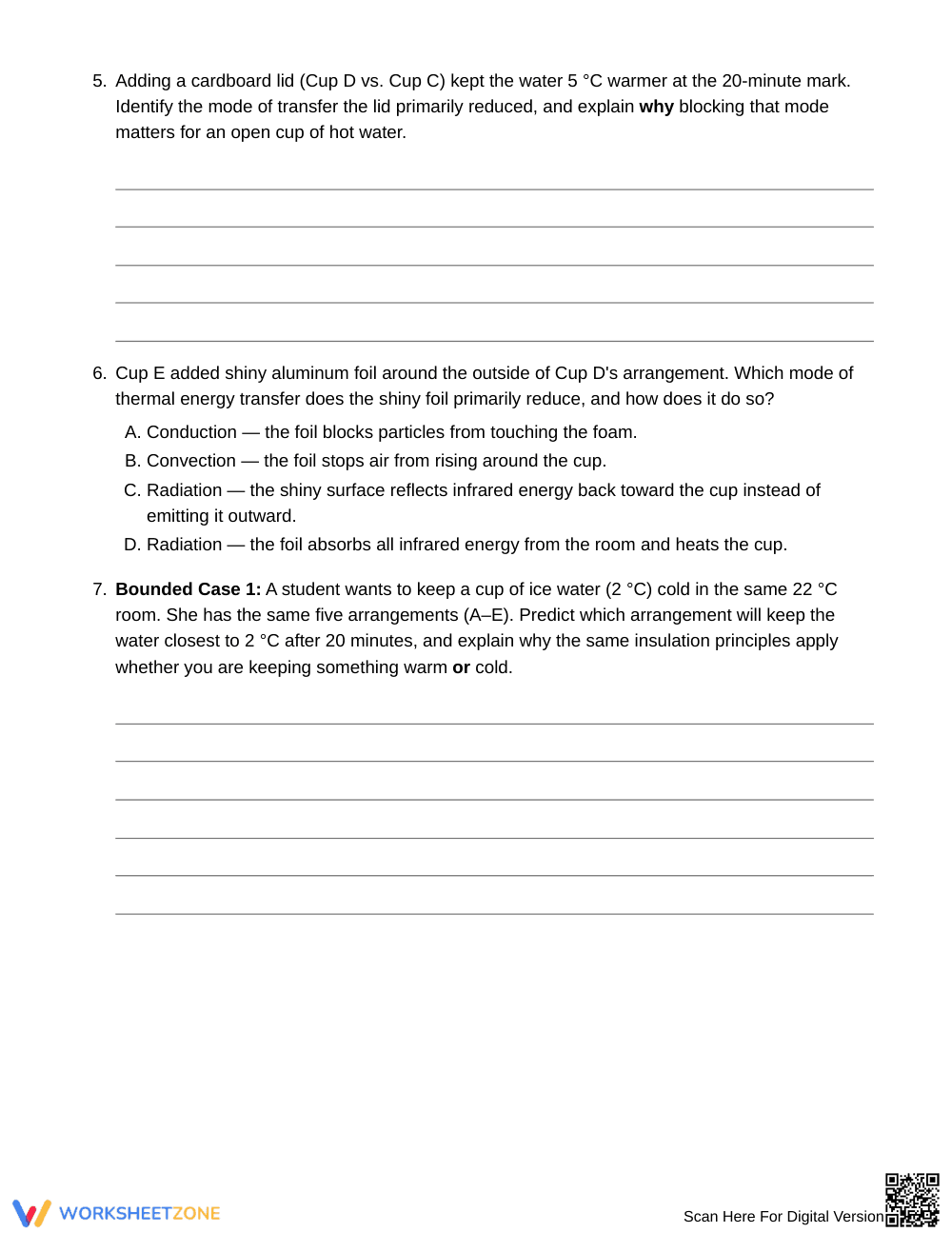
The 5-page worksheet includes a concise Key Ideas reference box, a comprehensive 20-minute synthetic data table comparing five distinct cup configurations, and 10 targeted analysis tasks. Questions range from multiple-choice constraint identification to constructed-response evaluations. A complete 4-page answer key provides sample explanations and clear reasoning criteria for every prompt.
Skill Progression
- Guided practice (Part A, 2 tasks): Students identify experimental constraints, establish controlled variables, and distinguish fixed testing parameters from variable design choices.
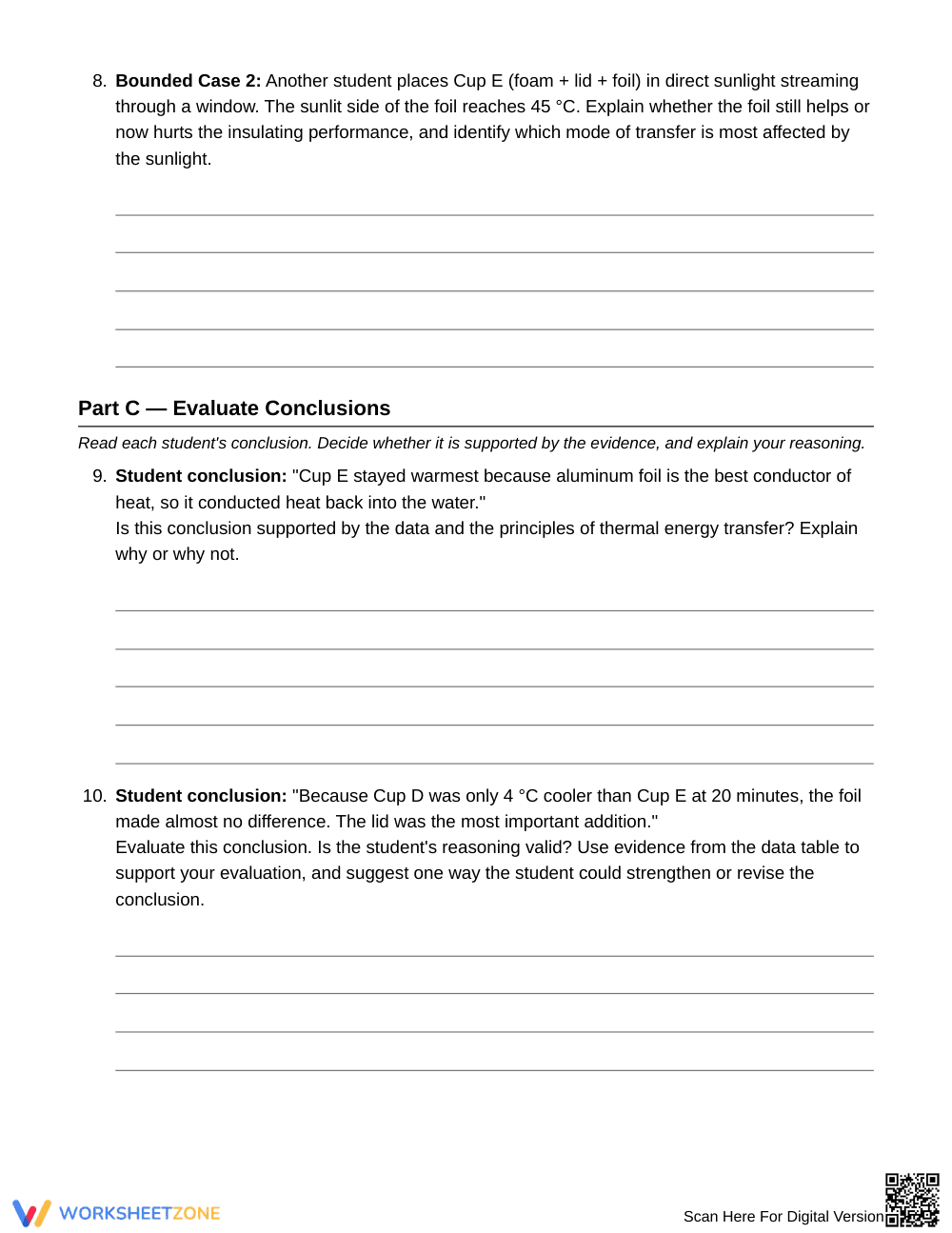
- Supported practice (Part B, 6 tasks): Learners connect observed temperature changes to specific heat transfer mechanisms across varied materials and bounded extension cases.
- Independent practice (Part C, 2 tasks): Students critically evaluate peer conclusions, identifying scientific misconceptions and suggesting evidence-based revisions.
This structured progression reflects the gradual release of responsibility model, guiding students from foundational comprehension to rigorous analytical critique.
Standards Alignment
This resource aligns with middle school physical science standards requiring students to apply scientific principles to design, construct, and test devices that either minimize or maximize thermal energy transfer. Core physical science benchmarks can be integrated directly into lesson plans, IEP goals, or district curriculum mapping tools.
How to Use It
Deploy this worksheet after direct instruction on heat transfer mechanisms, or use it as an analytical follow-up to a physical calorimetry investigation. During independent work, circulate to observe whether students attribute temperature changes to correct transfer mechanisms rather than simple material labels. Expect students to complete the 10 tasks in approximately 35 to 45 minutes.
Who It's For
This resource is designed for Grade 6 general science and introductory physical science classrooms. It provides structured scaffolding for emerging readers through explicit reference definitions while offering bounded extension scenarios for advanced learners. Pair this worksheet with a thermal conductivity anchor chart or hands-on calorimeter demonstration.
Middle school science instruction in thermal energy requires students to connect abstract kinetic particle models with observable macroscopic phenomena such as conduction, convection, and radiation. According to research by Fisher & Frey (2014) on the gradual release of responsibility framework, structuring analytical tasks from scaffolded constraint identification through independent claim evaluation significantly strengthens evidence-based reasoning in young adolescents. By presenting a systematic five-cup comparative dataset alongside explicit physical definitions, this instructional resource supports students in diagnosing heat transfer pathways across solid boundaries, open fluids, and reflective surfaces. Learners refine their scientific literacy by defending engineering design decisions, explaining inverse thermal scenarios such as cold preservation, and identifying logical fallacies in peer scientific claims. Ultimately, this scaffolded instructional structure builds lasting conceptual mastery and analytical confidence in middle school physical science investigations across diverse classroom environments.


