





























Complete Text Structures Worksheet | Grade 9 English I
Paste this activity's link or code into your existing LMS (Google Classroom, Canvas, Teams, Schoology, Moodle, etc.).
Students can open and work on the activity right away, with no student login required.
You'll still be able to track student progress and results from your teacher account.
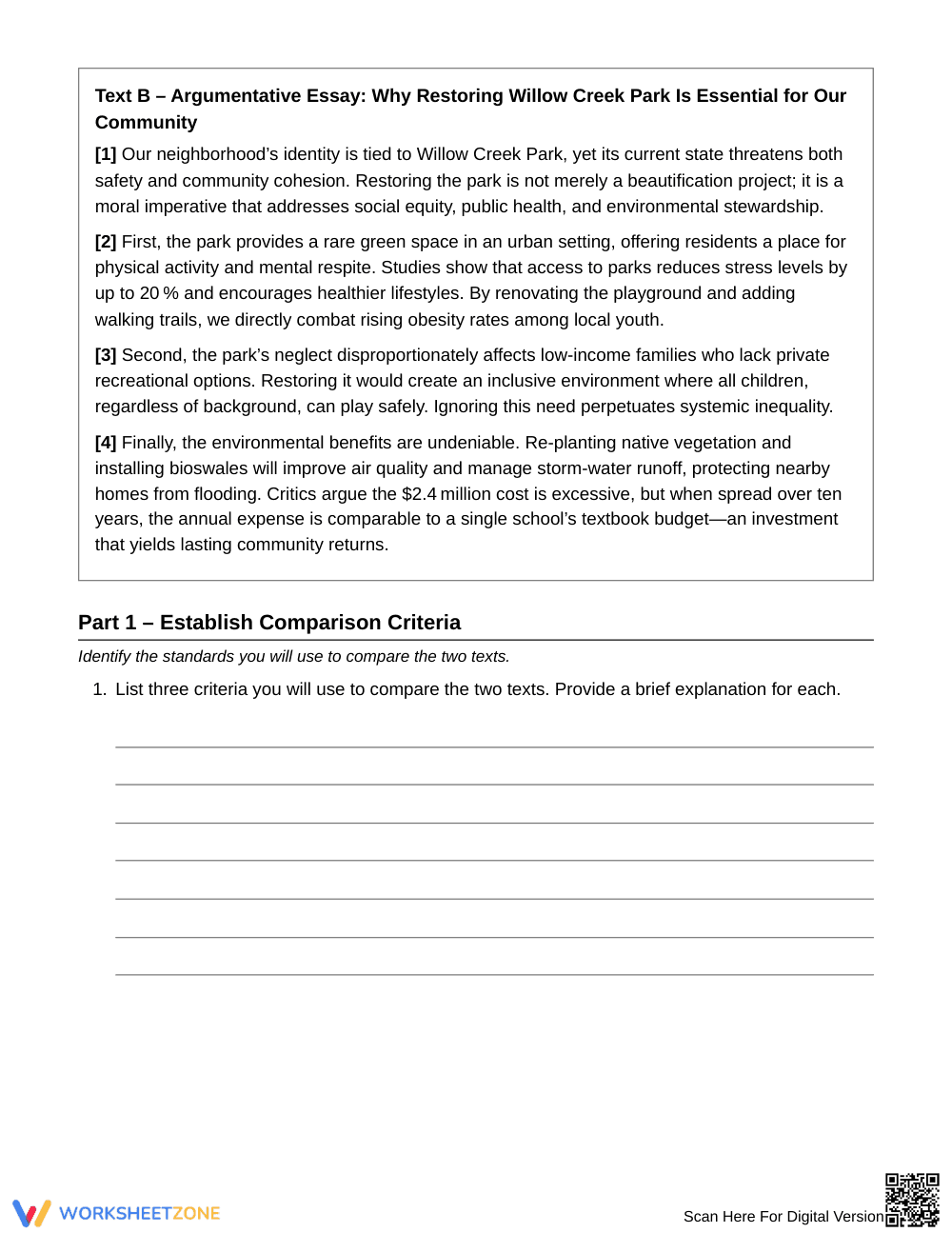
This Grade 9 informational text worksheet equips students to analyze and compare expository and argument structures. Using paired passages regarding community park restoration, learners evaluate how factual reporting differs from persuasive writing through ten rigorous analytical tasks to master structural analysis.
At a Glance
- Grade: 9 · Subject: English I (Informational Text)
- Standard:
RI.9-10.5— Analyze how an author's ideas or claims are developed and refined through sentence and paragraph structures- Skill Focus: Compare Expository and Argument Structures
- Format: 6 pages · 10 problems · Full answer key included · PDF
- Best For: Comparative informational and argumentative text analysis
- Time: 45–60 minutes
What's Inside: This 6-page printable packet presents two paired texts on the Willow Creek Park restoration alongside a 10-task written analysis sequence. A structural reminder box anchors student work with criteria for both expository and argument modes, followed by text-dependent comparison prompts and a complete 2-page answer key with exemplar responses.
Skill Progression
- Guided Practice (Part 1, 2 tasks): Students identify comparison criteria and justify standards using the provided reminder box.
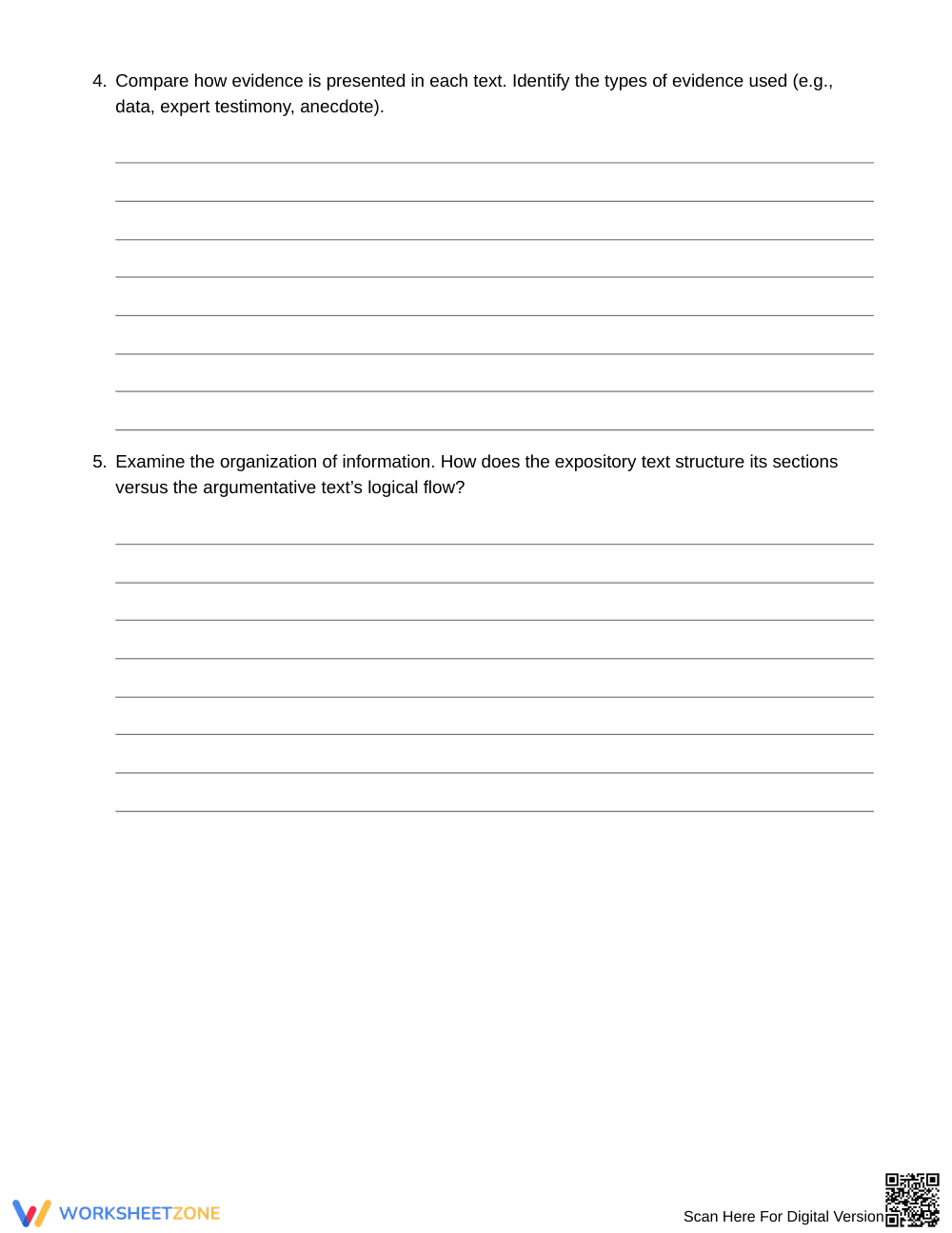
- Supported Practice (Part 2, 6 tasks): Learners complete paired analyses comparing introductions, evidence types, organization, counterarguments, tone, and conclusions.
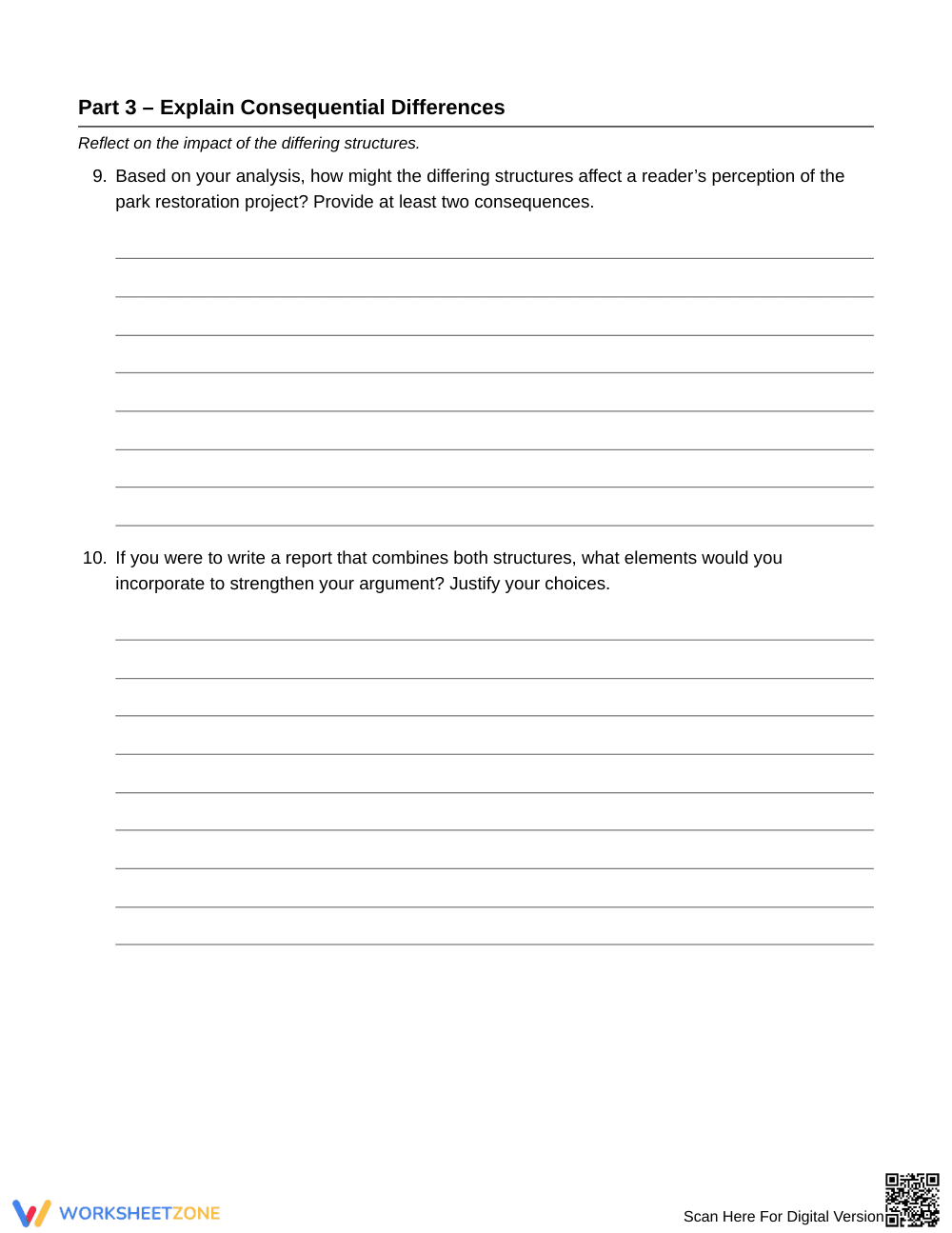
- Independent Practice (Part 3, 2 tasks): Students evaluate reader perception consequences and design an integrated structure independently.
This sequence follows a gradual release of responsibility model, shifting from explicit criteria to independent evaluation.
Standards Alignment
This resource aligns to Common Core standard `RI.9-10.5`: "Analyze in detail how an author's ideas or claims are developed and refined by particular sentences, paragraphs, or larger portions of a text." In addition, the comparative writing supports `RI.9-10.1` by requiring explicit textual citations. Both standard codes can be copied directly into lesson plans, IEP goals, or district curriculum mapping tools.
How to Use It
Use this worksheet after direct instruction on text structures. Have students annotate passages in pairs before tackling Part 1 and Part 2. For formative assessment, check Part 2, Item 4 to verify whether students detect counterarguments in the argument essay while noting their absence in the expository report. Completion takes 45 to 60 minutes.
Who It's For
This packet suits Grade 9 English I general education students, honors classes analyzing informational craft, and English learners needing structured comparative frames. Differentiate by providing sentence starters for striving writers or requiring rhetorical device analysis for advanced learners. Pair this activity with an informational text anchor chart or comparative essay unit.
Secondary literacy instruction under standard RI.9-10.5 requires Grade 9 students to analyze how authors organize information and develop central ideas across varied informational text types. According to Fisher & Frey (2014), high school learners demonstrate significantly higher analytical comprehension when instructional tasks implement paired-text analysis combining explicit structural modeling with text-dependent comparative writing. Comparing expository and argument structures side by side enables ninth-grade students to observe directly how informational organization governs authorial purpose, evidence selection, and persuasive impact. This 10-task worksheet strengthens critical reading by requiring pupils to cite textual evidence, contrast factual sequencing against persuasive claims, and evaluate the consequences of structural choices. Moving through structured instructional tiers systematically reinforces the close-reading stamina, comparative reasoning, and analytical writing required by college and career readiness benchmarks across secondary English language arts classrooms.


