


























Views
Downloads



Complete Text Structure & Purpose Worksheet | G6 ELA
Paste this activity's link or code into your existing LMS (Google Classroom, Canvas, Teams, Schoology, Moodle, etc.).
Students can open and work on the activity right away, with no student login required.
You'll still be able to track student progress and results from your teacher account.
This Grade 6 ELA worksheet teaches students to match informational text structures—chronological, problem-and-solution, categorical, and cause-and-effect—to the specific needs of different readers. Built around a realistic school event fact sheet, all 10 tasks ask students to select, organize, and justify structural choices, moving from recognition to written reasoning aligned to RI.6.5.
At a Glance
- Grade: 6 · Subject: ELA
- Standard:
RI.6.5— Analyze how a text's structure contributes to the development of ideas- Skill Focus: Match organization to a reader's need
- Format: 5 pages · 10 problems · Answer key included · PDF
- Best For: Guided or independent text-structure practice
- Time: 25–40 minutes
What's Inside
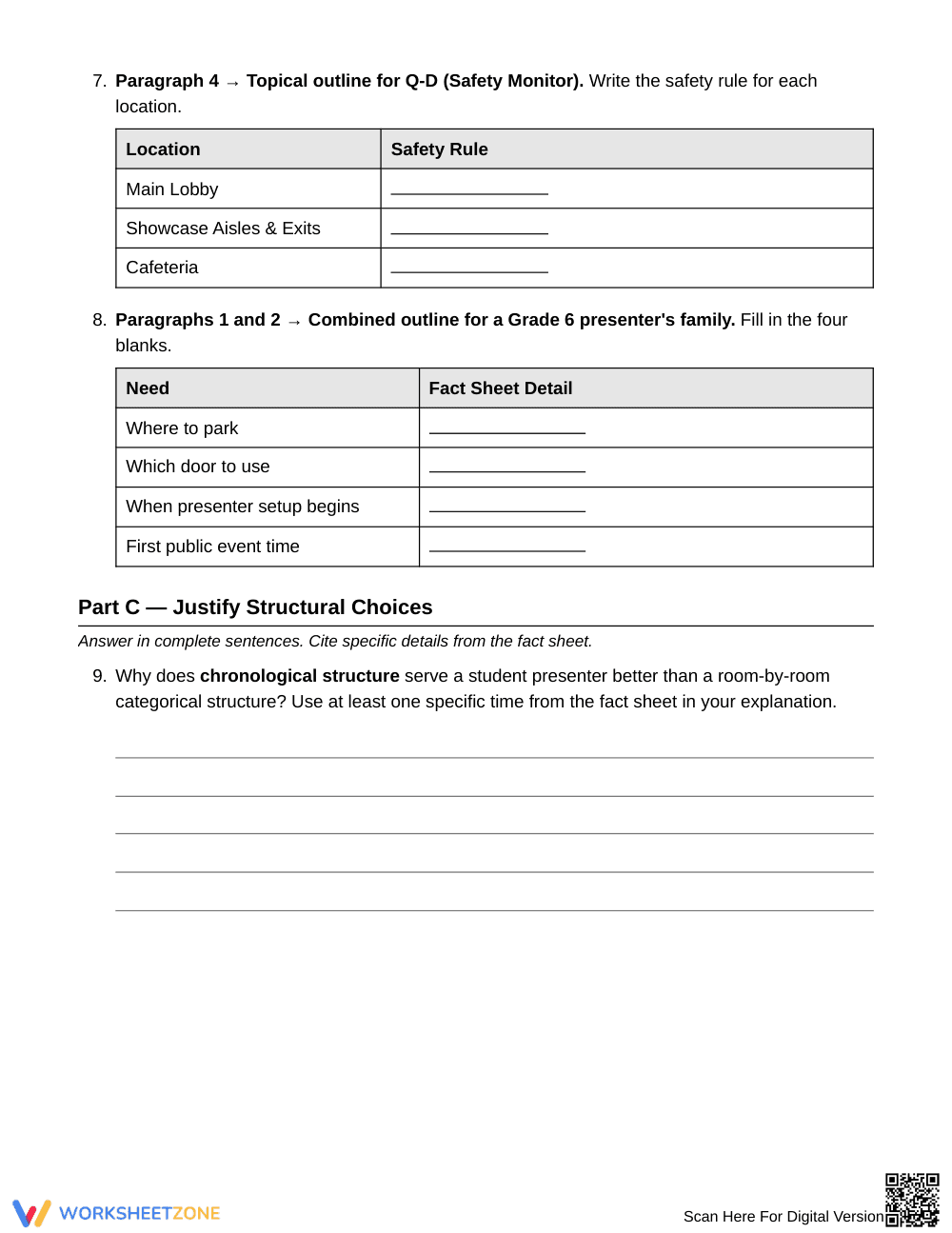
Students read a four-paragraph fact sheet about a fictional STEM showcase night, then respond to four distinct reader questions—a parent driver, a student presenter, a visiting judge, and a safety monitor. A Structure-Selection Reminder box defines four organizational patterns. Part A presents three multiple-choice items. Part B contains five outline-completion tables where students arrange details into structured frameworks. Part C closes with two open-response justification prompts. A 3-page answer key provides correct responses for every item.
Skill Progression
- Guided practice (Part A, 3 items): Students use the reference box to identify the correct organizational pattern for each reader's question. Answer choices include plausible distractors requiring careful reasoning.
- Supported practice (Part B, 5 items): Students transfer facts from labeled paragraphs into structured outlines—chronological timelines, problem-solution pairs, and category-criteria grids. Table scaffolds guide placement of each detail.
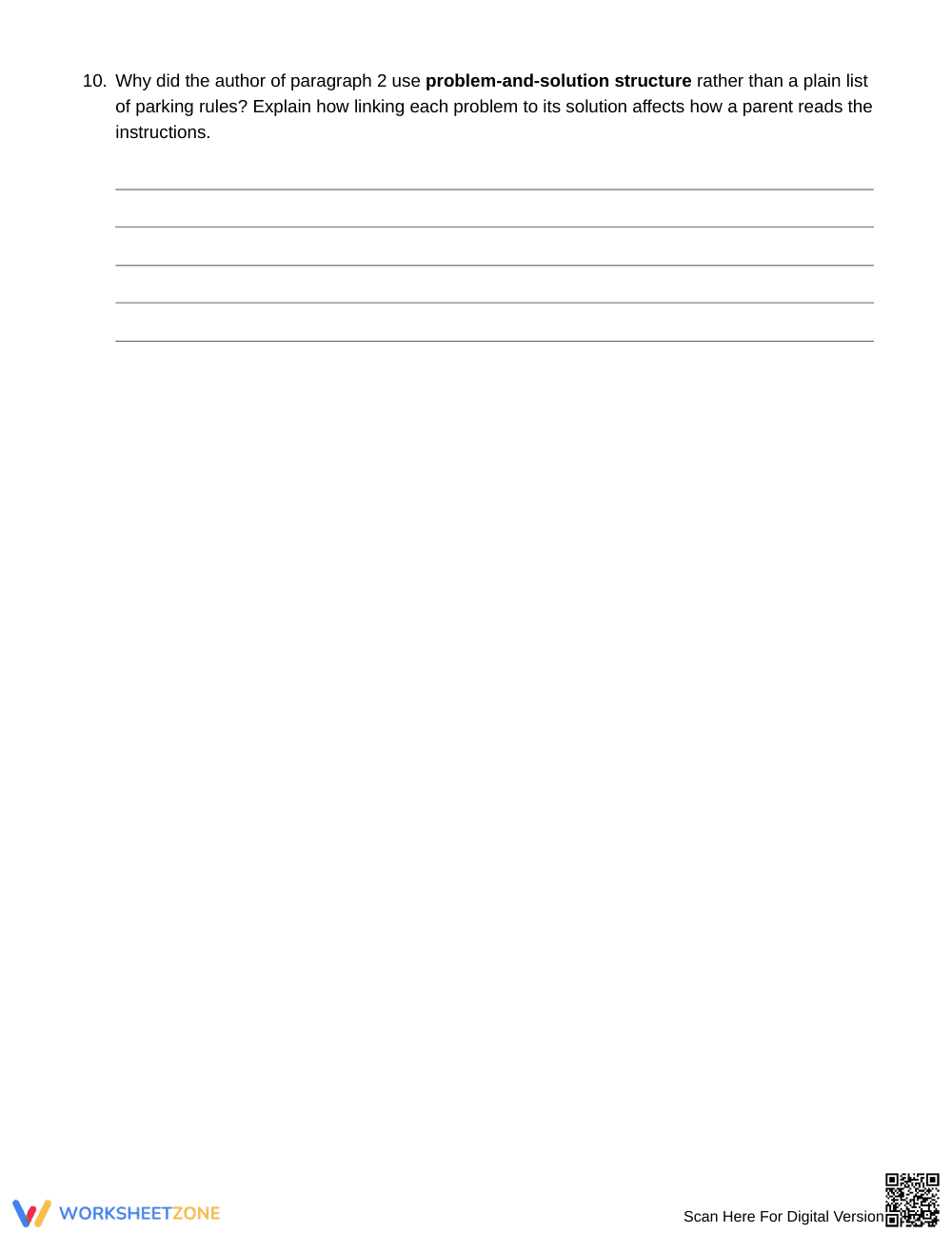
- Independent practice (Part C, 2 items): Students compose multi-sentence justifications explaining why one structure serves a particular reader better than an alternative, citing specific details such as the 4:00 p.m. setup time.
How to Use It
Use this worksheet after direct instruction on informational text structures. Students can complete Parts A and B during a 25-minute guided practice block, then tackle Part C as an exit ticket or homework extension. To gather formative data, note whether students can distinguish problem-and-solution from simple sequential listing—a common misconception at Grade 6. Alternatively, assign the full worksheet as independent seat work during a 40-minute literacy block.
Who It's For
Designed for Grade 6 general-education readers working at or near grade level. For students who need additional support, pair the worksheet with an anchor chart listing signal words for each structure (e.g., because, as a result, first, next). For advanced learners, ask them to rewrite one paragraph using an alternative structure and explain what information the reader would lose.
According to the NAEP 2022 reading assessment, only 36 percent of eighth graders scored at or above the proficient level in reading, underscoring the need for explicit text-structure instruction before middle school exit. This worksheet addresses standard RI.6.5, which asks students to analyze how a text's organizational pattern contributes to the development of its ideas. By requiring sixth graders to match four distinct structures to four authentic reader purposes across 10 scaffolded tasks, the resource builds the analytical habit Fisher & Frey (2014) call "close reading for structure." Students move from selecting a pattern, to arranging real details into outlines, to writing evidence-based justifications—a progression that mirrors the gradual-release framework supported by decades of literacy research. The included answer key allows teachers to score work immediately or use the worksheet as a self-check station.


