


























Views
Downloads
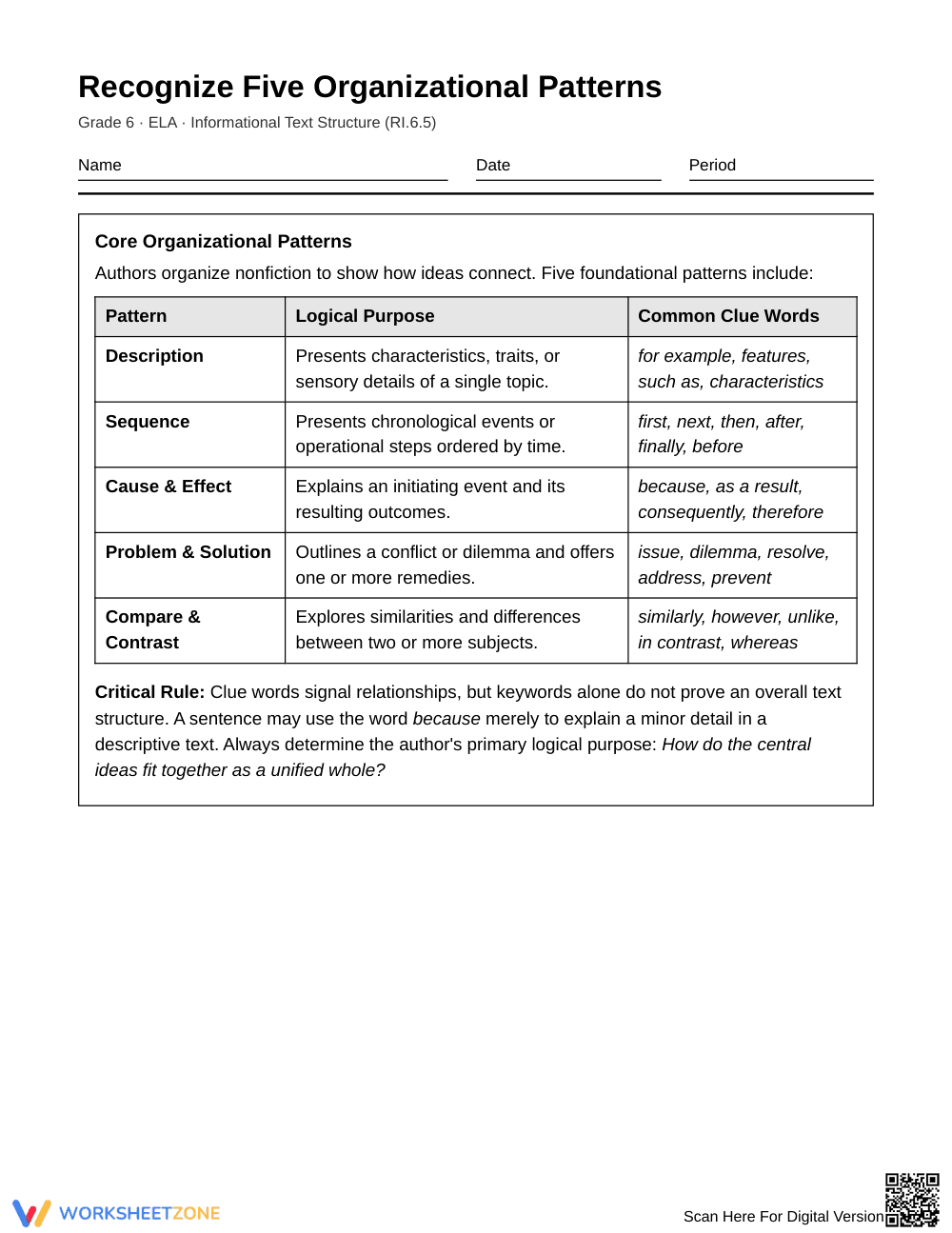


Complete Text Structure Patterns Worksheet | Grade 6 ELA
Paste this activity's link or code into your existing LMS (Google Classroom, Canvas, Teams, Schoology, Moodle, etc.).
Students can open and work on the activity right away, with no student login required.
You'll still be able to track student progress and results from your teacher account.
Mastering informational text structures enables middle school readers to comprehend complex nonfiction and analyze how authors organize central ideas. This Grade 6 ELA worksheet guides students through identifying and analyzing description, sequence, cause and effect, problem and solution, and compare and contrast patterns across five authentic informational passages.
At a Glance
- Grade: 6 · Subject: ELA
- Standard:
RI.6.5— Analyze how a particular sentence, paragraph, or section fits into the overall text structure- Skill Focus: Recognize Five Organizational Patterns
- Format: 5 pages · 10 problems · Answer key included · PDF
- Best For: Informational reading comprehension and structural analysis
- Time: 35–45 minutes
This comprehensive 5-page instructional resource includes a concise organizational patterns reference chart outlining logical purposes and clue words, five distinct scientific and social studies reading selections, and 10 rigorous text-dependent tasks. It features five pattern classification questions in Part A, five deep structural analysis prompts in Part B, and a thorough 3-page answer key.
Skill Progression
- Guided Practice: Students review a concise anchor table detailing the purpose and clue words for five core organizational formats.
- Supported Practice (Tasks 1–5): Learners identify dominant patterns in five informational paragraphs, citing signal words and evidence to justify classifications.
- Independent Practice (Tasks 6–10): Students evaluate structural relationships, paragraph architecture, and counterfactual scenarios without relying solely on surface clue words.
This sequence follows a gradual-release model, advancing students from keyword recognition to deep structural analysis.
Standards Alignment
This resource aligns with RI.6.5: Analyze how a particular sentence, paragraph, or section fits into the overall structure of a text and contributes to the development of ideas. It also supports RI.6.1 by requiring explicit textual evidence. Both standard codes can be copied directly into lesson plans, IEP goals, or district curriculum mapping tools.
How to Use It
Assign this worksheet after direct instruction on text structures for independent practice or guided small-group reading. For formative assessment, check whether students explain the author's primary logical purpose rather than relying only on isolated clue words. Expect students to complete all 10 tasks in 35 to 45 minutes.
Who It's For
Designed for Grade 6 ELA students, this resource supports whole-class instruction, tier-2 reading intervention, and English language learners. The reference chart aids striving readers, while Part B offers rigorous analytical challenges. Pair this activity with an informational mentor text or anchor chart.
According to Fisher & Frey (2014), explicit instruction in informational text structures significantly bolsters adolescent reading comprehension by equipping students with internal cognitive frameworks for organizing incoming content. This Grade 6 worksheet aligns with standard RI.6.5, prompting learners to examine how specific sentences and paragraphs contribute to overarching organizational designs including description, sequence, cause and effect, problem and solution, and compare and contrast. By requiring students to move beyond surface-level transition keywords and analyze genuine conceptual relationships, the resource deepens critical thinking across varied nonfiction topics. Structured practice with diverse informational texts reinforces student ability to identify logical arrangements, synthesize domain-specific details, and articulate how authors construct cohesive arguments. Educators can utilize these 10 text-dependent analytical tasks to reliably assess structural mastery and build foundational literacy skills essential for complex secondary-level reading demands.


