


























Views
Downloads



Complete Text Structure Analysis Worksheet | Grade 7 ELA
Paste this activity's link or code into your existing LMS (Google Classroom, Canvas, Teams, Schoology, Moodle, etc.).
Students can open and work on the activity right away, with no student login required.
You'll still be able to track student progress and results from your teacher account.
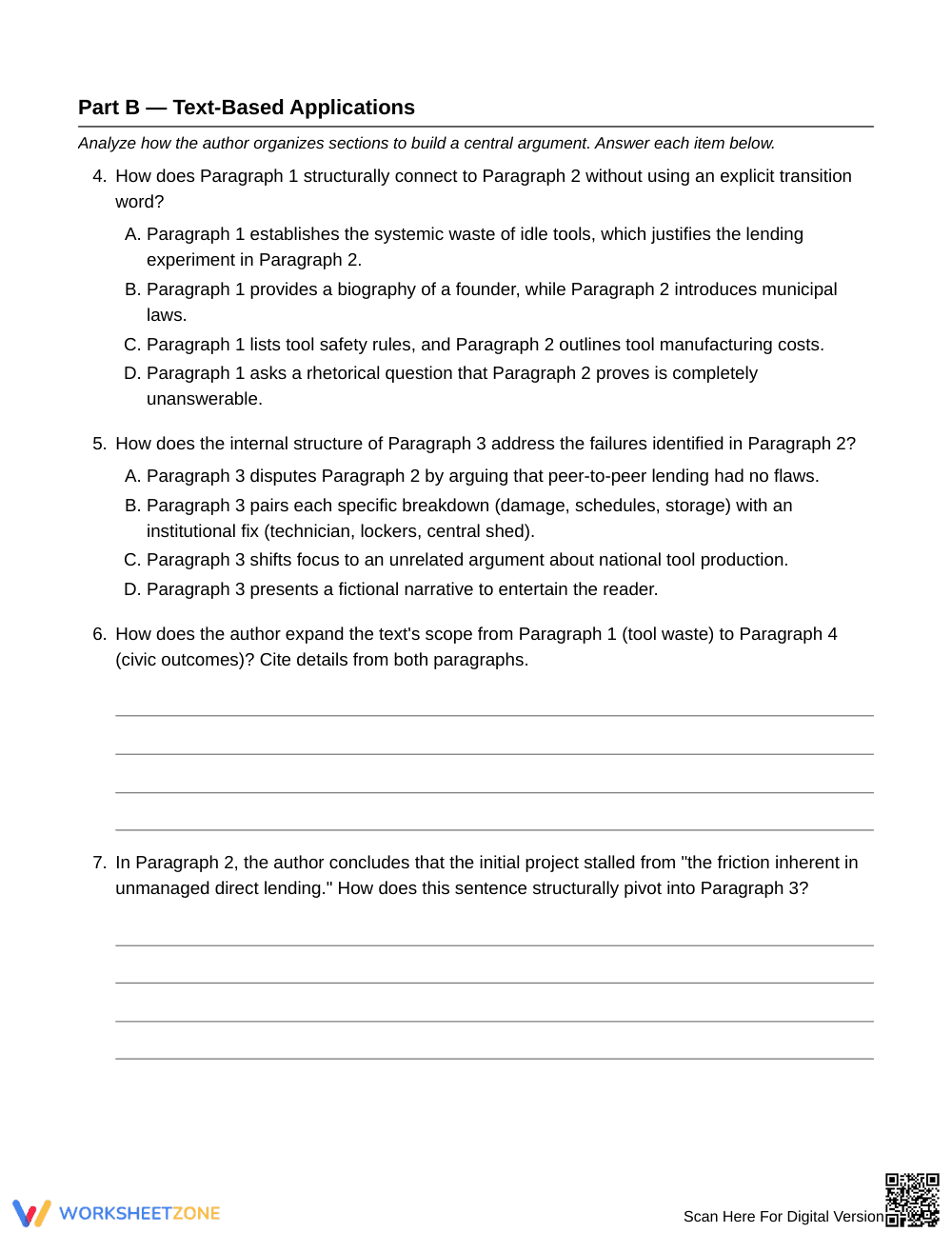
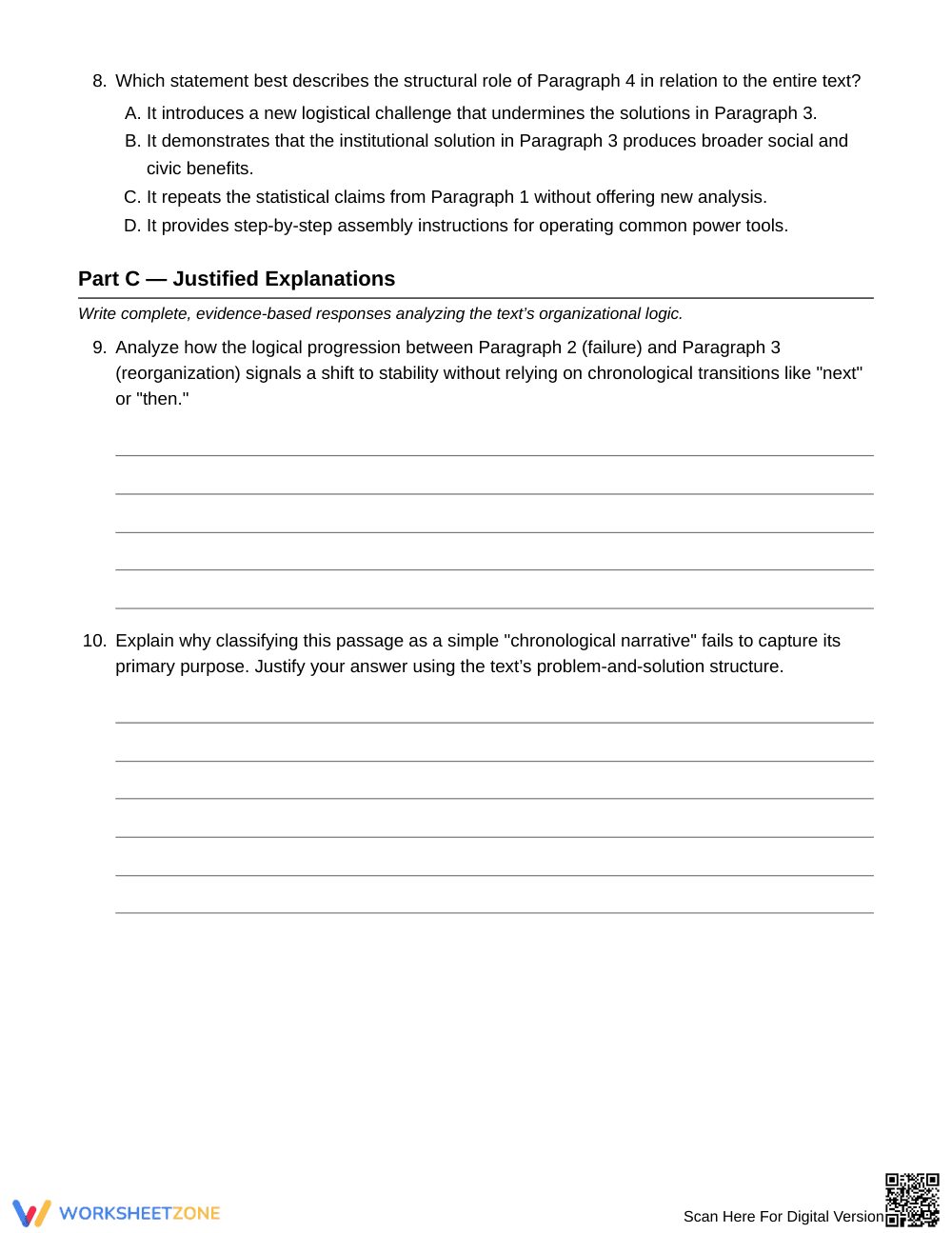
This targeted Grade 7 informational text worksheet equips middle school readers to evaluate macro-level organizational structure without relying on surface-level transition words. Students analyze an authentic informational passage on community tool cooperatives to identify functional paragraph roles, track systemic problem-and-solution logic, and justify structural connections across sections to achieve deep analytical comprehension.
At a Glance
- Grade: 7 · Subject: ELA
- Standard:
RI.7.5— Analyze how a text's structure contributes to its development of ideas- Skill Focus: Organizing Relationships Beyond Signal Words
- Format: 5 pages · 10 problems · Answer key included · PDF
- Best For: Close reading and structural analysis practice
- Time: 35–45 minutes
What's Inside: This 5-page printable resource features a multi-paragraph informational anchor text titled "Tools of the Trade: Building Community Infrastructure" alongside 10 structured analysis items. The student activity includes conceptual multiple-choice items, text-dependent function queries, and constructed-response prompts requiring textual justification. A comprehensive 3-page teacher answer key provides explicit analytical rationales and exemplar responses for every item.
Skill Progression:
- Guided Practice (Part A · 3 Tasks): Focuses on foundational concept distinctions, isolating how structural macro-architecture differs from sentence-level transitional words and distinguishing topic identification from functional analysis.
- Supported Practice (Part B · 5 Tasks): Guides students through text-based application, requiring them to trace how individual paragraphs pivot, introduce structural solutions, and expand argument scope across the text.
- Independent Practice (Part C · 2 Tasks): Demands open-ended written synthesis where students construct justified arguments evaluating organizational logic and defending classification of the text's problem-and-solution architecture.
This sequence follows a gradual-release instructional model that transitions learners from conceptual discernment to rigorous, evidence-grounded structural evaluation.
Standards Alignment: Primary standard `RI.7.5` requires students to analyze the structure an author uses to organize a text, including how the major sections contribute to the whole and to the development of the ideas. Supporting standard `RI.7.1` reinforces citing strong textual evidence to support structural inferences. Both standard codes can be copied directly into lesson plans, IEP goals, or district curriculum mapping tools.
How to Use It: Deploy this resource during mid-unit direct instruction or as a formative assessment check following a lesson on informational text structure. As a guided reading activity, have students annotate paragraph functions in the margins before answering Part B. For formative assessment, examine student responses to Part C to identify whether learners confuse chronological reporting with analytical problem-and-solution logic. The worksheet requires an estimated 35 to 45 minutes of total instructional time.
Who It's For: Designed for Grade 7 general education English language arts classrooms, this activity also provides structured support for Tier 2 intervention groups and advanced Grade 6 readers. Pair this worksheet with an anchor chart on organizational text patterns or a direct instruction mini-lesson on informational text architecture.
According to research by Fisher & Frey (2014), explicit instruction in complex text architecture significantly increases reading comprehension by prompting students to focus on how authors organize claims rather than skimming for isolated keywords. Middle school readers frequently over-rely on surface transitional cues, misinterpreting informational arguments as simple chronological accounts. By pairing a focused informational passage with rigorous analysis prompts aligned to standard `RI.7.5`, this resource requires students to evaluate functional paragraph relationships and justify the text's problem-and-solution framework. Structured across 10 targeted tasks, the activity transitions learners through concept clarification, evidence extraction, and written synthesis. Teachers can reliably evaluate student mastery of organizational logic and generate diagnostic data for informational close-reading instruction.


