































Complete Suspense Text Analysis Worksheet | Grade 7 ELA

Paste this activity's link or code into your existing LMS (Google Classroom, Canvas, Teams, Schoology, Moodle, etc.).
Students can open and work on the activity right away, with no student login required.
You'll still be able to track student progress and results from your teacher account.
This Grade 7 reading literature worksheet guides students to compare how authors manipulate pacing and control information to build suspense. Analyzing parallel neutral and suspenseful narrative accounts enables learners to examine syntactic structure, ticking clocks, and sensory restrictions, strengthening their analytical reading and text-based writing skills.
At a Glance
- Grade: 7 · Subject: ELA
- Standard:
RL.8.6— Analyze how differences in character and reader perspectives create effects such as suspense or dramatic irony.- Skill Focus: Compare Suspenseful and Neutral Versions
- Format: 5 pages · 10 problems · Complete 3-page answer key included · Printable PDF
- Best For: Comparative paired-text analysis, close reading, and craft evaluation
- Time: 45–60 minutes
What's Inside
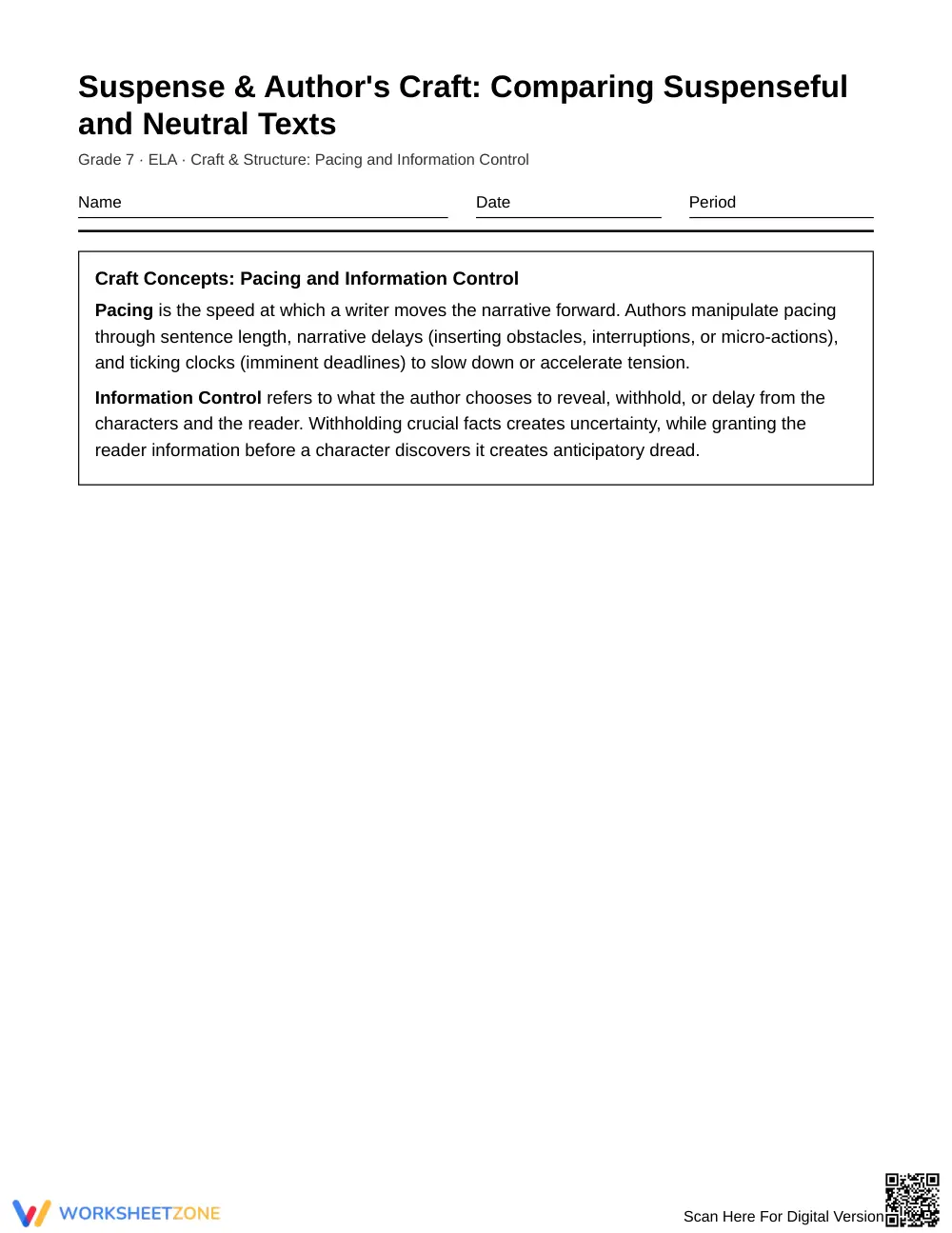
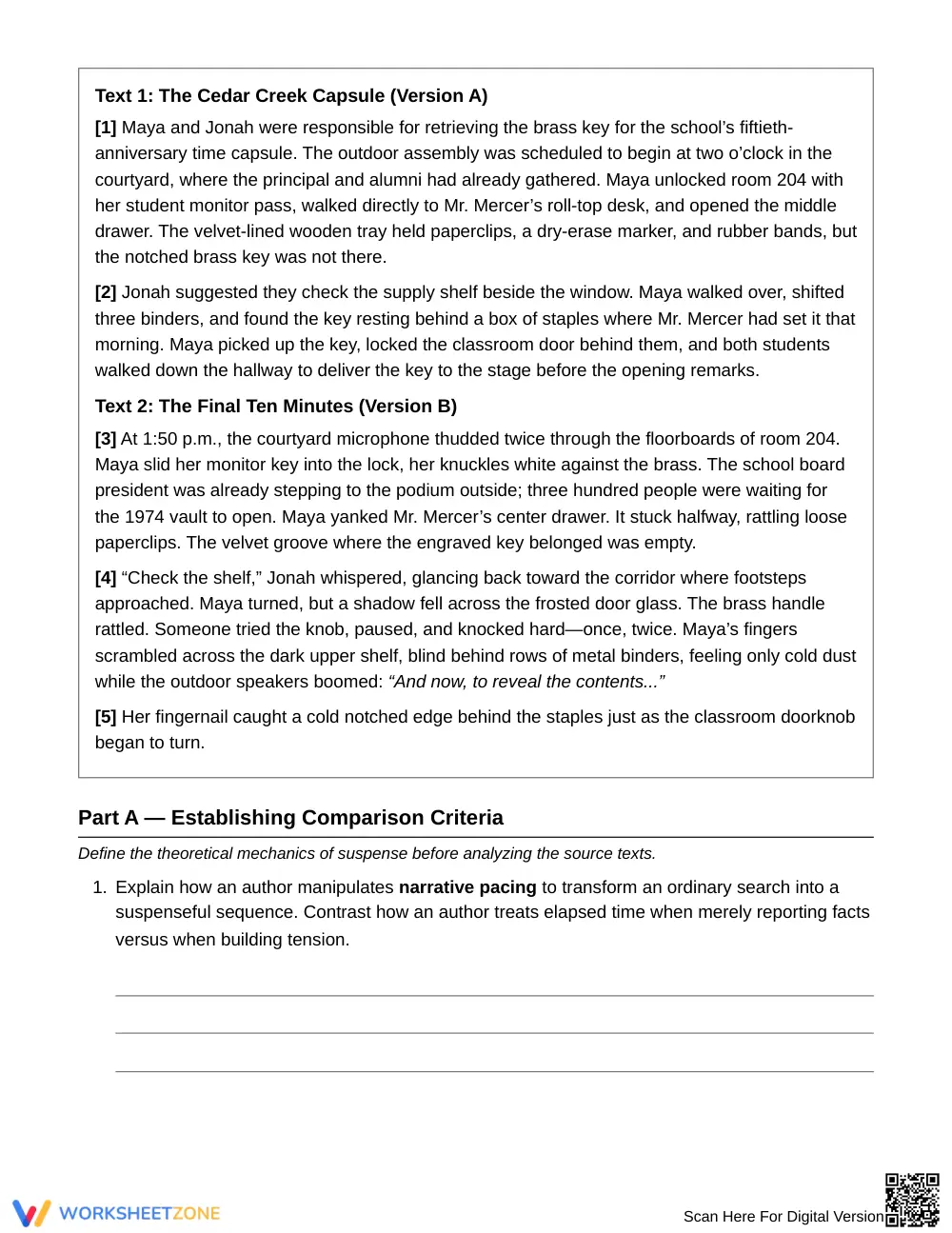
This five-page packet centers on two parallel texts depicting the same classroom search: a neutral account and a suspenseful version. It includes explicit craft reference boxes for pacing and information control, two foundational criteria prompts, six paired-text comparative analyses requiring cited evidence, two evaluative extension questions, and a detailed three-page answer key.
Skill Progression
- Guided practice: Part A prompts students to define pacing mechanics and information withholding using reference boxes before reading.
- Supported practice: Part B presents six text-dependent tasks comparing sentence structures, ticking clocks, sensory friction, and acoustic delays across both passages.
- Independent practice: Part C requires students to evaluate acoustic patterns and apply dramatic irony to transform narrative tension.
This gradual release sequence moves learners from conceptual scaffolding to independent craft evaluation.
Standards Alignment
This worksheet aligns with `RL.8.6` by analyzing how differing perspectives and narrative delays generate suspense. It also supports `RL.7.5` by examining how an author's structural choices affect overall meaning. Both standard codes can be copied directly into lesson plans, IEP goals, or district curriculum mapping tools.
How to Use It
Use this resource during a craft unit or following a direct instruction mini-lesson on narrative pacing. For formative assessment, monitor Part B responses to confirm students analyze sentence syntax rather than simply summarizing plot actions. Students typically complete the 10 tasks in 45 to 60 minutes.
Who It's For
This activity supports Grade 7 ELA classes, advanced Grade 6 learners, and secondary intervention groups studying author's craft. Provide sentence starters for striving students to support evidence citation. Pair this lesson with a suspenseful mentor text such as Edgar Allan Poe's classic short fiction.
Comparative text analysis provides an effective instructional framework for mastering standard RL.8.6, enabling middle school students to analyze how differing points of view and structural techniques produce dramatic suspense. By evaluating parallel accounts of the same event, learners isolate distinct authorial variables such as narrative pacing, syntactic compression, and deliberate information withholding. According to Fisher & Frey (2014), purposeful paired-text tasks that scaffold close reading through guided criteria empower students to uncover how craft decisions shape reader emotion. This worksheet operationalizes that approach across ten structured analytical items, requiring learners to substantiate claims with concrete paragraph citations. Through systematic juxtaposition of neutral reporting and tension-filled prose, students cultivate transferrable evaluative habits essential for secondary literary analysis. The resource bridges foundational comprehension with rigorous craft evaluation, ensuring students develop deep analytical precision when assessing how authors manipulate narrative pacing and reader perspective across complex texts.


