




























Views
Downloads




Complete Surface Area vs Volume Worksheet | Grade 6 Math

Paste this activity's link or code into your existing LMS (Google Classroom, Canvas, Teams, Schoology, Moodle, etc.).
Students can open and work on the activity right away, with no student login required.
You'll still be able to track student progress and results from your teacher account.
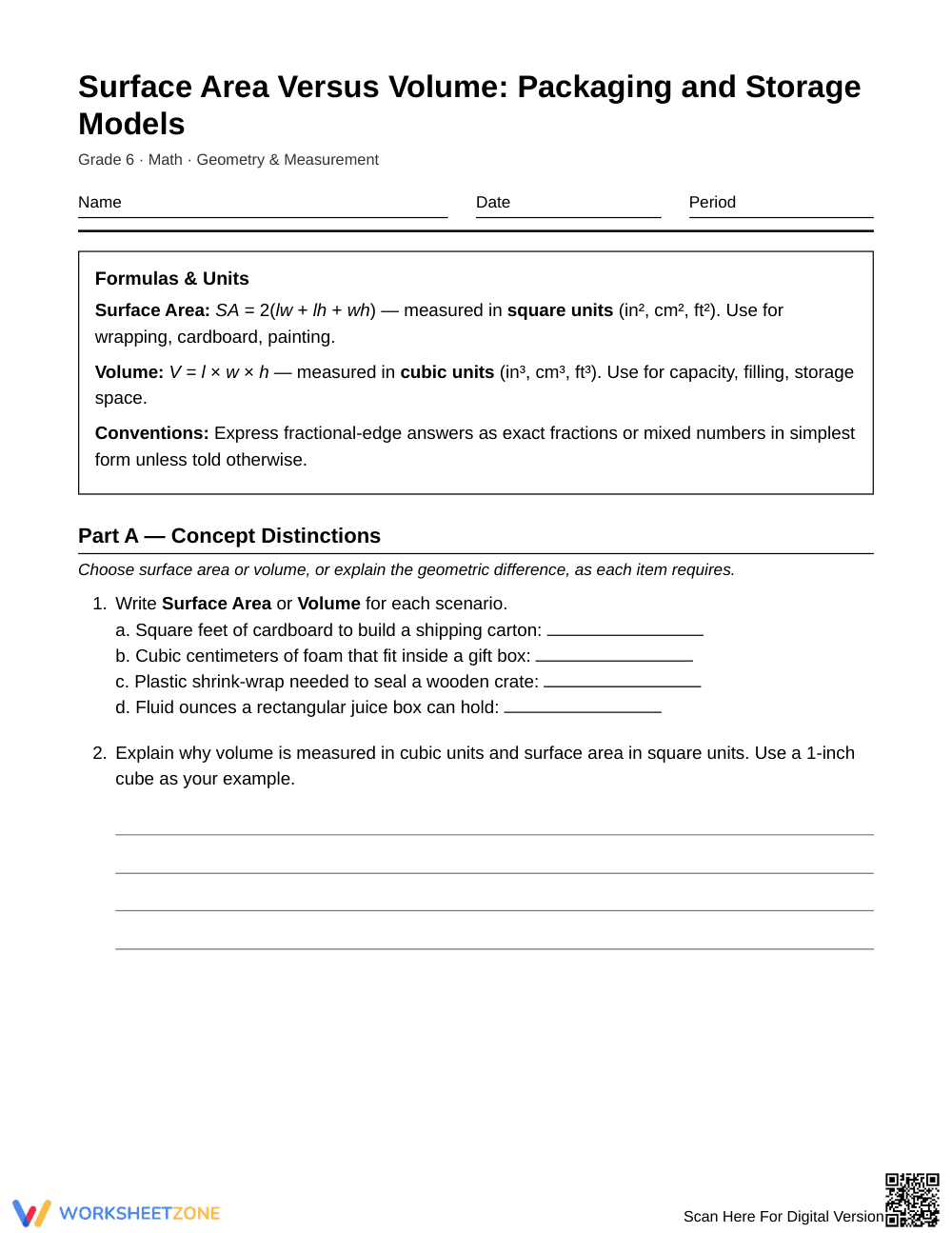
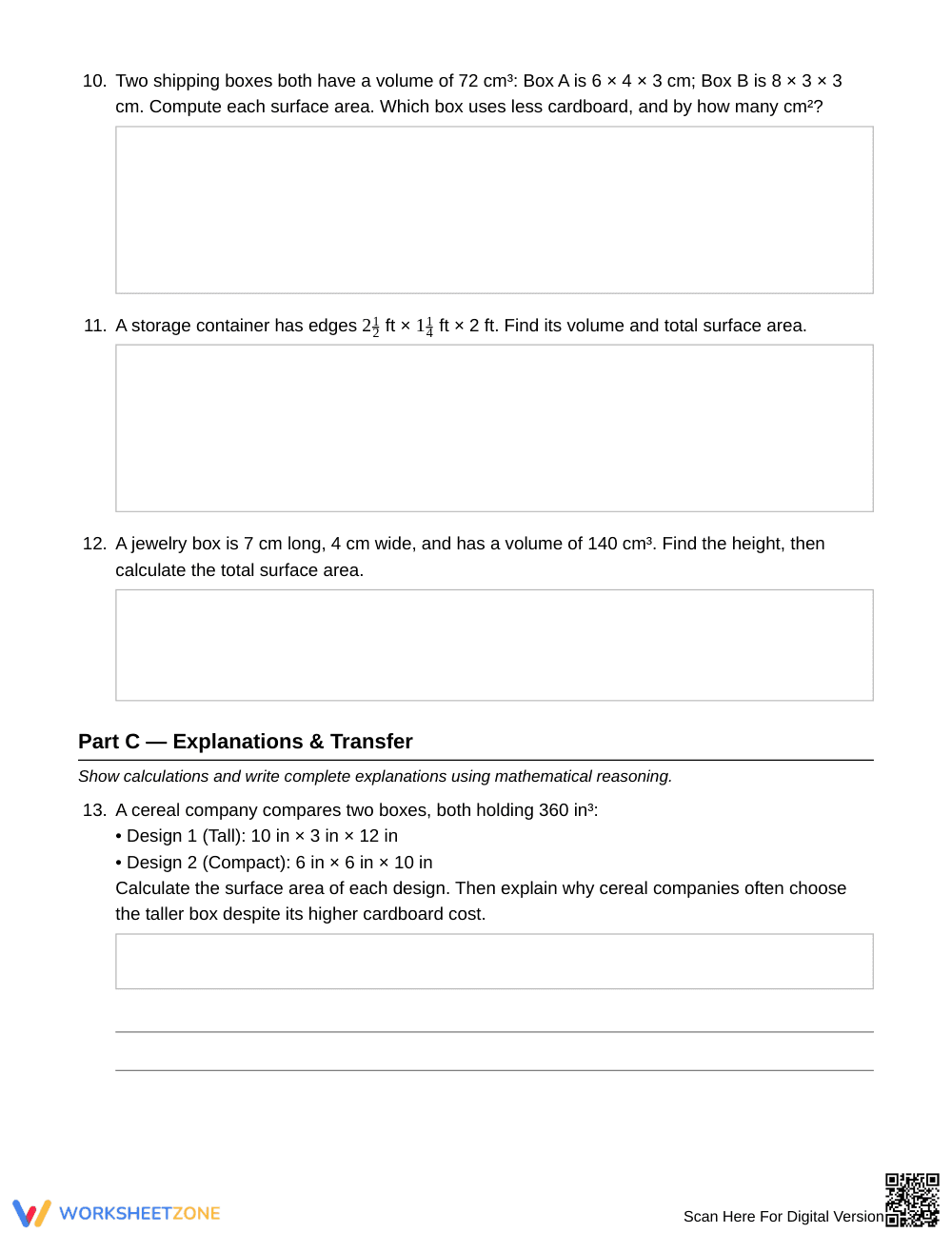
This comprehensive 5-page geometry worksheet helps Grade 6 students master the conceptual and computational differences between surface area and volume. Learners evaluate 16 rigorous problems spanning 2D nets, fractional edge dimensions, cardboard packaging costs, and physical rate comparisons to solidify spatial measurement reasoning.
At a Glance
- Grade: 6 · Subject: Math
- Standard: Solve real-world geometry problems involving surface area and volume of rectangular prisms
- Skill Focus: Surface Area Versus Volume
- Format: 5 pages · 16 problems · Answer key included · PDF
- Best For: Mid-unit practice, review, or assessment
- Time: 45–60 minutes
What's Inside
The resource provides 16 multi-step problems supported by a dedicated formula reference box, prism net diagram, and detailed 3-page answer key showing full computational steps. Students progress from conceptual sorting to fractional calculations, open-top containers, and real-world industrial packaging scenarios.
Skill Progression
- Guided Practice (Part A, Problems 1–4): Distinguish square versus cubic units, analyze prism nets, and construct counterexamples for equal-volume cartons.
- Supported Practice (Part B, Problems 5–12): Apply formulas across 8 computation tasks featuring fractional edge lengths, unit-cube packing, and missing dimension calculations.
- Independent Transfer (Part C, Problems 13–16): Complete 4 open-ended challenges evaluating commercial cereal box geometry, dimensional scaling factors, ice melt rates, and depot shipping costs.
This intentional structure mirrors the gradual release of responsibility model, shifting students from foundational concept recognition to autonomous analytical reasoning.
Standards Alignment
This activity targets Grade 6 geometry standards requiring students to find the volume of right rectangular prisms with fractional edge lengths by packing unit cubes, alongside computing surface area using two-dimensional nets and face formulas. These curriculum standards can be copied directly into lesson plans, IEP goals, or district curriculum mapping tools.
How to Use It
Deploy this worksheet after direct instruction on 3D measurement formulas to reinforce application skills. During independent work, conduct a formative check on Problem 9 to ensure students omit the top face when computing open-top container surface area. The activity requires approximately 45 to 60 minutes for full completion.
Who It's For
Designed for general education Grade 6 math classrooms, advanced Grade 5 learners, or Grade 7 remedial interventions. Pair this activity with physical unit cubes, folding 3D geometric nets, or an anchor chart highlighting square versus cubic unit distinctions.
Grade 6 geometry curricula demand that students clearly distinguish two-dimensional boundary coverage from three-dimensional interior capacity across varied contexts. According to research synthesized by Fisher & Frey (2014), structured instructional progressions that bridge visual representations with mathematical modeling substantially improve long-term conceptual retention in middle school mathematics. This 16-task resource operationalizes that research framework by guiding learners through net decomposition, unit fraction multiplication, and industrial packaging cost calculations. By contrasting identical-volume rectangular prisms that require unequal surface areas, students confront common geometric misconceptions directly. The 5-page worksheet includes a comprehensive 3-page step-by-step solution guide, making it an effective instructional asset for building spatial problem-solving fluency, supporting multi-tiered academic intervention systems, and demonstrating rigorous standards mastery across general education settings. Educators can readily deploy these targeted exercises for diagnostic benchmarks or targeted small-group remediations.


