































Complete Sublimation Word Search | Grades 4–5 Science

Paste this activity's link or code into your existing LMS (Google Classroom, Canvas, Teams, Schoology, Moodle, etc.).
Students can open and work on the activity right away, with no student login required.
You'll still be able to track student progress and results from your teacher account.
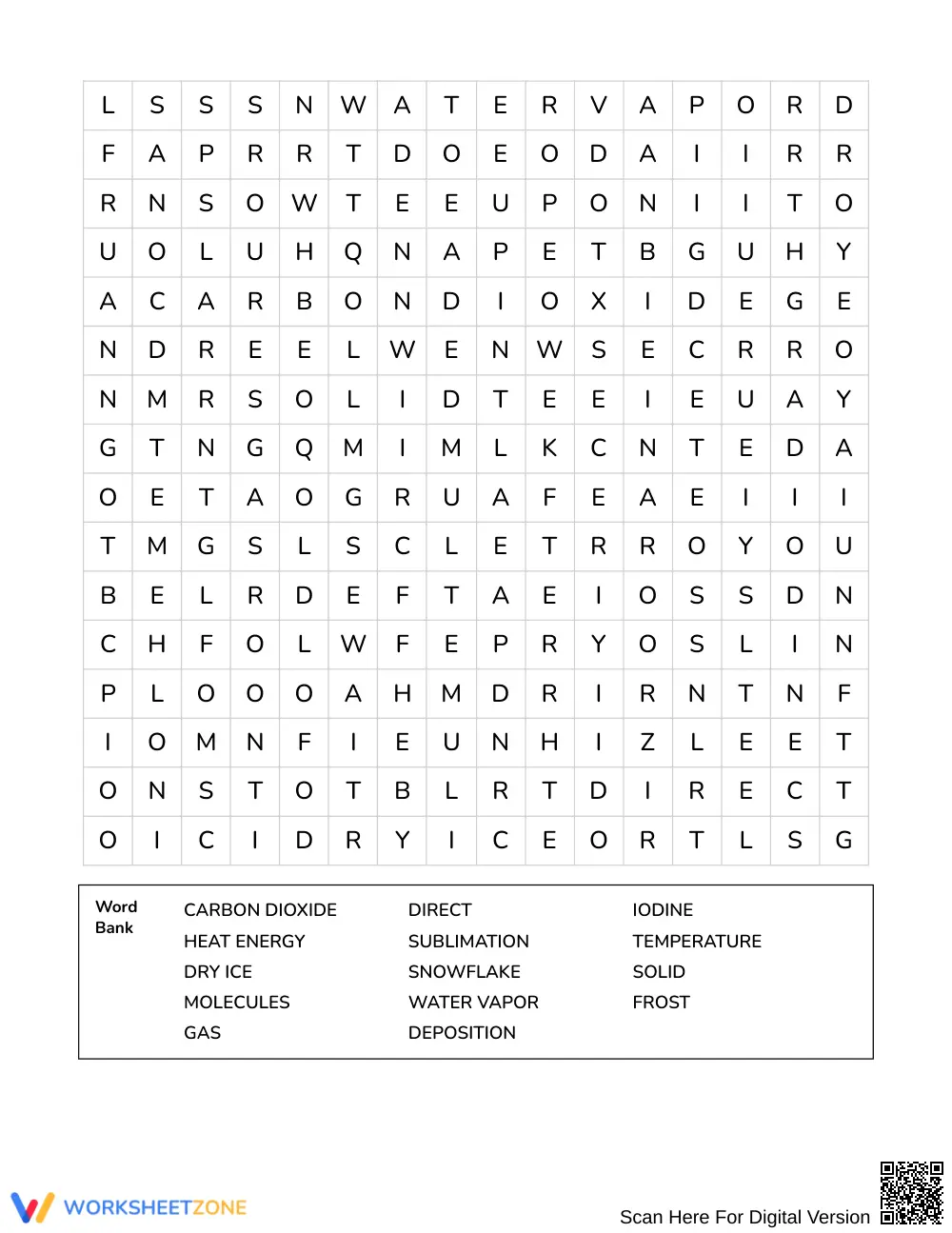
This States of Matter word search builds student mastery of sublimation and deposition by pairing rigorous definitions with active vocabulary identification. Students analyze descriptive clues for phase transitions, isolate key scientific terminology, and locate 14 vocabulary terms hidden within a puzzle grid to solidify core concepts in physical science.
At a Glance
- Grade: Grades 4–5 · Subject: Science
- Standard: Not standards-assessed — supplemental physical science vocabulary enrichment
- Skill Focus: Sublimation, deposition, and thermal phase changes
- Format: 3 pages · 14 words · Full answer key included · PDF printable
- Best For: Independent vocabulary review, science stations, and early finishers
- Time: 20–30 minutes of focused learning
What's Inside
This 3-page science resource features a clue-driven vocabulary puzzle designed to deepen comprehension of phase changes without routine memorization. The student activity page presents 14 substantive science clues outlining critical concepts such as dry ice sublimation, frost deposition, molecular kinetic behavior, and direct phase transitions. A complete 3-page teacher answer key provides full solutions showing exact word placements across the puzzle matrix.
Puzzle Structure and Mechanics
The activity utilizes a 16 by 16 letter grid where words are placed across four directional orientations: northeast, east, southeast, and south. Rather than relying on a simple word search list, students read context-rich scientific clues, deduce the corresponding term, and search the shuffled word bank to track their discoveries. This multi-step process ensures students actively process definitions of dry ice, iodine, and atmospheric water vapor before locating the letters.
Standards Alignment
This resource serves as targeted vocabulary enrichment and is not aligned to a specific state or national standard. It provides supplemental domain-specific language practice to support general fourth- and fifth-grade units covering matter, thermal energy, and phase transitions.
How to Use It
Integrate this word search during or immediately after direct instruction on changes of state. During a mid-unit review station, have students solve the clues in collaborative pairs to prompt peer discussion about thermal energy and gas-to-solid transitions. Alternatively, assign the puzzle as an independent formative check following a dry ice laboratory demonstration. Teachers should circulate to observe whether students recognize the term "direct" as skipping the intermediate liquid phase, targeting common misconceptions on the spot. Expect completion within 20 to 30 minutes.
Who It's For
This word search is tailored for Grades 4–5 science students encountering advanced physical science concepts. For emerging readers or multilingual learners, teachers can highlight key clue phrases such as "without melting into a liquid." Pair this activity directly with a visual states-of-matter phase diagram or hands-on dry ice observation lesson to reinforce conceptual retention.
According to Fisher & Frey (2014), intentional disciplinary vocabulary instruction requires students to engage with academic terms through meaningful definitional context rather than isolated memorization. This Grades 4–5 science word search operationalizes that principle across 14 specialized terms centered on sublimation and deposition. While not standards-assessed, this supplemental vocabulary enrichment activity prompts learners to analyze descriptive prompts regarding thermal energy, molecular motion, and direct state transitions before locating target words within a 16 by 16 grid. By connecting concrete phenomena like frost formation, snowflake creation, and dry ice sublimation to rigorous definitions, the 3-page resource bridges conversational language and formal scientific discourse. The embedded clue-solving task transforms standard word searches into an active retrieval practice exercise that reinforces essential physical science concepts during 20 to 30 minutes of structured instructional time.


