




























Complete Subduction Word Search | Grade 6 Science
Paste this activity's link or code into your existing LMS (Google Classroom, Canvas, Teams, Schoology, Moodle, etc.).
Students can open and work on the activity right away, with no student login required.
You'll still be able to track student progress and results from your teacher account.
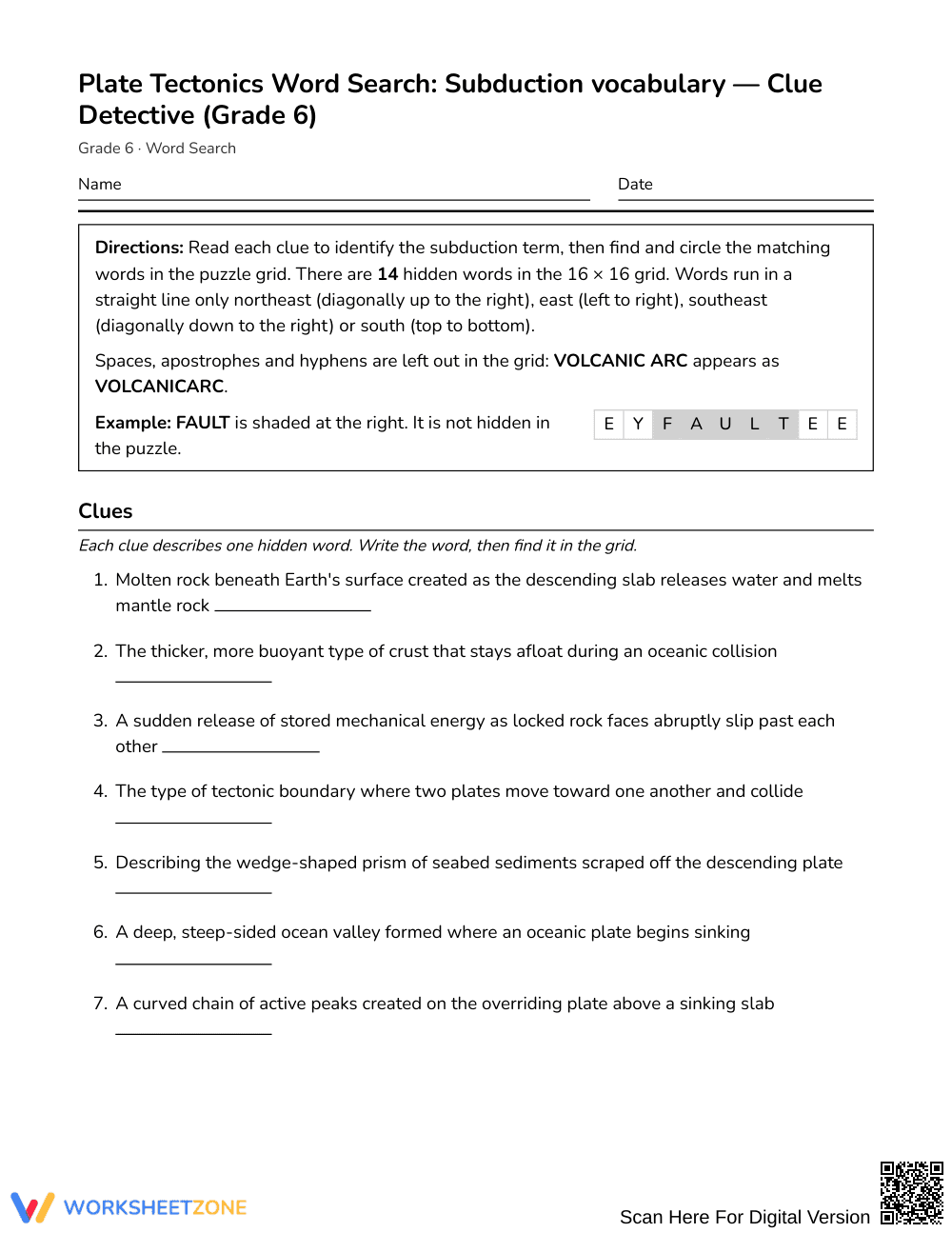
This Grade 6 plate tectonics word search reinforces essential Earth science vocabulary through clue-based retrieval practice. Students read geological definitions to identify 14 key subduction terms, connecting concepts like lithospheric plates and oceanic trenches to their correct scientific names. It provides focused vocabulary review that strengthens geological comprehension and scientific literacy.
At a Glance
- Grade: Grade 6 · Subject: Science
- Standard: Not standards-assessed — vocabulary enrichment
- Skill Focus: Subduction vocabulary
- Format: 3 pages · 14 words · Answer key included · PDF
- Best For: Science vocabulary review and early finishers
- Time: 15–25 minutes
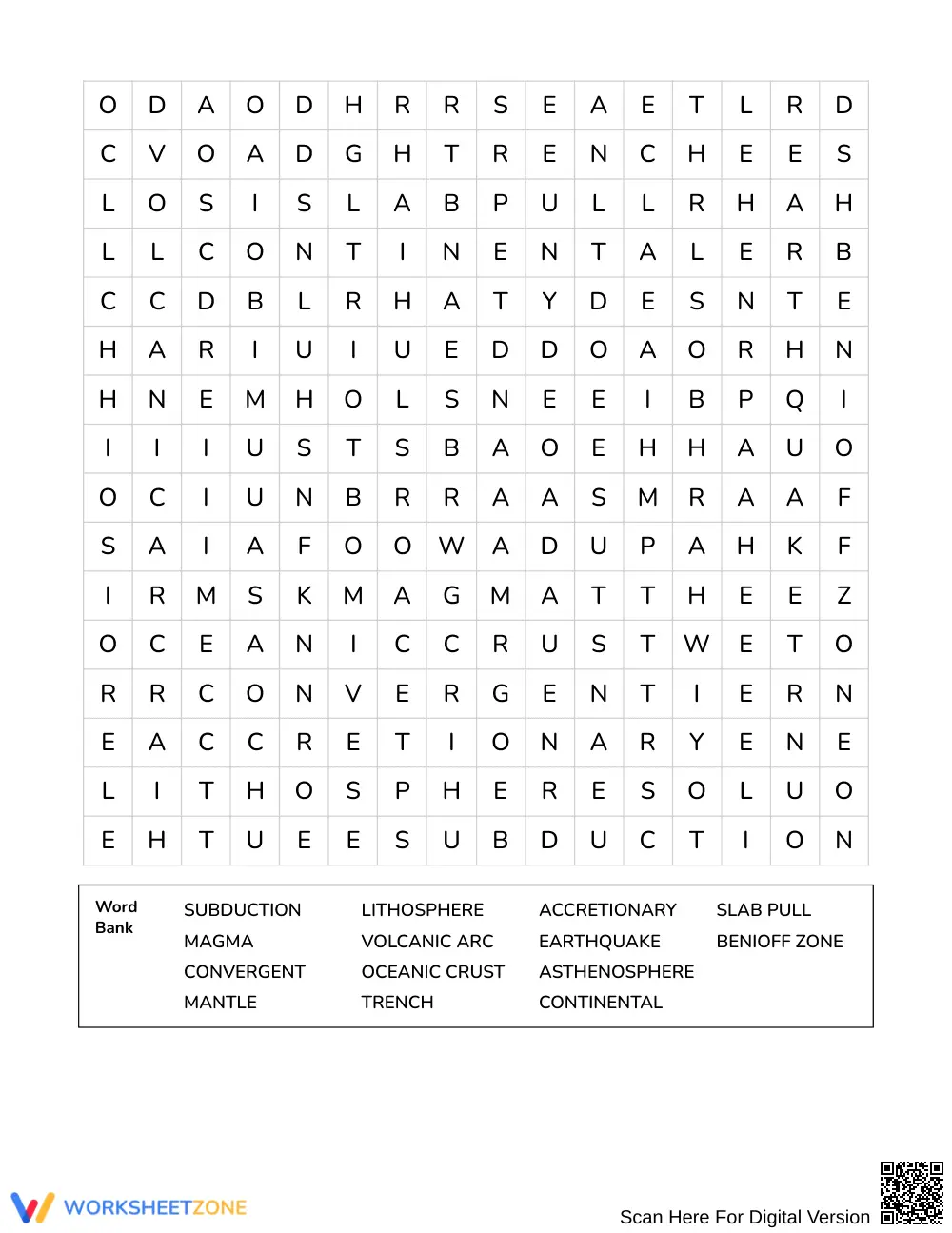
This resource spans 3 pages, including a printable student puzzle page and complete answer keys. Each task challenges students to analyze science clues rather than simply scanning a list. Structural features include a shuffled word bank containing 14 targeted Earth science vocabulary terms paired with precise conceptual descriptions, allowing students to verify terms before locating them.
Puzzle Mechanics and Structure
The activity is built on a 16 x 16 letter grid containing 14 hidden vocabulary words. Words run in four specific orientations: northeast, east, southeast, and south. Students first read the provided definitions—such as the role of the asthenosphere, the formation of volcanic arcs, and mantle convection dynamics—then deduce the matching term from the shuffled word bank. Once identified, learners search the 16 x 16 letter field along the designated directional paths to locate and circle each term.
Standards Alignment
This activity serves as vocabulary enrichment and is not aligned to a formal standard. It supplements middle school Earth science curricula by reinforcing domain-specific terminology across plate tectonics, seismic boundaries, and convergent margin processes.
How to Use It
This word search fits naturally after direct instruction on convergent boundaries or as an introductory vocabulary preview. Teachers can assign it as an independent warm-up, a partner review station, or a self-checking sub plan. For formative assessment, circulate during the first 5 minutes to observe whether students use the clue definitions to retrieve terms independently or rely entirely on letter scanning. Expected completion time is 15 to 25 minutes.
Who It's For
Designed for Grade 6 science classrooms, this activity supports general education students, visual learners, and English language learners needing contextual vocabulary reinforcement. Pair this puzzle with an illustrated plate tectonics diagram or a subduction zone cross-section anchor chart to help students visually connect terminology to real-world geological structures.
Explicit vocabulary acquisition in middle school science establishes the foundation for deep conceptual comprehension in Earth systems. According to Fisher & Frey (2014), intentional exposure to domain-specific terminology through varied contextual interactions—such as definition matching and retrieval exercises—significantly improves student retention and expressive language in STEM subjects. Rather than engaging in rote letter tracing, students using this subduction vocabulary activity must decode descriptive scientific definitions to identify terms like oceanic crust, asthenosphere, and slab pull before locating them within the 16 x 16 grid. This two-step retrieval process reinforces cognitive connections between geological phenomena and scientific nomenclature. By combining definition analysis with visual word recognition, learners consolidate crucial plate boundary concepts, equipping Grade 6 students with the academic vocabulary required to articulate complex tectonic interactions and understand dynamic Earth processes effectively during subsequent inquiry-based science units.


