




























Views
Downloads




Complete Structure & Emphasis Worksheet | Grade 8 ELA

Paste this activity's link or code into your existing LMS (Google Classroom, Canvas, Teams, Schoology, Moodle, etc.).
Students can open and work on the activity right away, with no student login required.
You'll still be able to track student progress and results from your teacher account.
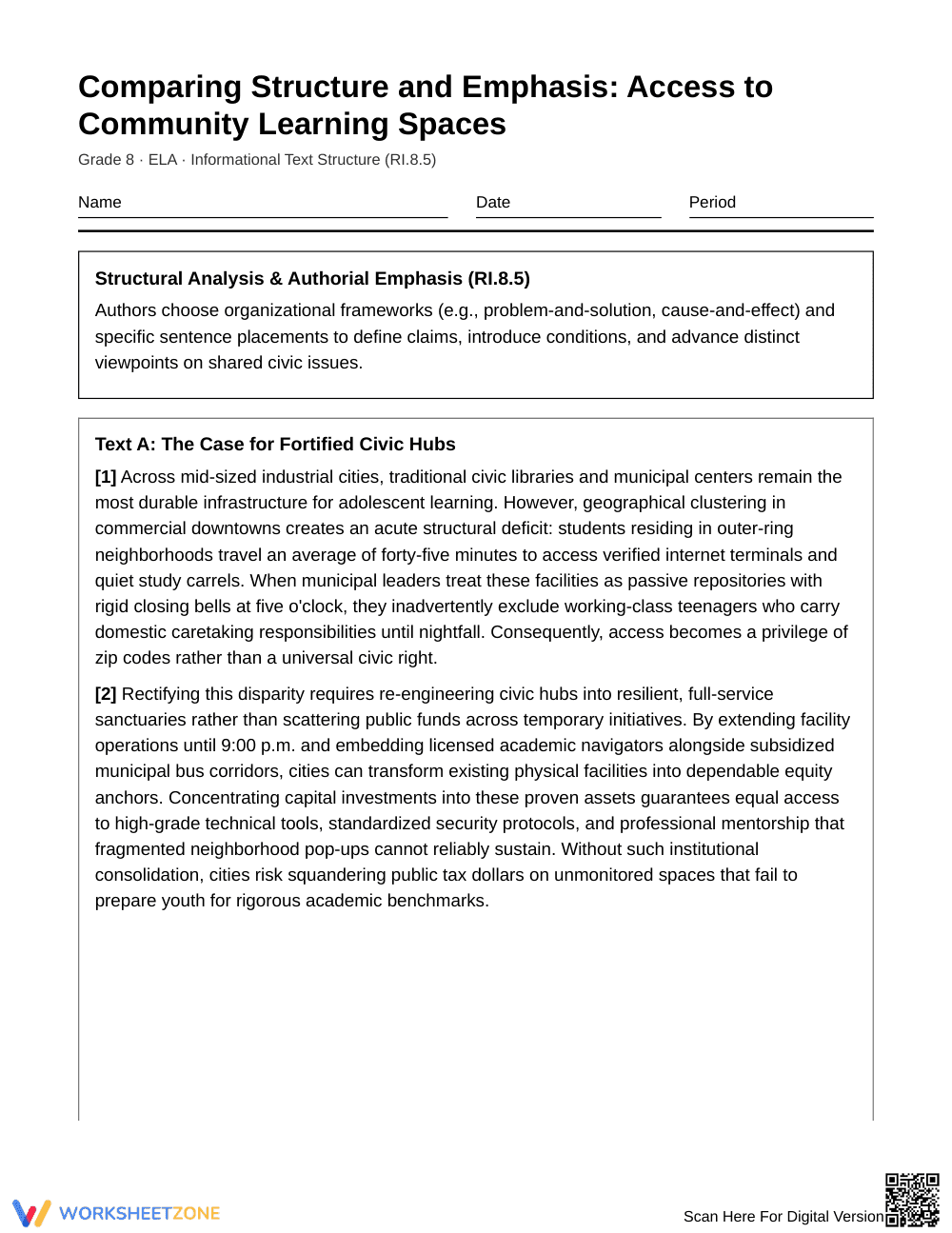
This Grade 8 informational text worksheet trains students to analyze how authors use specific paragraph frameworks and sentence placements to advance contrasting viewpoints on community learning spaces. Students evaluate paired texts, dissect structural choices, and explain how structural emphasis shapes claims and policy arguments to achieve analytical mastery.
At a Glance
- Grade: 8 · Subject: ELA
- Standard:
RI.8.5— Analyze in detail how text structure develops and refines key concepts- Skill Focus: Compare Structure and Emphasis
- Format: 5 pages · 10 problems · Answer key included · PDF
- Best For: Paired-text structural analysis practice
- Time: 40–50 minutes
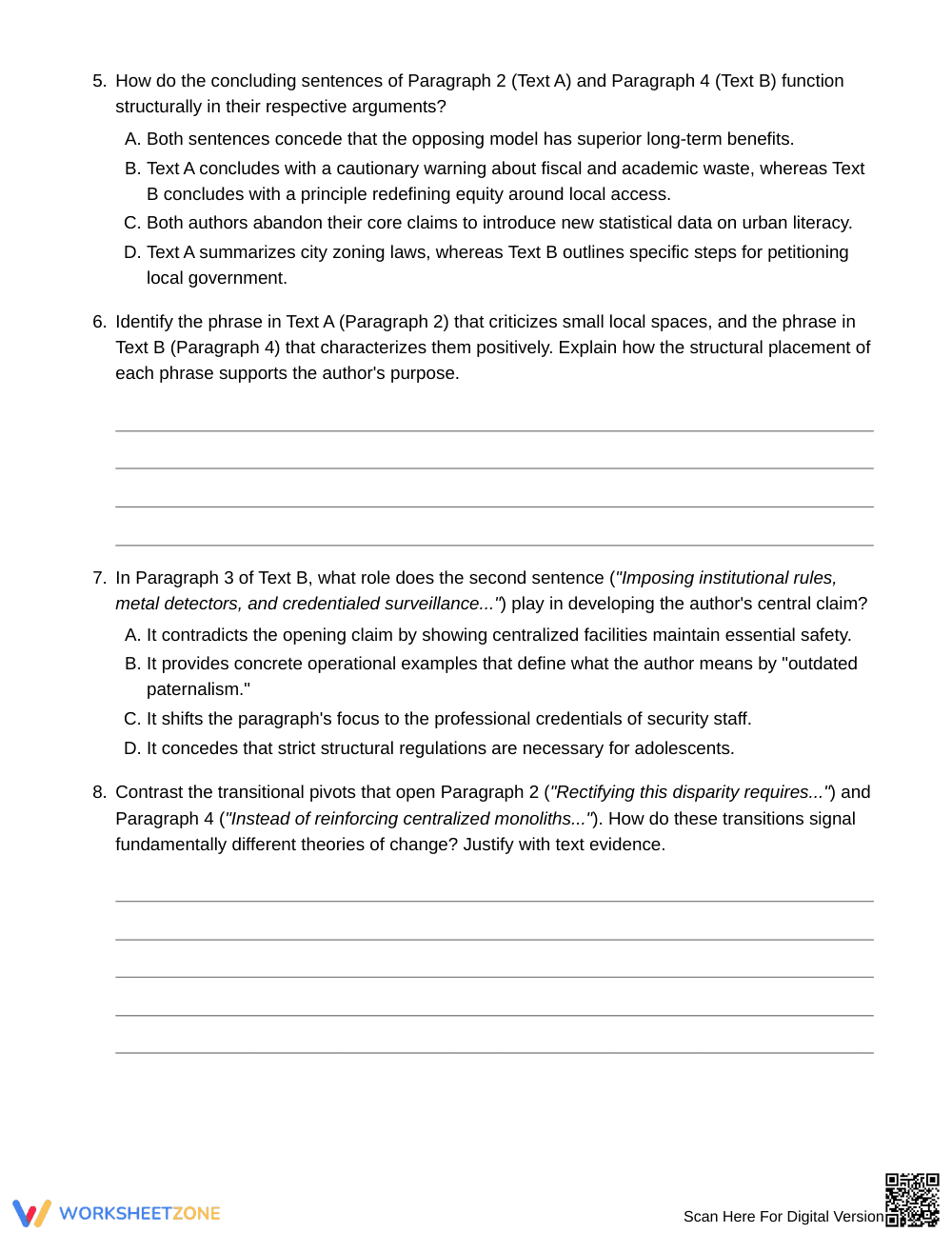
What's Inside: The 5-page worksheet provides two complete paired informational passages examining civic learning spaces through divergent viewpoints. It contains 10 rigorous tasks spanning multiple-choice structural identification, short-response comparative analyses, and extended evaluative critiques. A comprehensive 3-page answer key provides complete model responses and textual evidence justifications for every question.
Skill Progression
- Guided Practice (Part A): 2 foundational tasks prompt students to identify broad organizational frameworks (problem-and-solution versus cause-and-effect) and authorial evaluation criteria using targeted selection stems.
- Supported Practice (Part B): 6 analytical prompts challenge students to evaluate specific sentence functions, transition pivots, and contrasting details across both passages.
- Independent Practice (Part C): 2 open-response evaluative prompts require students to explain how structural design drives divergent budgetary recommendations and judge competing arguments.
This deliberate sequence reflects the gradual release of responsibility model, guiding eighth graders from structural identification to complex textual critique.
Standards Alignment
This resource aligns directly to RI.8.5: Analyze in detail how the structure of a specific paragraph in a text, including the role of particular sentences in developing and refining a key concept, contributes to the overall development of ideas. It also reinforces RI.8.6 as students contrast distinct authorial perspectives. Both standard codes can be copied directly into lesson plans, IEP goals, or district curriculum mapping tools.
How to Use It
Deploy this worksheet after direct instruction on non-fiction organizational structures. Use it during independent practice or partner analysis stations where students annotate paired arguments side-by-side. For formative assessment, examine students' Part B responses to verify whether they can distinguish between an author's organizational method and their underlying claim. The resource requires 40 to 50 minutes for full completion.
Who It's For
This resource is designed for eighth-grade English Language Arts students mastering comparative non-fiction analysis. Support struggling readers by highlighting transitional phrases in both passages, while challenging advanced learners to evaluate unstated assumptions. Pair this activity with an anchor chart outlining structural patterns or an introductory mini-lesson on rhetorical emphasis.
Mastering informational text analysis under standard RI.8.5 requires eighth-grade students to evaluate how specific paragraph structures and sentence placements develop an author's central claims. According to foundational research synthesized by Fisher & Frey (2014) on close reading and text-dependent questioning, engaging middle school students in direct comparative structural analysis across paired non-fiction texts significantly accelerates analytical reasoning and evidence-based writing competencies. This 10-task informational text resource systematically requires learners to identify organizational frameworks, critique transitional pivots, and compare how divergent structural emphases lead authors to opposing civic and policy recommendations. By analyzing competing arguments about municipal learning spaces, students gain extensive practice isolating structural mechanics from surface-level thematic content. This structured analytical exposure ensures eighth graders develop the rigorous critical thinking and textual evaluation skills demanded by secondary literacy benchmarks and standardized state assessments.


