




























Views
Downloads




Complete Strong & Weak Support Worksheet | Grade 7 ELA

Paste this activity's link or code into your existing LMS (Google Classroom, Canvas, Teams, Schoology, Moodle, etc.).
Students can open and work on the activity right away, with no student login required.
You'll still be able to track student progress and results from your teacher account.
This Grade 7 reading informational text worksheet equips students to evaluate argument validity by comparing strong and weak support across competing texts. Learners analyze sound reasoning versus logical fallacies, critique youth center proposals, and revise flawed assertions into evidence-backed claims to master evaluative reading skills.
At a Glance
- Grade: 7 · Subject: ELA
- Standard:
RI.7.8— Trace and evaluate arguments, distinguishing sound claims from unsupported assertions- Skill Focus: Compare Strong and Weak Support
- Format: 5 pages · 10 problems · Answer key included · PDF
- Best For: Paired-text argument analysis
- Time: 40–50 minutes
What's Inside
This 5-page resource includes a Core Concepts reference box defining claims, sound reasoning, and empirical evidence, followed by two contrasting paired proposals. Students complete 10 analytical tasks across three scaffolded sections, supported by a 3-page answer key with sample responses and model claim revisions.
Skill Progression
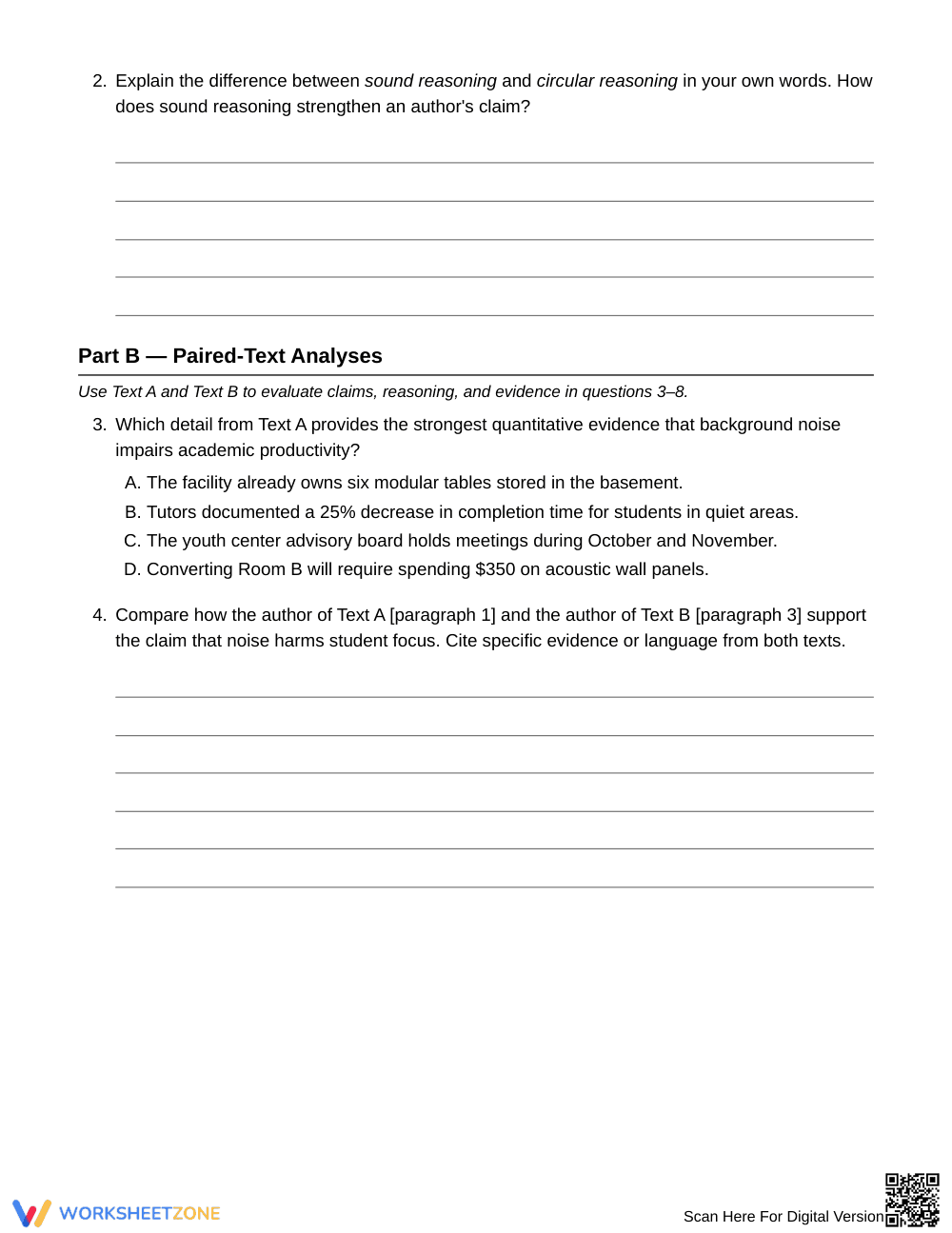
- Guided practice (Tasks 1–2): Students establish evaluation criteria by identifying characteristics of sufficient evidence and contrasting sound logic with circular reasoning.
- Supported practice (Tasks 3–8): Working through paired texts, learners analyze data metrics, evaluate feasibility, detect logical fallacies, and assess proposal credibility.
- Independent practice (Tasks 9–10): Students synthesize findings by justifying board funding decisions and rewriting a weak claim using verifiable evidence.
This sequence follows the gradual release of responsibility model, guiding students from foundational concepts to independent evaluative writing.
Standards Alignment
This resource directly addresses RI.7.8: Trace and evaluate the argument and specific claims in a text, assessing whether the reasoning is sound and the evidence is relevant and sufficient to support the claims. It additionally reinforces RI.7.1 through text-based citation. Both standard codes can be copied directly into lesson plans, IEP goals, or district curriculum mapping tools.
How to Use It
Deploy this worksheet after direct instruction on logical fallacies. In a paired-text workshop, have students complete Part A before examining Texts A and B in pairs. For formative assessment, check Task 6; struggling to identify circular logic indicates a need to review hasty generalizations before Part C revisions. Expected completion time is 40 to 50 minutes.
Who It's For
This resource suits Grade 7 ELA classes, reading intervention groups, and advanced Grade 6 readers. Differentiate by providing the Core Concepts box as a desk reference for emerging bilingual learners. Pair this printable with an argumentative essay unit or a direct instruction lesson on rhetorical analysis.
Explicit instruction in evaluating argument validity is essential for middle school literacy development. Under standard RI.7.8, students must evaluate arguments by distinguishing sound reasoning and empirical evidence from unsupported assertions and emotional appeals. According to Fisher & Frey (2014), structured comparative analysis of paired texts accelerates adolescent critical reading skills by requiring students to justify why specific evidence meets sufficiency standards rather than passively consuming claims. This 5-page worksheet provides 10 scaffolded tasks that guide Grade 7 learners through contrasting data-driven proposals with emotionally charged rhetoric. By analyzing concrete feasibility metrics and rewriting flawed assertions, students internalize the distinction between anecdotal opinions and verifiable data. This deliberate practice directly supports analytical writing and evaluative reading comprehension, equipping students with the foundational skills necessary to navigate complex academic and real-world arguments successfully across secondary curricula.


