































Complete Sound Properties Worksheet | Grade 6 Science

Paste this activity's link or code into your existing LMS (Google Classroom, Canvas, Teams, Schoology, Moodle, etc.).
Students can open and work on the activity right away, with no student login required.
You'll still be able to track student progress and results from your teacher account.
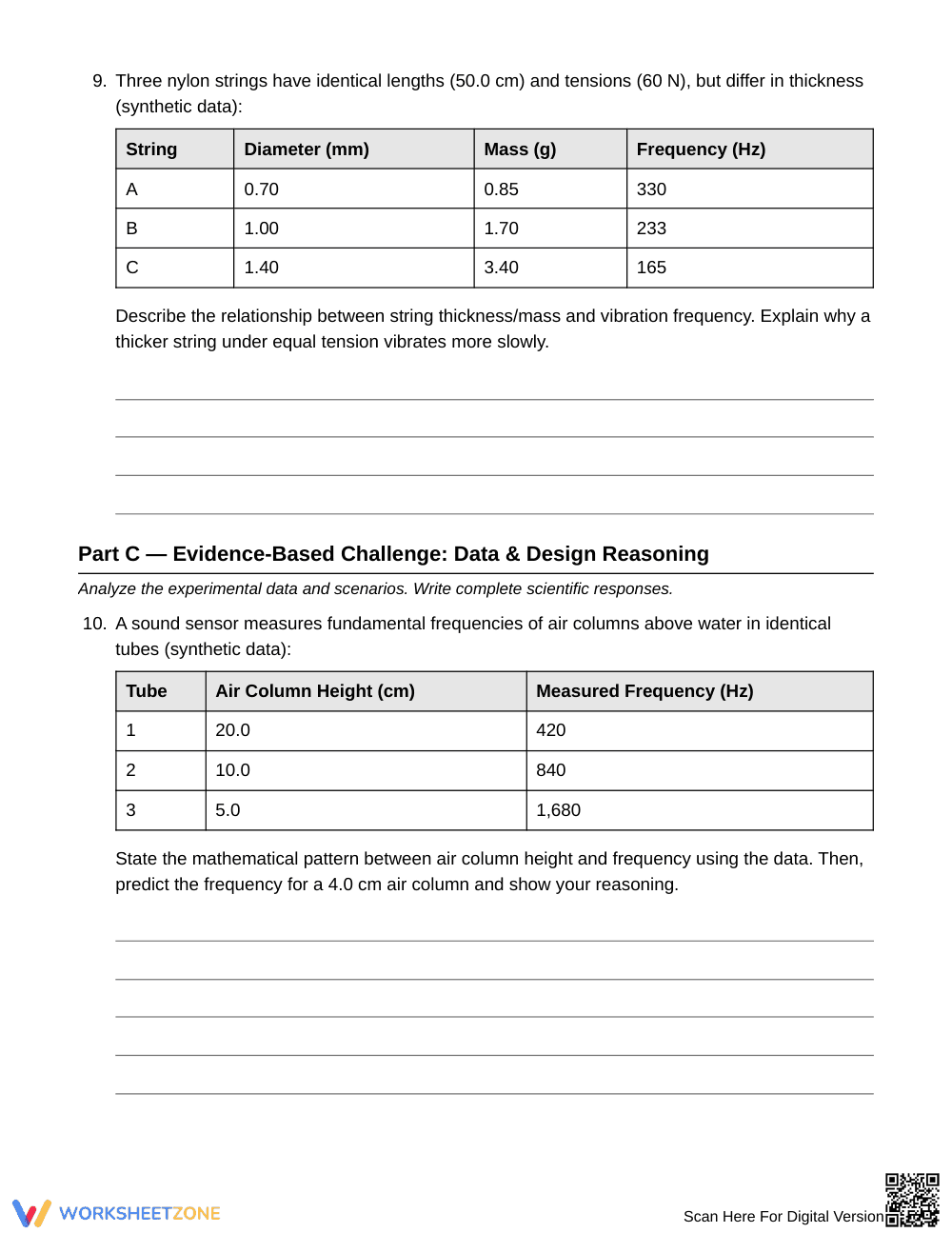
This physical science worksheet builds conceptual understanding and data analysis skills for sound wave mechanics. Students evaluate how vibration frequency governs pitch, how amplitude dictates loudness, and how medium properties control wave speed across strings and air columns. Through structured data tables and scenario modeling, learners connect physical vibrations directly to sound wave behaviors.
At a Glance
- Grade: 6 · Subject: Science
- Standard: Relate sound wave characteristics including pitch and loudness to physical vibrations and medium properties
- Skill Focus: Sound-Properties Check
- Format: 5 pages · 12 problems · Answer key included · PDF
- Best For: Independent physical science practice and review
- Time: 40–50 minutes
The 5-page resource includes a 3-page student worksheet containing 12 structured problems and a complete 2-page answer key with exemplar explanations. A concise Core Principles reference box anchors the activity, defining key terms such as frequency, amplitude, and wave speed. Students engage with multiple-choice conceptual checks, short-response comparative explanations, multi-variable cello string data analysis, and mathematical inverse-proportion modeling of vibrating air columns.
Skill Progression
- Guided practice (Part A — 3 problems): Students review foundational definitions and proportional patterns using explicit conceptual scenarios and core reference notes.
- Supported practice (Part B — 6 problems): Learners analyze multi-column synthetic data tables of string tension, length, and air columns to isolate variables influencing frequency versus volume.
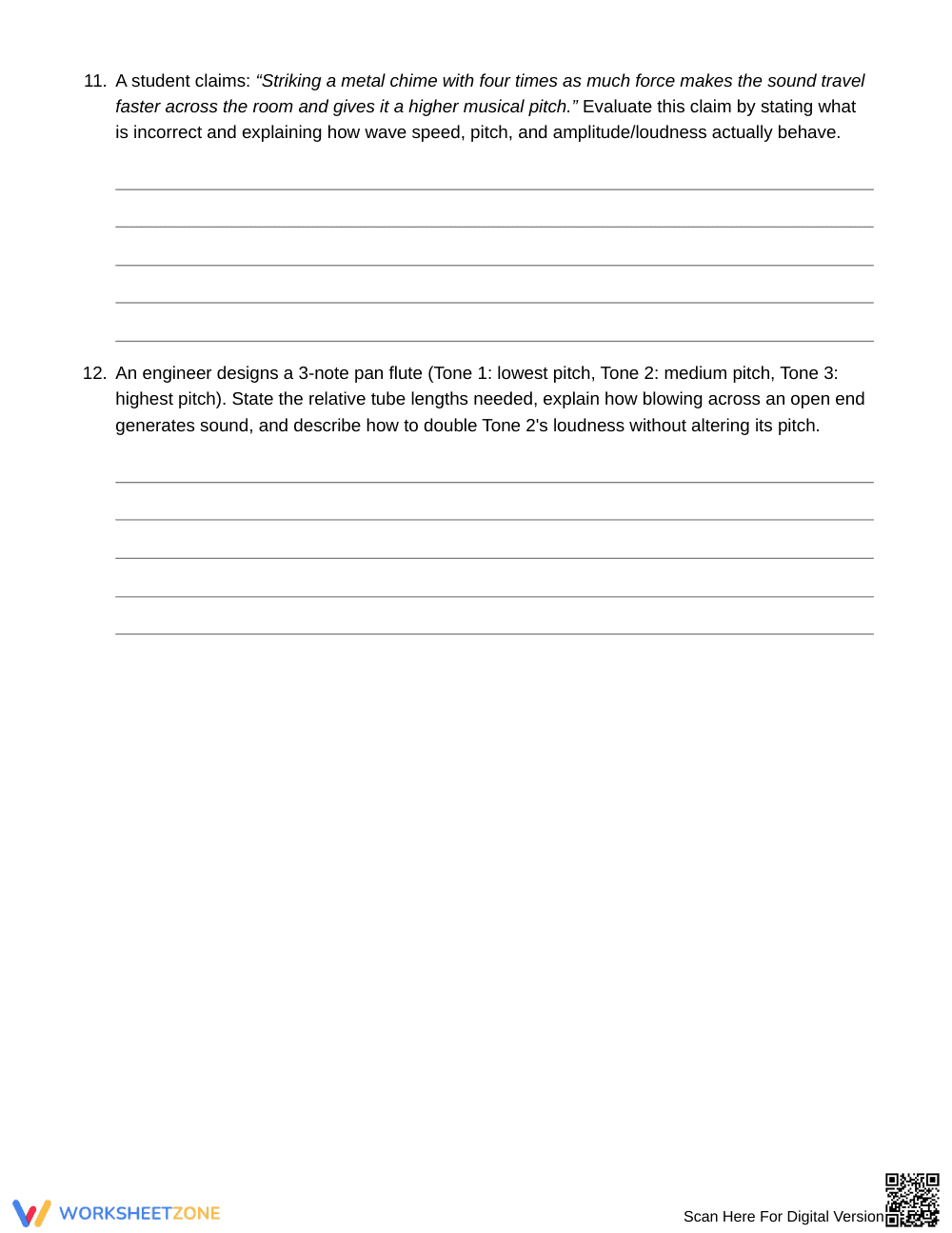
- Independent practice (Part C — 3 problems): Students complete evidence-based challenge tasks, predicting air column frequencies using inverse proportions, critiquing scientific misconceptions, and designing a functional multi-tone instrument.
This structured progression follows a gradual-release model, transitioning students from fundamental conceptual recognition to autonomous experimental evaluation and design reasoning.
Standards Alignment
This resource aligns with middle school physical science expectations for wave properties and energy transfer. Students develop and use models to describe how waves are reflected, absorbed, or transmitted through various materials, and demonstrate that a simple wave has a repeating pattern with a specific wavelength, frequency, and amplitude. Both standard codes can be copied directly into lesson plans, IEP goals, or district curriculum mapping tools.
How to Use It
Deploy this activity after direct instruction on wave mechanics as mid-unit formative practice or as a targeted review before a unit assessment. During the activity, circulate during Part B to observe whether students correctly differentiate between pluck displacement (amplitude/loudness) and vibrating length (frequency/pitch) in the data tables. The entire 12-problem sequence requires approximately 40 to 50 minutes of instructional time.
Who It's For
This worksheet is designed for Grade 6 science students mastering sound mechanics, wave properties, and variable manipulation. The built-in Core Principles reference box supports striving readers and English learners, while the multi-step quantitative tasks in Part C offer rigorous extension for advanced learners. Pair this worksheet with an interactive tuning fork demonstration or virtual wave simulator lab.
Mastering sound wave mechanics requires middle school students to systematically differentiate between wave speed, frequency, pitch, amplitude, and loudness. According to Fisher & Frey (2014), structured instructional frameworks that transition students from guided conceptual recognition to independent data analysis significantly enhance conceptual retention and scientific reasoning in physical science classrooms. This 12-task worksheet operationalizes that research by pairing foundational core principles with authentic data analysis and engineering design challenges. Students systematically evaluate how string length, air column height, and applied force alter sound waves across vibrating media. With scaffolded data tables, clear conceptual models, and a complete 2-page answer key, this resource provides an effective tool for assessing Grade 6 sound and wave properties. Educators can use these structured tasks to identify misconceptions surrounding wave speed and frequency while supporting rigorous, inquiry-based physical science learning.


