




























Views
Downloads


Complete Skeptical Audience Writing Worksheet | Grade 8 ELA

Paste this activity's link or code into your existing LMS (Google Classroom, Canvas, Teams, Schoology, Moodle, etc.).
Students can open and work on the activity right away, with no student login required.
You'll still be able to track student progress and results from your teacher account.
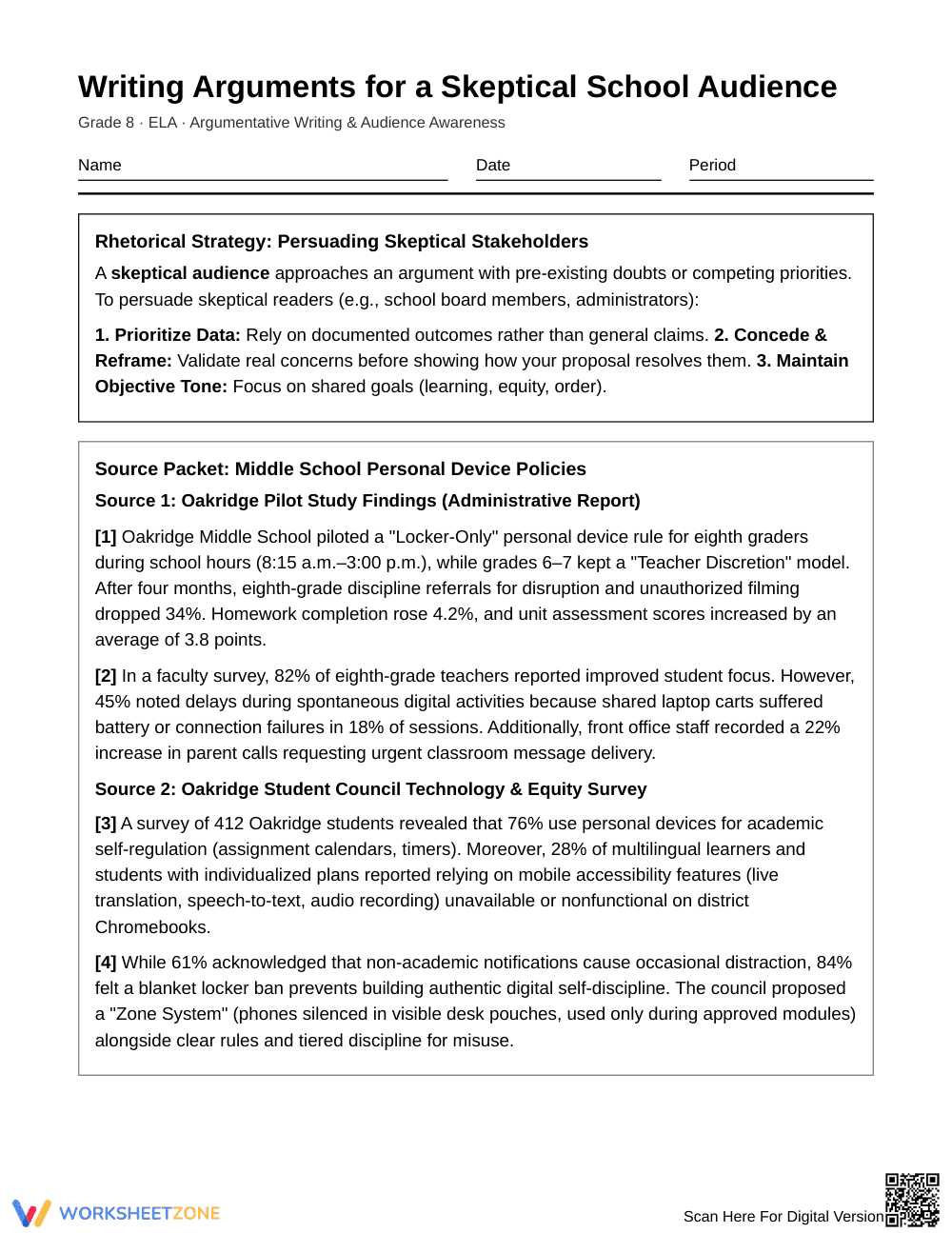
Equip middle school writers to address resistant stakeholders with persuasive precision. This four-page argumentative writing resource guides eighth graders through analyzing administrative survey data, framing strategic concessions, and drafting formal policy arguments tailored for school leaders. Students transform combative claims into evidence-backed, audience-centered proposals that address real institutional concerns.
At a Glance
- Grade: 8 · Subject: ELA
- Standard: Argumentative Writing — Write arguments to support claims with clear reasons and relevant evidence
- Skill Focus: Write for a Skeptical School Audience
- Format: 4 pages · 8 problems · Answer key included · PDF
- Best For: Middle school argumentative writing units
- Time: 45–60 minutes
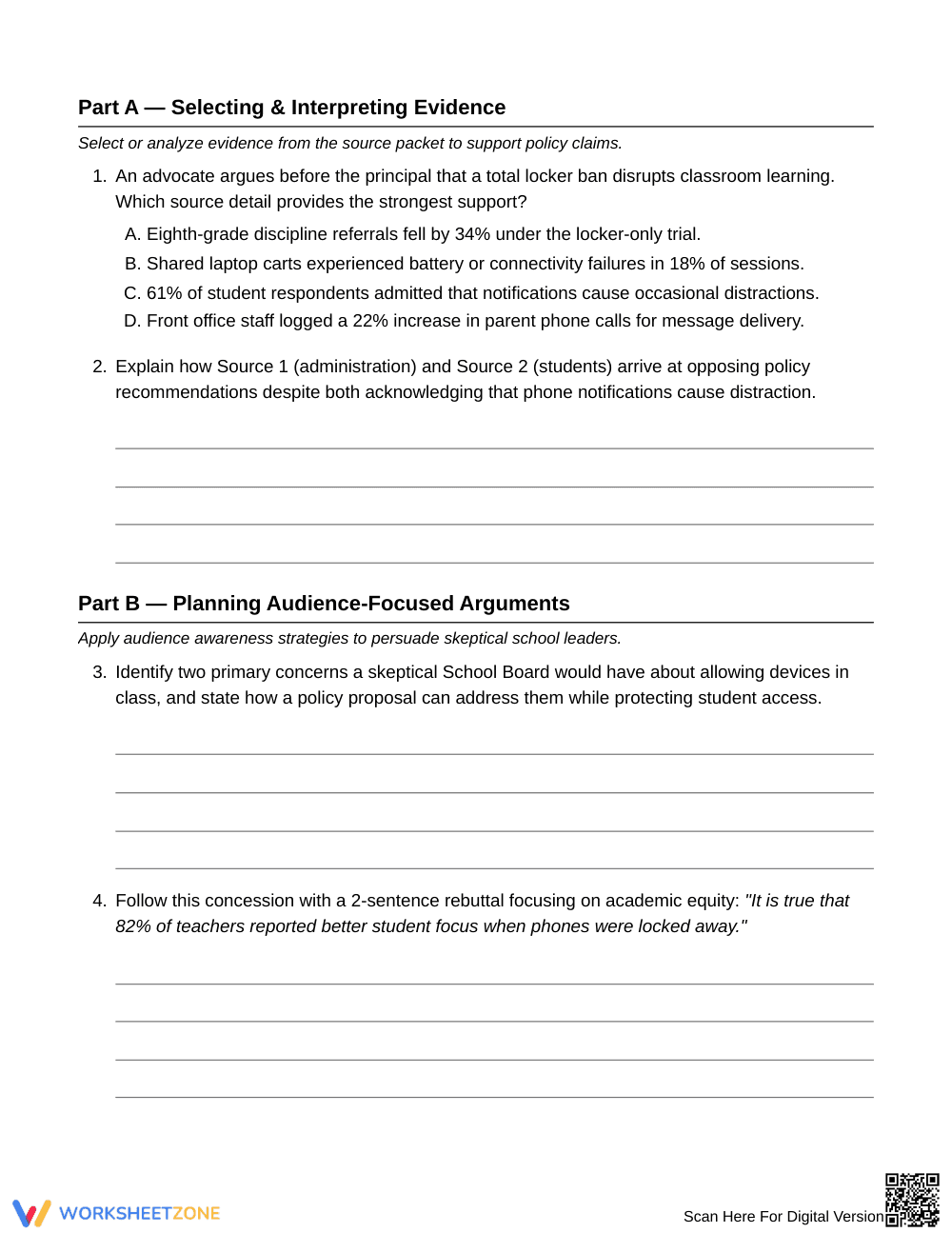
This resource features a dual-source informational packet outlining competing school device policies alongside 8 targeted tasks. Across 4 student pages, learners encounter multiple-choice evidence evaluation, analytical short-answer questions, structured paragraph outlines, a complete 250-to-350-word policy argument prompt, and a tone-revision task. A complete 4-page answer key provides sample model responses and analytical rationales.
Skill Progression
- Guided Practice (Part A, 2 tasks): Students evaluate factual excerpts and analyze how opposing stakeholders interpret identical device distraction data to draw conflicting conclusions.
- Supported Practice (Part B, 4 tasks): Writers anticipate administrator objections, construct two-sentence concession rebuttals, compare persuasive rhetoric, and map out four-part paragraph frames.
- Independent Practice (Part C, 2 tasks): Learners synthesize source data into a full 350-word formal board proposal and revise informal, defensive drafts into objective prose.
This sequence follows a gradual-release model, transitioning students from passive evidence analysis to active rhetorical composition.
Standards Alignment
This worksheet supports Grade 8 argumentative writing standards requiring students to introduce precise claims, acknowledge and distinguish counterclaims, organize reasons logically, and establish a formal style. Students evaluate conflicting viewpoints and synthesize quantitative data to persuade authentic academic decision-makers. Both standard codes can be copied directly into lesson plans, IEP goals, or district curriculum mapping tools.
How to Use It
Implement this packet during mid-unit argument instruction after introducing claim structure and counterargument strategies. For formative assessment, monitor Part B to check whether students validate administrator concerns before offering solutions rather than dismissing them. The full activity requires approximately 45 to 60 minutes of focused writing time.
Who It's For
This activity is designed for Grade 8 ELA classrooms, secondary writing workshops, and students preparing for formal argument assessments. Sentence starters and structured paragraph outlines support emerging writers, while data synthesis tasks challenge advanced students. Pair this worksheet with a mini-lesson on rhetorical tone or school board policy debates.
According to research on adolescent literacy by Fisher & Frey (2014), explicit instruction in argumentative writing routines—specifically evaluating conflicting source data, framing counterarguments, and targeting skeptical stakeholders—significantly enhances students' rhetorical decision-making and written clarity. When eighth-grade students engage with authentic policy scenarios, they develop critical perspective-taking abilities necessary to anticipate reader objections and articulate measured, data-supported claims. This worksheet targets middle school argumentative writing by prompting students to extract objective evidence from dual administrative reports, formulate structured concessions, and compose formal policy arguments. By moving methodically from evidence selection to full drafting and tone revision, the instructional progression reinforces core academic writing standards while building essential civic communication skills. The complete four-page format with model response keys supports teachers in delivering rigorous, standards-aligned instruction across diverse middle school classroom settings.


