































Complete Skeletal System Worksheet | Grades 6–12 Science

Paste this activity's link or code into your existing LMS (Google Classroom, Canvas, Teams, Schoology, Moodle, etc.).
Students can open and work on the activity right away, with no student login required.
You'll still be able to track student progress and results from your teacher account.
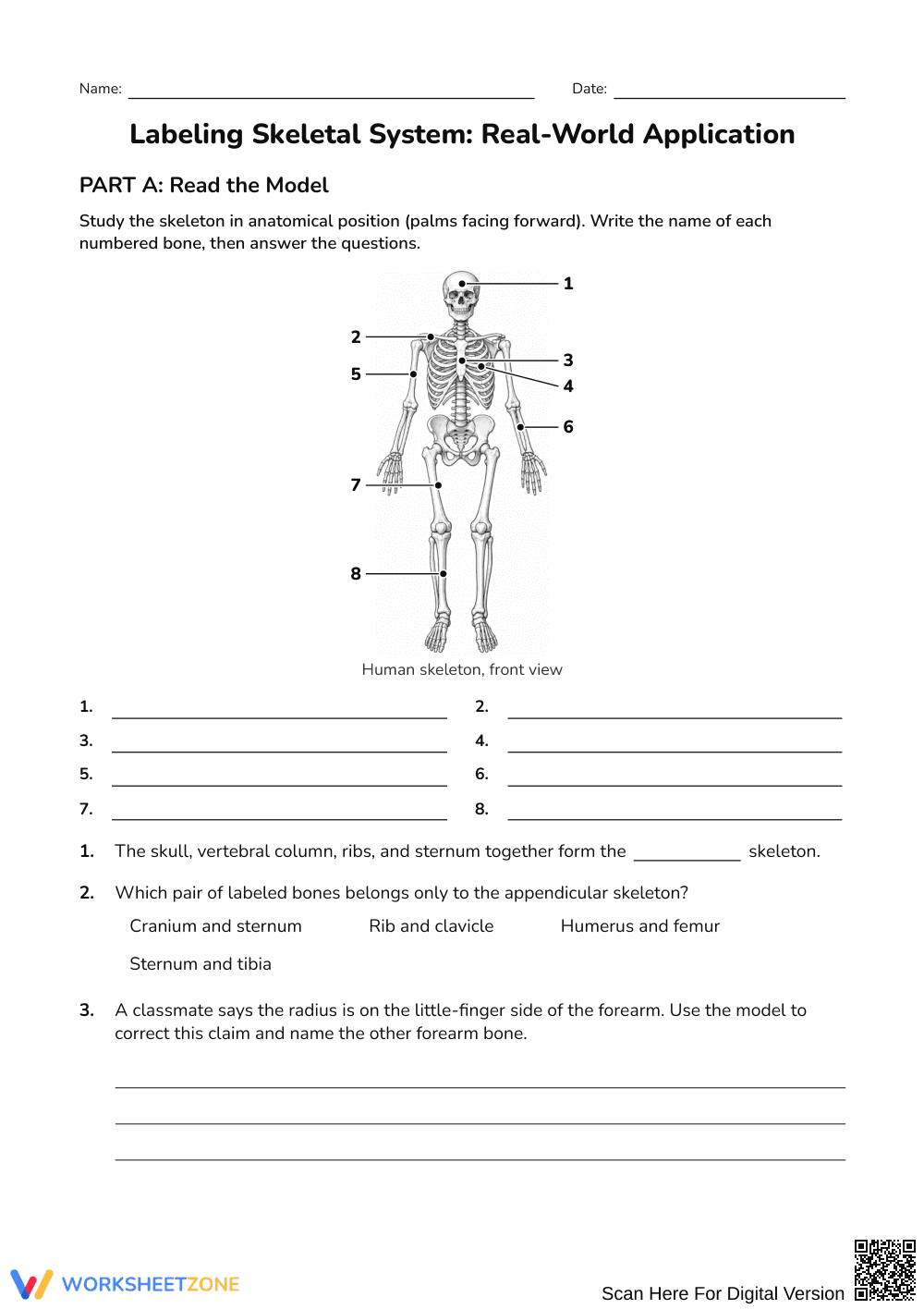
This skeletal system worksheet strengthens students' ability to label human bones, analyze structure-function relationships, and evaluate physiological data across 22 targeted items. Built for Grades 6–12 science classes, this resource transitions students from anatomical identification to biomechanical reasoning and data interpretation.
At a Glance
- Grade: Grades 6–12 · Subject: Science
- Standard: Identify anatomical structures and explain mechanical structure-function relationships within human body systems
- Skill Focus: Skeletal labeling, axial versus appendicular divisions, and bone density
- Format: 4 pages · 22 total problems · Full answer key included · Printable PDF
- Best For: Comprehensive musculoskeletal unit review or active biology class practice
- Time: 45–60 minutes
What's Inside
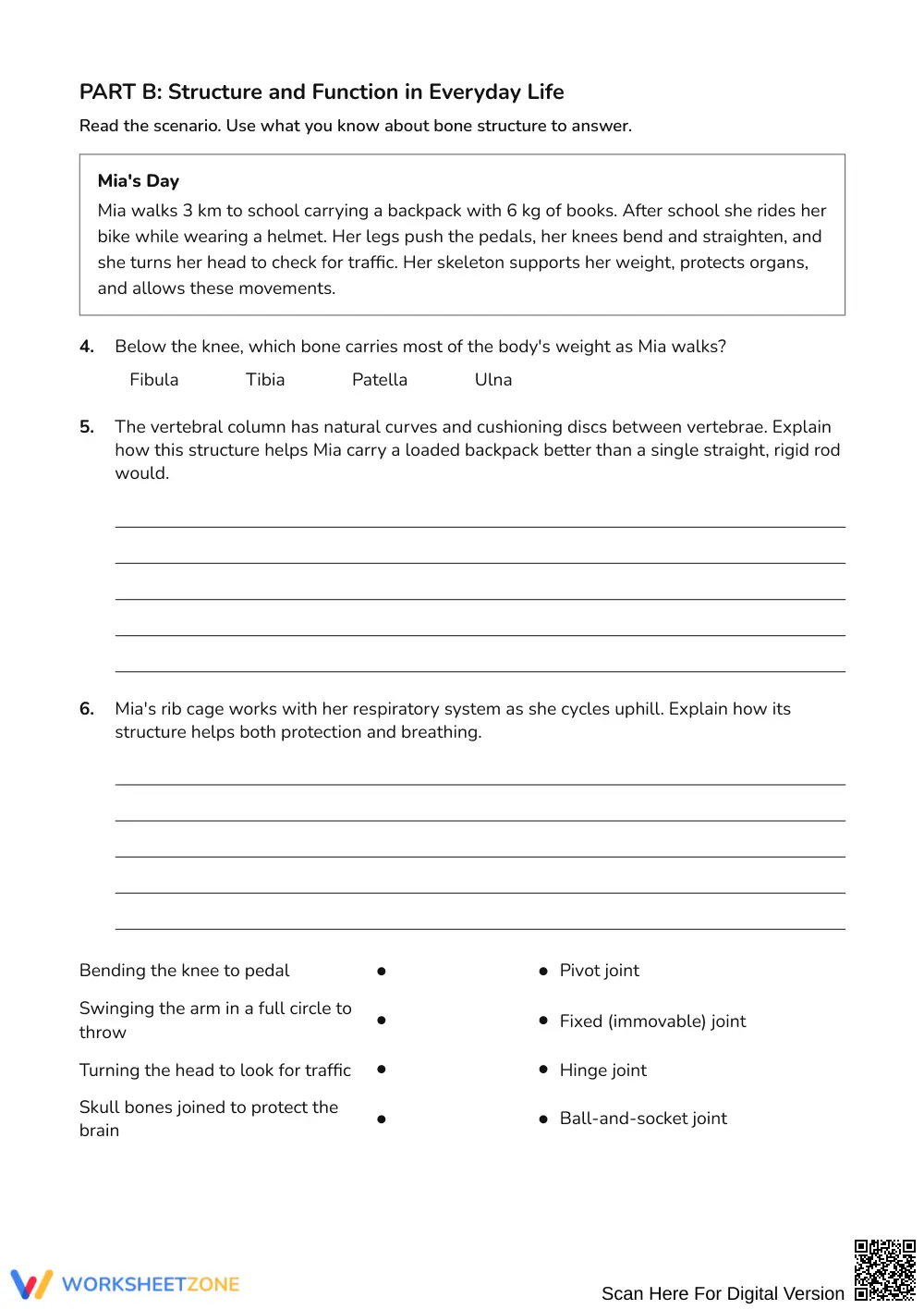
This 4-page worksheet includes 22 tasks arranged across three progressive sections. Students label an anterior skeleton diagram, examine a biomechanics scenario to classify joints and protective structures, and interpret a microgravity bone density graph. A 4-page answer key provides complete solutions, sample explanations, and mathematical calculations.
Skill Progression
- Guided practice (Part A): Students label key bones on an anterior diagram, contrast axial and appendicular skeletons across 8 items, and correct a misconception about forearm orientation.
- Supported practice (Part B): Using a daily scenario, students complete 9 tasks matching four joint types and explaining how curvature, cartilage, and ribs protect organs during movement.
- Independent practice (Part C): Students evaluate a microgravity bone density graph across 5 tasks, calculating 24-week projections and proposing exercise countermeasures.
This sequence follows a gradual-release model, moving from visual identification to evidence-based scientific argumentation.
Standards Alignment
This resource aligns with secondary life science standards requiring students to model organ system interactions and explain specialized structures. Students demonstrate how skeletal assemblies provide support, enable locomotion, and respond adaptively to forces. Both standard codes can be copied directly into lesson plans, IEP goals, or district curriculum mapping tools.
How to Use It
Deploy this packet during mid-unit instruction after introducing anatomical terminology, or use it for pre-exam review. When facilitating the joint classification section, circulate to check how learners differentiate hinge and pivot motions, addressing misunderstandings immediately. Students finish the 4 pages in 45 to 60 minutes of partner or independent work.
Who It's For
This worksheet serves middle and high school life science and introductory biology students exploring organ systems. Visual diagrams support developing readers and multilingual learners, while graphing exercises challenge advanced students. Pair this activity with a whole-class skeletal model demonstration or an anchor chart.
Grounded in the gradual release of responsibility framework described by Fisher & Frey (2014), this 4-page secondary science resource guides learners toward complete mastery of human skeletal anatomy, joint mechanics, and organ system interactions across 22 multi-tiered tasks. Students advance systematically from anatomical model labeling and axial-appendicular classification to complex biomechanical analysis and real-world microgravity data extrapolation. By structuring student practice through scaffolded visual diagrams, daily living vignettes, and empirical graphing exercises, the worksheet builds enduring conceptual links between biological structure and physiological function. Independent investigations into bone density adaptations in space challenge students to evaluate quantitative scientific evidence and propose mechanical exercise countermeasures. Accompanied by a 4-page teacher answer key detailing complete structural explanations and mathematical rate projections, this instructional document offers secondary educators a rigorous, research-supported tool for formative assessment, laboratory preparation, and standards-aligned biology instruction.


