





























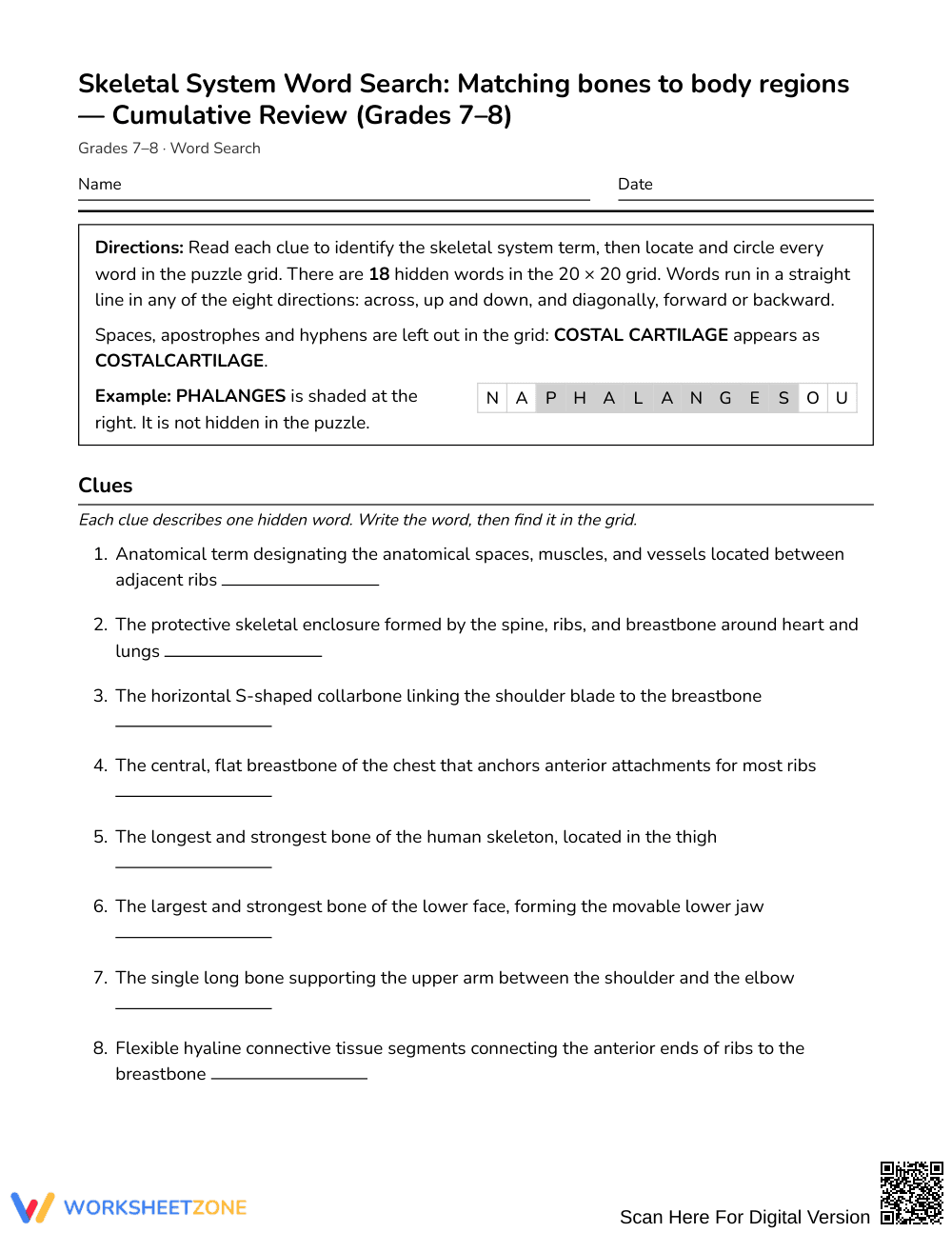


Complete Skeletal System Word Search | Grades 7–8 Science

Paste this activity's link or code into your existing LMS (Google Classroom, Canvas, Teams, Schoology, Moodle, etc.).
Students can open and work on the activity right away, with no student login required.
You'll still be able to track student progress and results from your teacher account.
This skeletal system word search helps Grades 7–8 science students master anatomical vocabulary by connecting 18 major bones and rib cage structures to their functions and body regions. Students actively decipher descriptive clues to identify each bone, reinforcing critical biological terminology through targeted puzzle retrieval.
At a Glance
- Grade: Grades 7–8 · Subject: Science
- Standard: Not standards-assessed — vocabulary enrichment and anatomical terminology practice
- Skill Focus: Matching human bones to body regions and skeletal structures
- Format: 3 pages · 18 words · Full answer key included · Printable PDF
- Best For: Skeletal system unit review and science vocabulary reinforcement
- Time: 25–35 minutes
What's Inside
This 3-page science resource features an 18-word puzzle paired with physiological definitions. Rather than rote copying, students solve descriptive anatomical clues for every bone, such as identifying the sesamoid patella or lateral radius. A shuffled word bank provides reference support, while a 4-page answer key details grid locations for efficient checking.
How the Puzzle Works
The puzzle is built on a 20 x 20 grid. All 18 vocabulary words are hidden across eight directions: north, northeast, east, southeast, south, southwest, west, and northwest. Students read each clue to determine the correct bone, locate the matching term in the shuffled word bank, and find it in the grid.
Standards Alignment
This word search is designed for vocabulary enrichment and conceptual reinforcement rather than direct standard assessment; no standard code is assigned. Middle school science educators can integrate this puzzle into human body systems units to reinforce regional bone terminology alongside core anatomy lessons.
How to Use It
Use this puzzle after direct instruction on the skeletal system as a cumulative review to consolidate bone identification. Alternatively, assign it as a paired science station before an anatomy exam. Formatively observe whether students deduce bones directly from the clues or depend heavily on the word bank; difficulty with terms like costal cartilage or fibula highlights areas needing review. Expected completion time is 25 to 35 minutes.
Who It's For
This activity suits Grades 7–8 science students studying human anatomy. The clues provide reading scaffolding for developing learners, while eight-direction word placement engages advanced students. Pair this puzzle with a labeled skeletal anchor chart or full-body anatomical model for immediate visual support.
Designed as a targeted vocabulary enrichment resource rather than an assessed standard, this middle school science word search builds anatomical literacy by prompting students to match major bones to specific body regions and structural functions. Learners decode clues describing 18 skeletal components — ranging from thoracic cage anatomy like the sternum and floating ribs to appendicular structures like the femur and clavicle — before searching across a 20 by 20 puzzle grid. According to research on adolescent literacy by Fisher & Frey (2014), intentional vocabulary acquisition that pairs domain-specific terminology with clear contextual definitions accelerates conceptual understanding and long-term retention in science classrooms. By integrating anatomical clues with word puzzle retrieval, this printable 3-page resource strengthens biological terminology recognition, supports teacher observation during human body units, and provides purposeful independent practice that directly reinforces structural anatomy across diverse science learning environments.


