


























Views
Downloads



Complete Site Condition Models Worksheet | Grade 8 Science
Paste this activity's link or code into your existing LMS (Google Classroom, Canvas, Teams, Schoology, Moodle, etc.).
Students can open and work on the activity right away, with no student login required.
You'll still be able to track student progress and results from your teacher account.
This Grade 8 science worksheet develops students' ability to evaluate how geological site conditions influence earthquake shaking using synthetic shake-table data. Learners analyze controlled trials, compare competing explanations, and cite quantitative evidence to explain why loose sediment amplifies seismic waves compared to solid bedrock. Students master variable control and evidence-based reasoning in Earth science.
At a Glance
- Grade: 8 · Subject: Science
- Standard: Earth and Space Science — Analyze controlled model data to evaluate competing explanations of earthquake shaking
- Skill Focus: Compare Site Conditions in a Controlled Model
- Format: 5 pages · 10 problems · Answer key included · PDF
- Best For: Earth science data analysis lab
- Time: 40–50 minutes
What's Inside
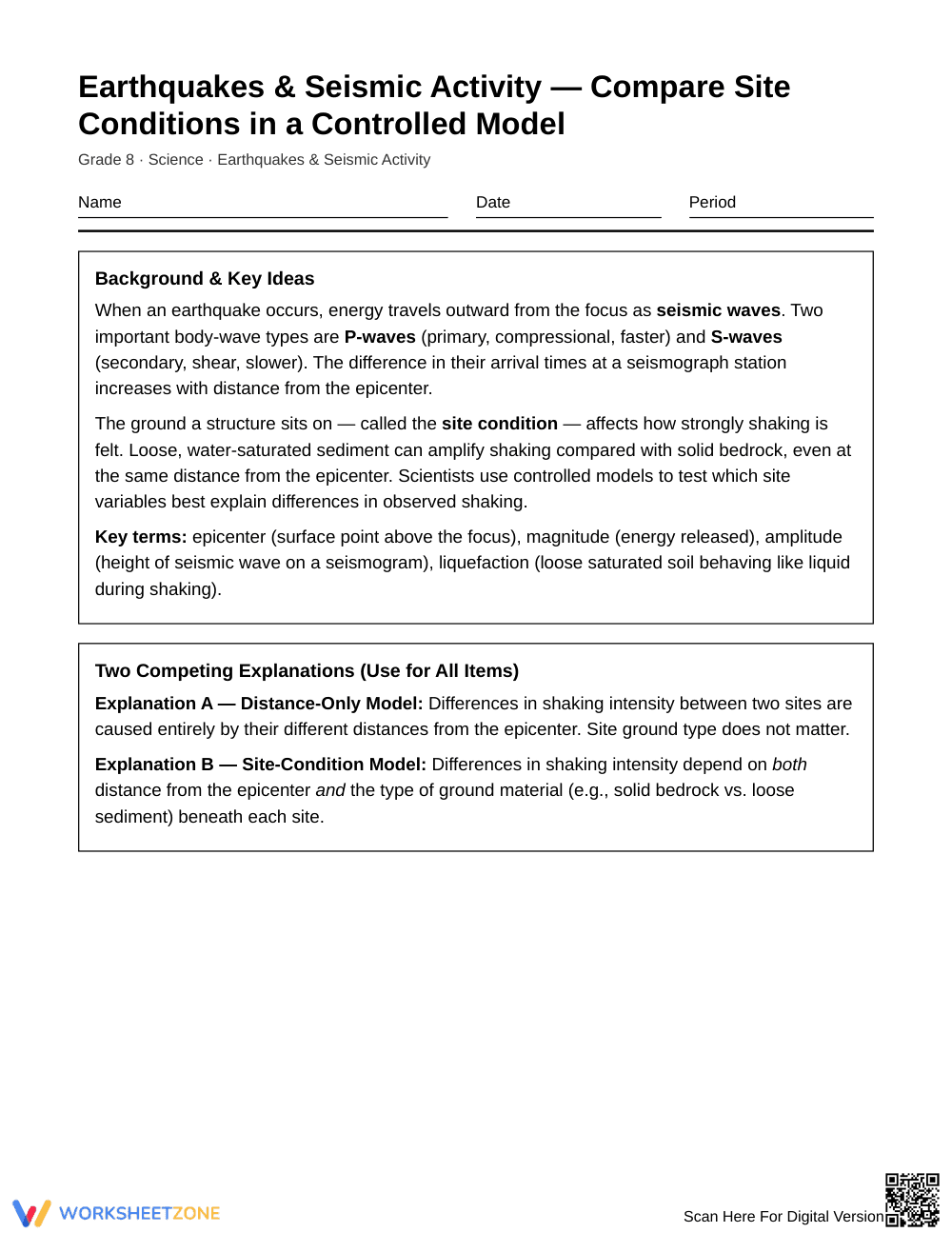
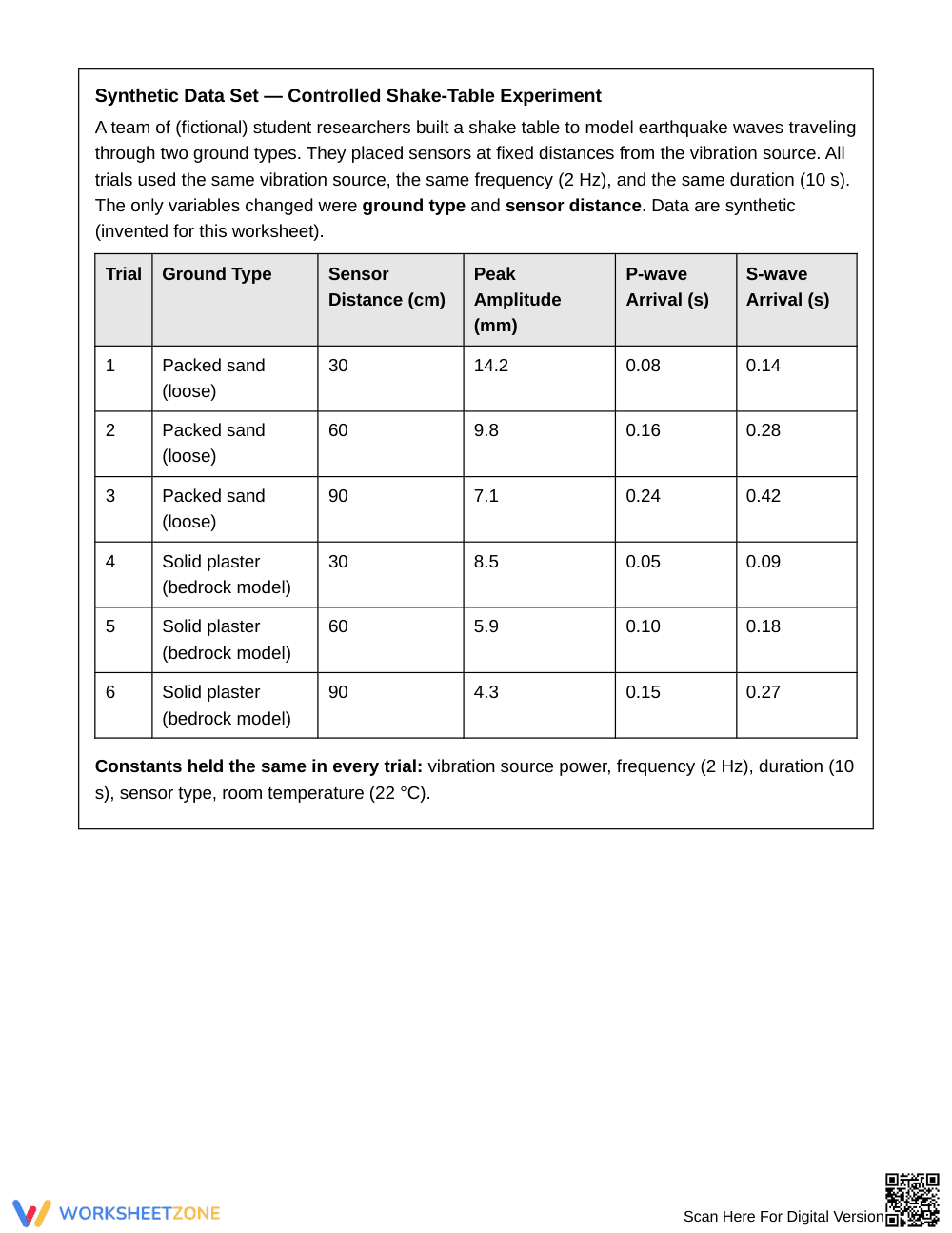
The 5-page printable resource includes an introductory reference guide outlining P-wave and S-wave properties, two competing scientific models, and a 6-trial synthetic data set from a controlled shake-table experiment. Across 10 structured tasks, students complete quantitative predictions, variable identification exercises, and evidence-evaluation prompts. A comprehensive 4-page answer key provides complete model responses, rationale explanations, and precise data citations for rapid grading.
Skill Progression
- Guided Practice (Part A, Problems 1–2): Students apply competing scientific models to predict amplitude outcomes across novel distances and materials, referencing established baseline data trends.
- Supported Practice (Part B, Problems 3–8): Learners evaluate six questions on experimental design, isolating independent and controlled variables, explaining fair testing, and justifying measurement choices.
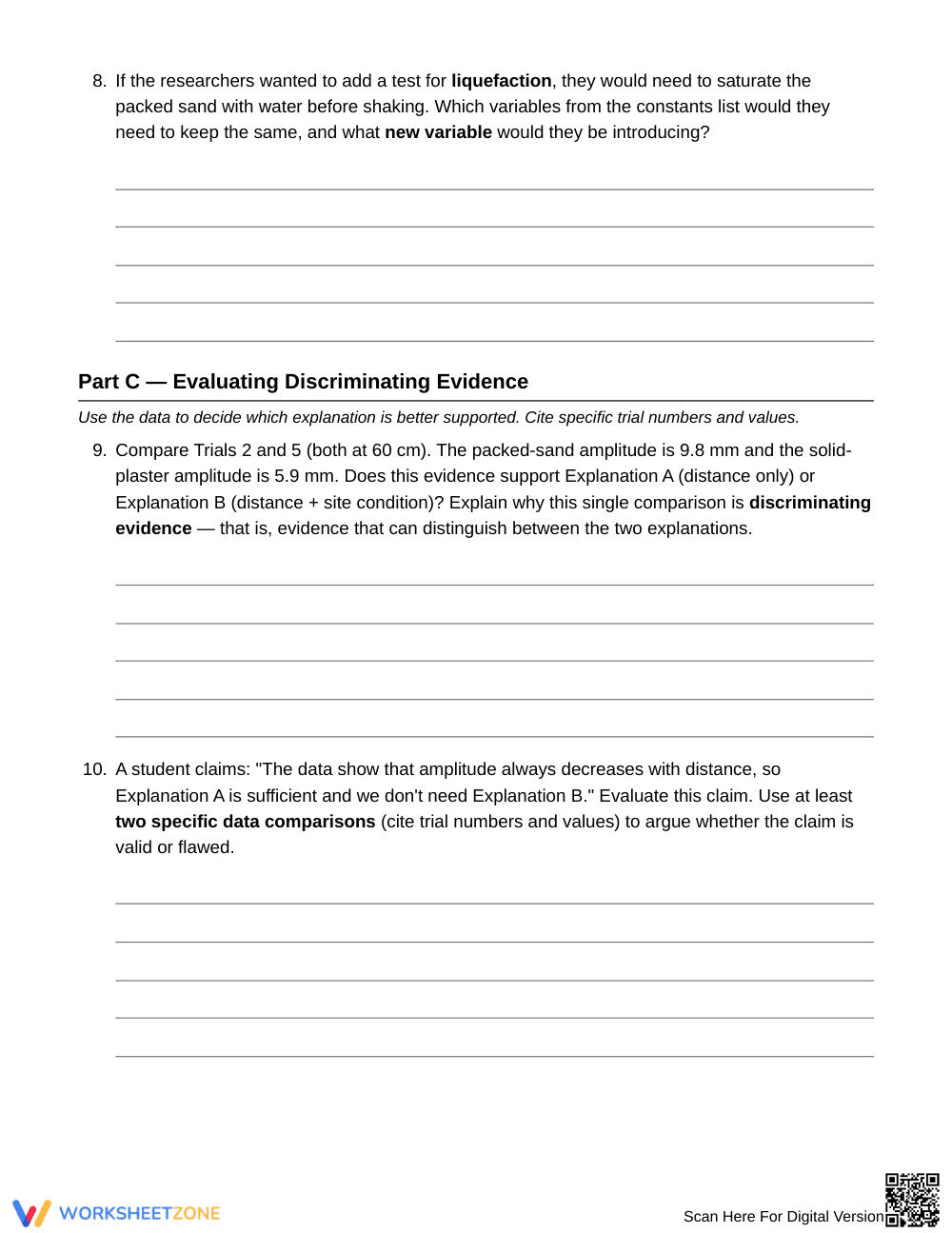
- Independent Practice (Part C, Problems 9–10): Working with minimal scaffolds, students evaluate discriminating evidence between competing explanations and critique flawed peer claims using multi-trial data comparisons.
This sequence reinforces student autonomy through a structured gradual-release framework, guiding learners from initial model application to rigorous scientific argumentation.
Standards Alignment
This worksheet aligns with middle school Earth and space science standards where students analyze data from models to determine how site conditions affect seismic hazard intensity. Students evaluate how distance and subsurface material interact during ground shaking. Both standard goals can be copied directly into lesson plans, IEP goals, or district curriculum mapping tools.
How to Use It
Implement this worksheet during or after direct instruction on seismic waves and ground amplification. As a formative check, observe whether students identify sensor distance as a held constant when comparing Trials 2 and 5 in Part B. Anticipate 40 to 50 minutes for completion in collaborative pairs or individual practice.
Who It's For
This activity supports Grade 8 science students and Earth science learners requiring structured data analysis practice. Provide sentence frames for English learners in Part C, or pair the data set with a hands-on wave demonstration.
Middle school science achievement requires systematic opportunities to interrogate physical models and evaluate competing explanations using empirical data. According to Fisher & Frey (2014), structured gradual-release frameworks significantly increase student competence in disciplinary literacy and scientific argumentation when learners progress from guided predictions to independent evidentiary critiques. This Grade 8 seismic activity operationalizes that instructional trajectory across 10 targeted problems centered on comparing site conditions in a controlled model. Students examine synthetic shake-table trials, distinguish between independent and controlled variables, and leverage quantitative measurements—including wave arrival times and peak amplitudes—to support or refute scientific claims. By confronting competing explanations directly, learners develop robust evidentiary habits essential for secondary Earth science mastery. Teachers receive an actionable diagnostic tool that pinpoints student misconceptions regarding ground amplification, wave attenuation, and experimental fair testing before summative unit assessments.


