





























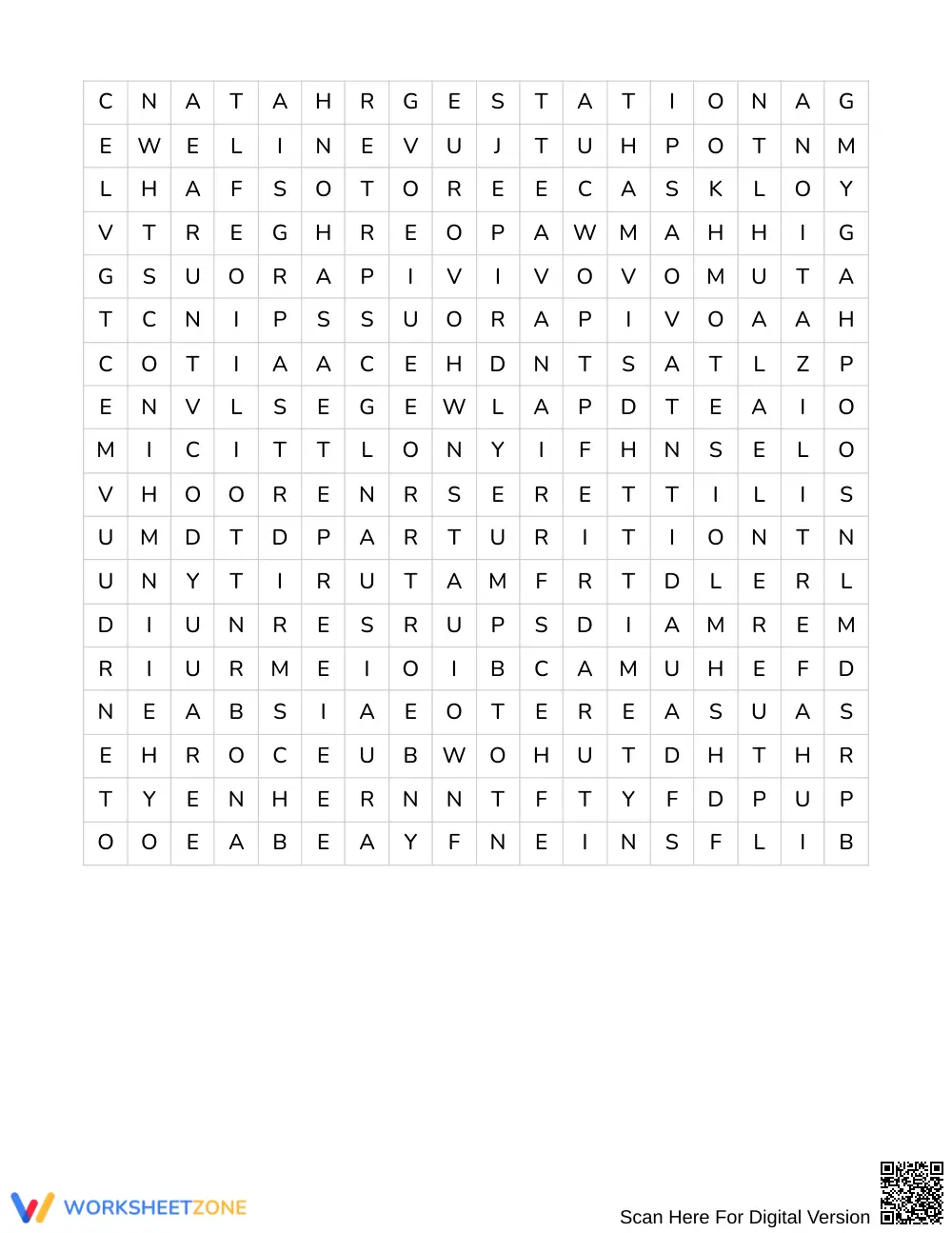


Complete Shark Life Cycles Word Search | Grades 6–7 Science

Paste this activity's link or code into your existing LMS (Google Classroom, Canvas, Teams, Schoology, Moodle, etc.).
Students can open and work on the activity right away, with no student login required.
You'll still be able to track student progress and results from your teacher account.
This shark life cycles word search engages Grades 6–7 science students in active vocabulary retrieval and marine biology reinforcement. Learners analyze 16 biological clues to identify and locate key developmental terms, solidifying life science concepts through an engaging, no-bank puzzle format.
At a Glance
- Grade: Grades 6–7 · Subject: Science (Life Science)
- Standard: Not standards-assessed — vocabulary enrichment
- Skill Focus: Shark life cycles, reproductive strategies, and anatomical development
- Format: 3 student pages · 16 hidden words · Complete 4-page answer key included · PDF
- Best For: Middle school life science vocabulary review and reinforcement
- Time: 20–35 minutes of focused student work
What's Inside
This 3-page science resource features a clue-driven puzzle on marine life cycles. Rather than using a word bank, students read 16 detailed definitions covering terms like viviparous, clasper, and mermaid's purse. The set includes a comprehensive 4-page answer key containing full term identification and grid solutions with marked word paths.
Puzzle Mechanics and Structure
The activity operates on an 18 x 18 grid using clues instead of a word bank:
- Clue-Based Solving: Learners deduce 16 target terms from descriptive clues rather than searching from a passive list.
- 18 x 18 Matrix: The letter grid conceals multi-length vocabulary terms across balanced letter distributions.
- All Directions: Hidden words run in all 8 directions: north, northeast, east, southeast, south, southwest, west, and northwest.
Standards Alignment
This word search is designed strictly as vocabulary enrichment and is not aligned to a specific standard. It supports middle school life science units by reinforcing technical terminology related to reproductive modes, embryonic growth, and shark development.
How to Use It
Assign this activity after direct instruction on animal life cycles to reinforce technical vocabulary. In class, students can work individually or in pairs during review stations. As students complete the puzzle in 20 to 35 minutes, observe whether they correctly distinguish between oviparous, viviparous, and ovoviviparous definitions to formatively assess conceptual retention.
Who It's For
This resource is built for Grades 6–7 science classes studying marine biology and reproduction. Teachers can scaffold the task by providing a partial word list or challenge students with the no-bank format. It pairs naturally with an introductory reading passage on shark reproduction or an ocean adaptations anchor chart.
Vocabulary acquisition in secondary science requires deliberate opportunities for retrieval and contextual application. According to Fisher & Frey (2014), intentional vocabulary instruction that moves beyond rote memorization fosters deeper disciplinary literacy by requiring students to connect technical definitions directly to conceptual frameworks. This Grades 6–7 animal life cycles resource embodies that principle through a clue-based word search structure where learners interpret complex descriptions of shark reproduction, internal fertilization, and embryological nourishment before locating the hidden terms. Bypassing a passive word list compels active cognitive retrieval, transforming a standard search puzzle into an analytical task. Research synthesized by Fisher & Frey (2014) demonstrates that engaging middle school students in multi-modal retrieval tasks strengthens long-term memory consolidation of specialized scientific terminology. By integrating 16 high-utility life science concepts across an 18 x 18 grid, this activity delivers rigorous vocabulary enrichment that bridges basic concept introduction and summative assessment.


