































Complete Sentence Length & Pacing Worksheet | Grade 7 ELA

Paste this activity's link or code into your existing LMS (Google Classroom, Canvas, Teams, Schoology, Moodle, etc.).
Students can open and work on the activity right away, with no student login required.
You'll still be able to track student progress and results from your teacher account.
This Grade 7 reading literature worksheet trains students to analyze how authors manipulate sentence length, syntax, and information flow to control narrative pacing and build suspense. Working through an original suspense passage, students evaluate structural shifts from descriptive multi-clause sentences to urgent staccato fragments to determine their psychological effect on the reader.
At a Glance
- Grade: 7 · Subject: ELA
- Standard:
RL.8.6— Analyze how differences in point of view create suspense or humor- Skill Focus: Annotate Sentence Length and Pacing
- Format: 5 pages · 10 problems · Answer key included · PDF
- Best For: Close reading suspense craft analysis
- Time: 40–50 minutes
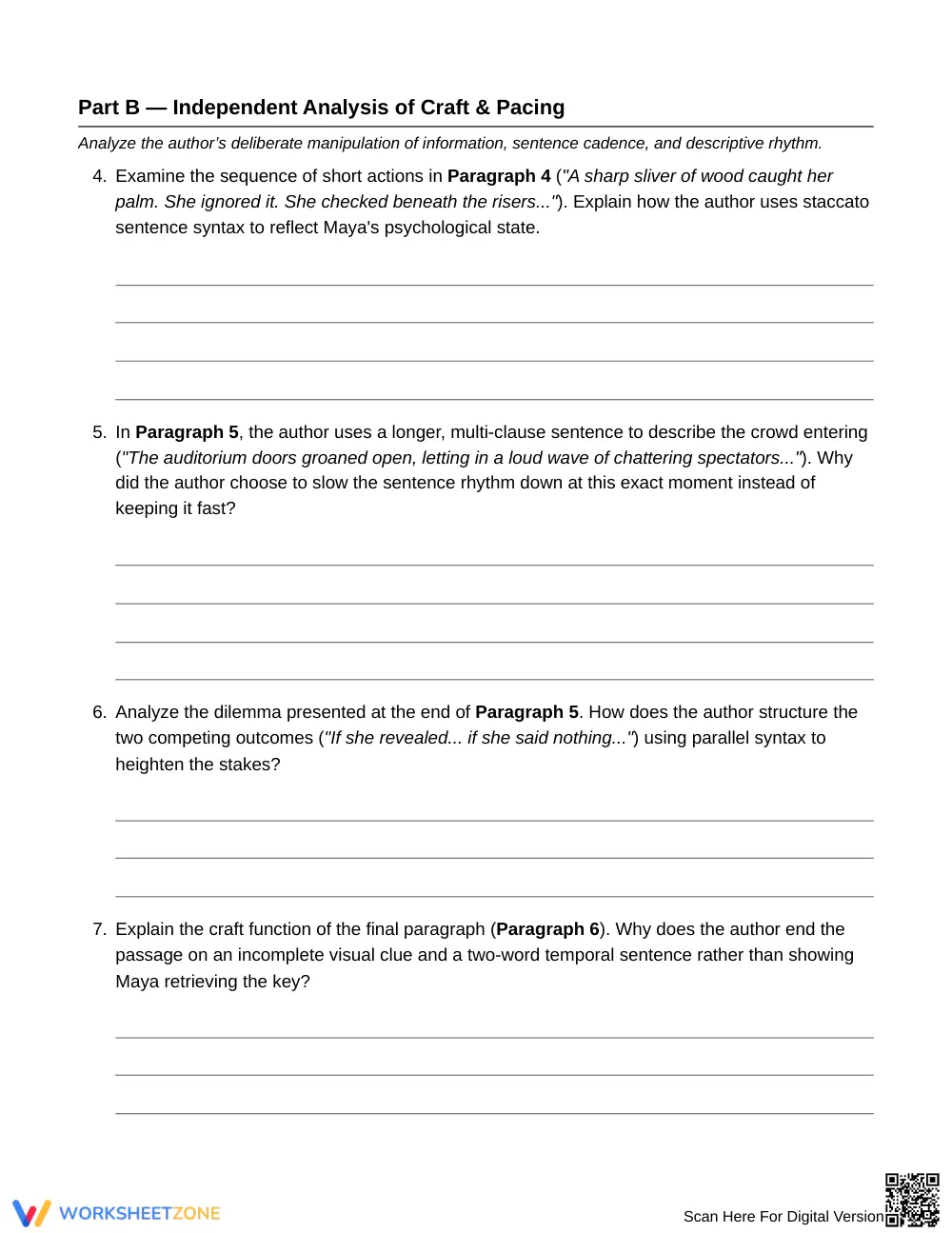
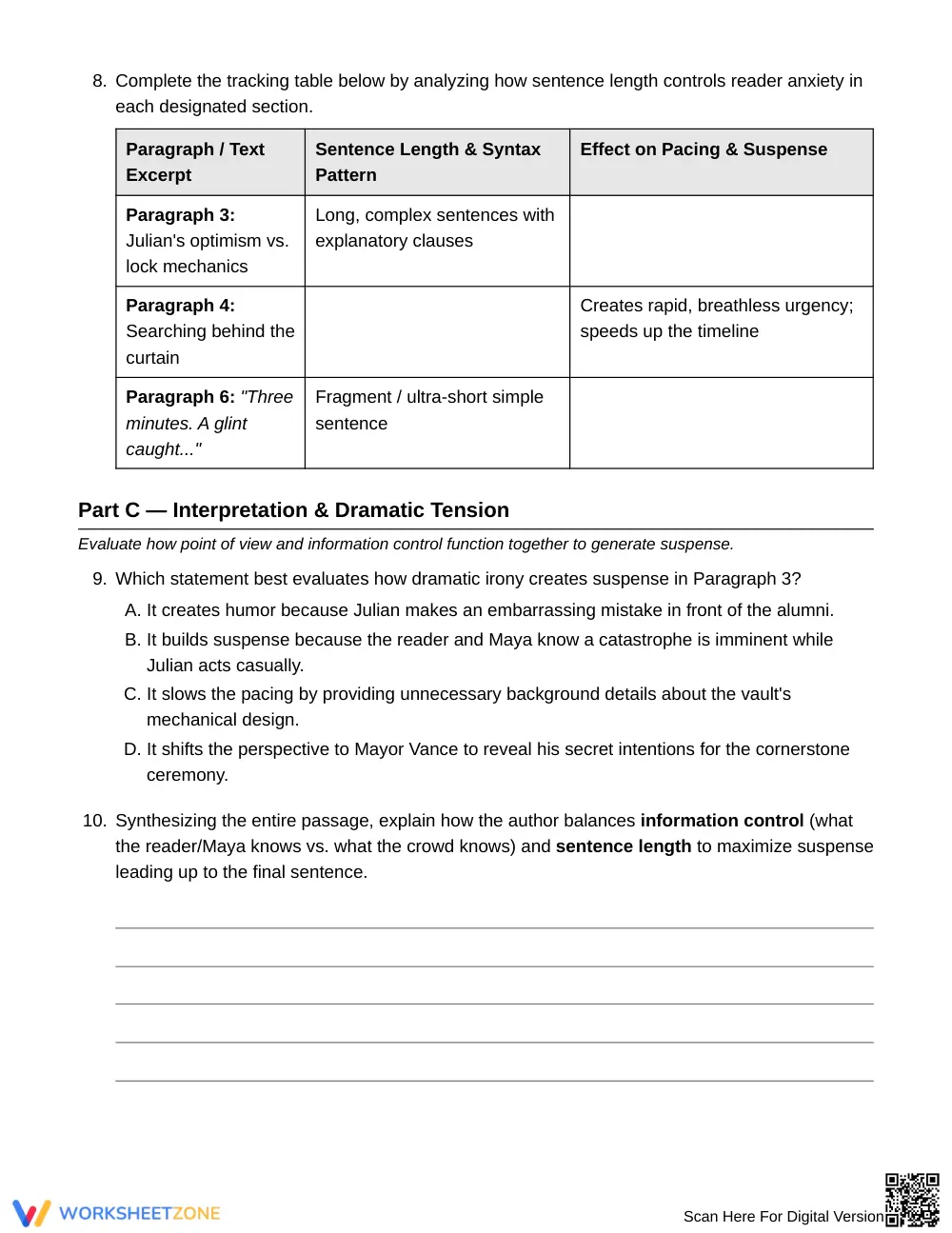
The 5-page printable resource features the complete narrative text "The Cornerstone Vault," an annotated mentor model demonstrating syntax breakdown, and 10 structured analytical questions across three progressive sections. Students complete text evidence comparisons, syntax tracing, a sentence structure tracking table, and a multiple-choice check. A detailed 3-page answer key provides complete model annotations and sample analytical responses.
Skill Progression
- Guided Practice (Part A, Tasks 1–3): Students examine paired structural shifts, cite text evidence, and trace temporal syntax markers using the provided mentor annotation model as an analytical benchmark.
- Supported Practice (Part B, Tasks 4–8): Students analyze staccato phrasing, parallel syntax dilemmas, and complete a multi-row sentence tracking table mapping syntax patterns to reader suspense.
- Independent Practice (Part C, Tasks 9–10): Students independently evaluate dramatic irony in an assessment-style question and synthesize the dual impact of information disparity and cadence.
This structured sequence follows a gradual-release instructional model, transitioning students from supported craft deconstruction to autonomous literary analysis.
Standards Alignment
This resource aligns directly with `RL.8.6`: "Analyze how differences in the points of view of the characters and the audience or reader create effects such as suspense or humor." The tasks explicitly unpack how information control and pacing alter audience perception. Both standard codes can be copied directly into lesson plans, IEP goals, or district curriculum mapping tools.
How to Use It
Implement this worksheet during core instruction following a mini-lesson on narrative craft. Alternatively, assign it as a targeted mid-unit formative assessment to measure analytical writing before students compose their own suspense narratives. While students complete Part B, observe whether they can articulate why short syntax accelerates tension rather than just identifying sentence word counts. Expect completion in 40 to 50 minutes.
Who It's For
This printable is designed for Grade 7 and Grade 8 English language arts classrooms, honors courses, and targeted reading intervention groups. Differentiate by providing the included model annotation to struggling readers as an anchor reference. Pair this activity with a whole-class reading of classic suspense fiction such as Edgar Allan Poe's "The Tell-Tale Heart."
Middle school reading comprehension research emphasizes that direct instruction in authorial craft significantly improves student analytical writing and interpretive depth. According to Fisher & Frey (2014), scaffolding rigorous text-dependent questions through gradual-release frameworks enables adolescent readers to deconstruct complex syntax patterns and structural choices with higher independence. This 5-page printable worksheet operationalizes standard RL.8.6 by requiring Grade 7 learners to annotate sentence length, track temporal markers, and analyze how strategic information disparity generates psychological suspense across narrative text. By combining an explicit model annotation, structured evidence collection tables, and evaluative synthesis prompts, the instructional material effectively bridges foundational reading fluency and advanced literary criticism. Educators utilizing these 10 targeted tasks can systematically measure student mastery of structural pacing while directly supporting district curriculum benchmarks and state standards for rigorous text analysis.


