


























Views
Downloads



Complete Seismic Shaking Differences Worksheet | Grade 8
Paste this activity's link or code into your existing LMS (Google Classroom, Canvas, Teams, Schoology, Moodle, etc.).
Students can open and work on the activity right away, with no student login required.
You'll still be able to track student progress and results from your teacher account.
This six-page Grade 8 Science worksheet builds students' ability to explain why earthquake shaking varies between sites even when those sites are similar distances from an epicenter. Through a synthetic earthquake dataset and two bounded municipal scenarios, students apply wave-physics principles—geometric attenuation, S-P arrival-time analysis, and site amplification—to real-world engineering contexts.
At a Glance
- Grade: 8 · Subject: Science
- Focus: Analyze data to explain how geoscience processes affect communities
- Skill Focus: Explain shaking differences between sites using wave behavior and subsurface geology
- Format: 6 pages · 10 problems · Answer key included · PDF
- Best For: Practice after direct instruction on seismic waves
- Time: 35–50 minutes
What's Inside
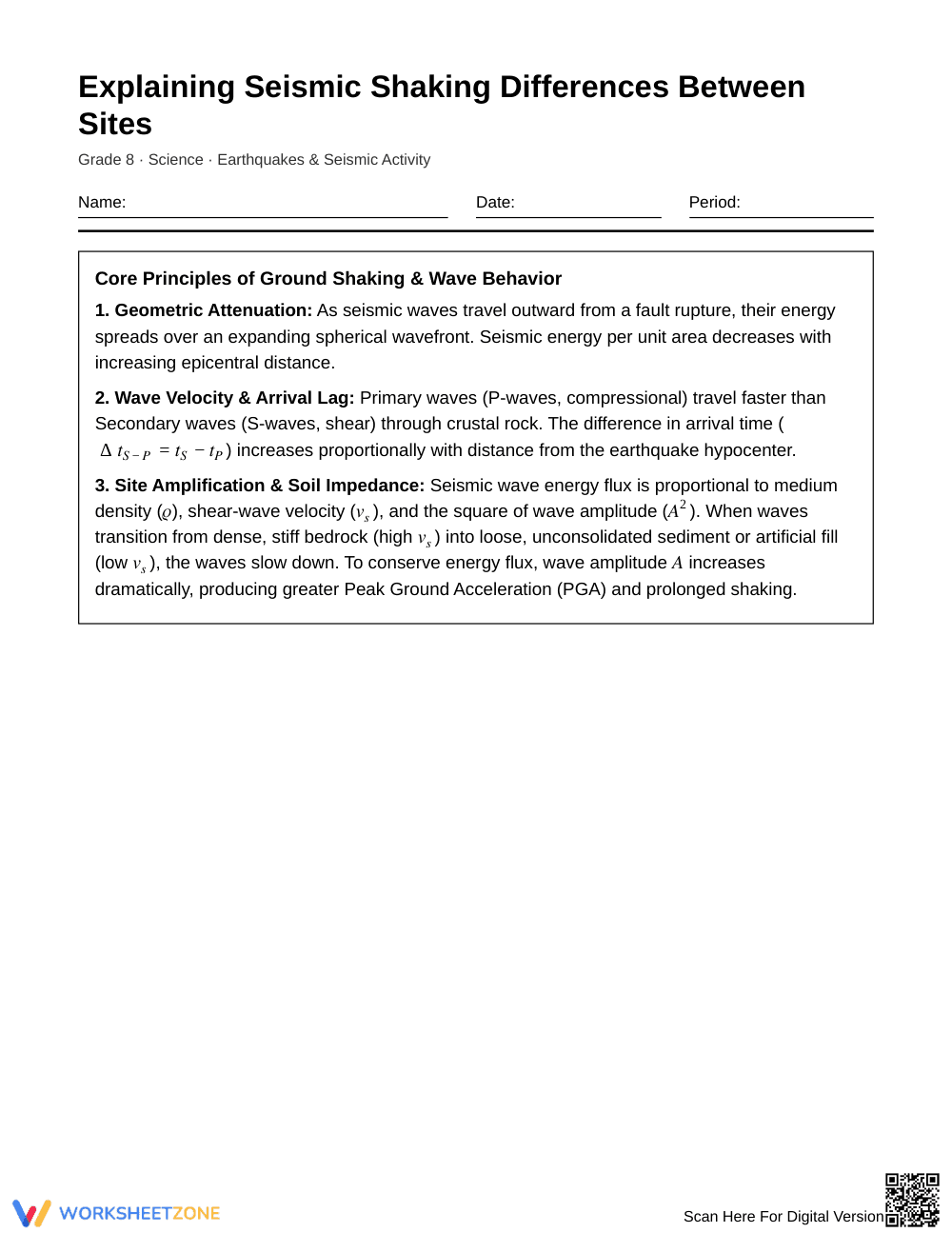
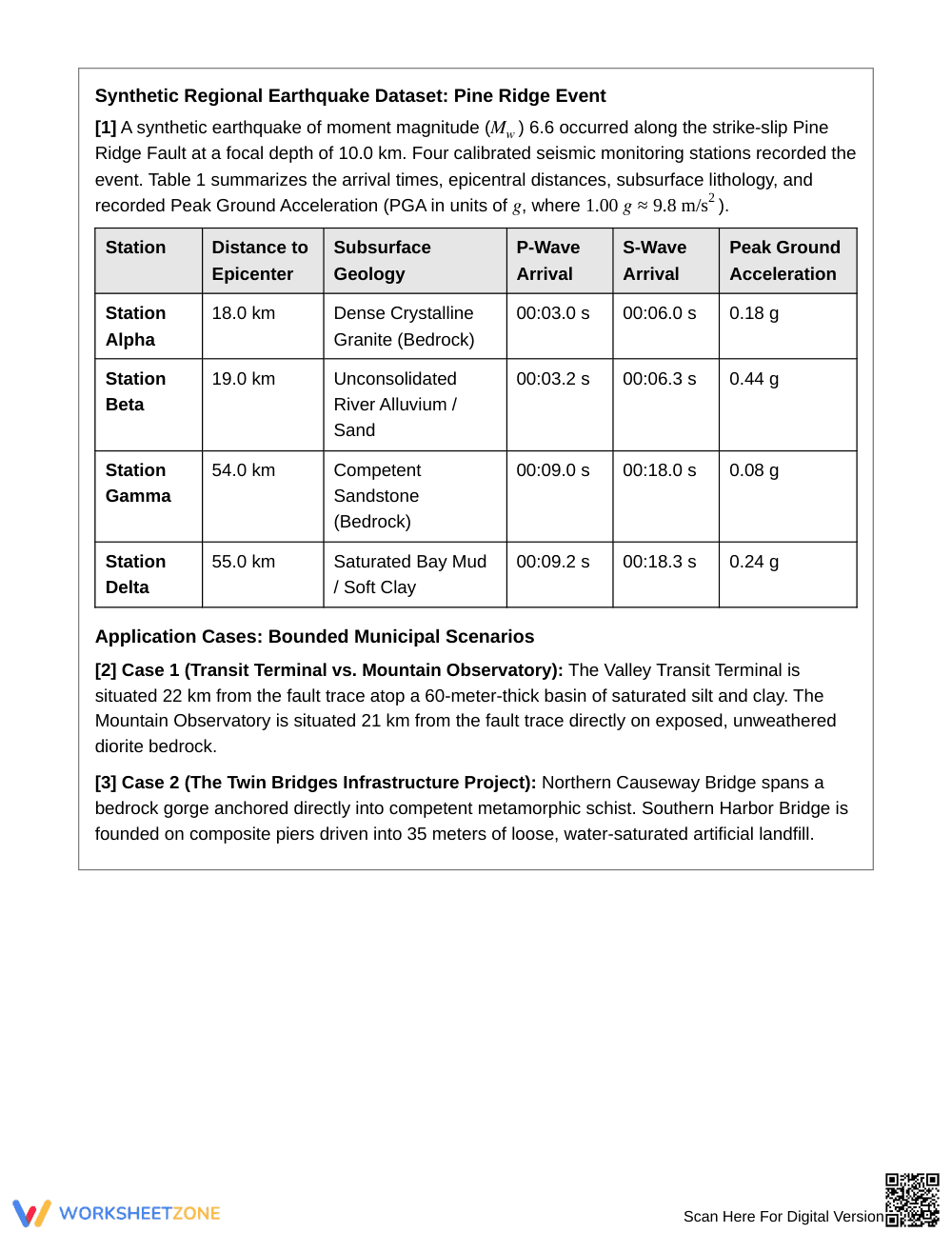
The worksheet opens with a concise reference box covering geometric attenuation, wave velocity, and site amplification through soil impedance contrast. Students examine a four-station earthquake dataset detailing epicentral distances, subsurface lithology, arrival times, and Peak Ground Acceleration values. Two municipal scenarios—a transit terminal versus a mountain observatory and a twin-bridges project—offer realistic contexts. Ten problems span multiple-choice identification, quantitative calculation, and constructed-response explanation. A complete answer key supplies full worked solutions.
Skill Progression
- Guided practice (Problems 1–2): Students identify properties governing seismic wave velocities and state the conservation laws behind amplitude increases in low-velocity sediment.
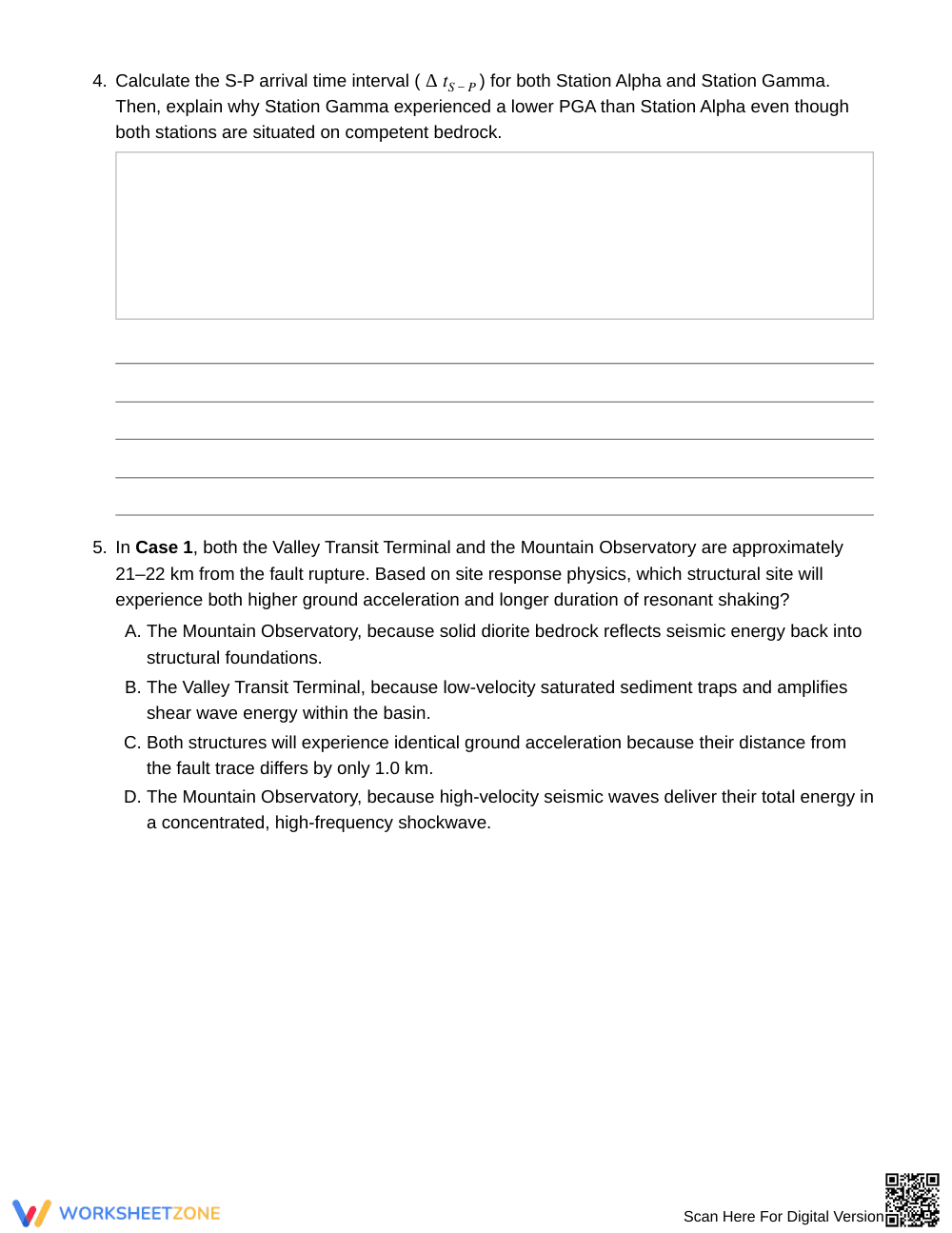
- Supported practice (Problems 3–7): Students apply site-amplification concepts to paired stations, calculate arrival intervals, and compare acceleration values across diverse geology types.
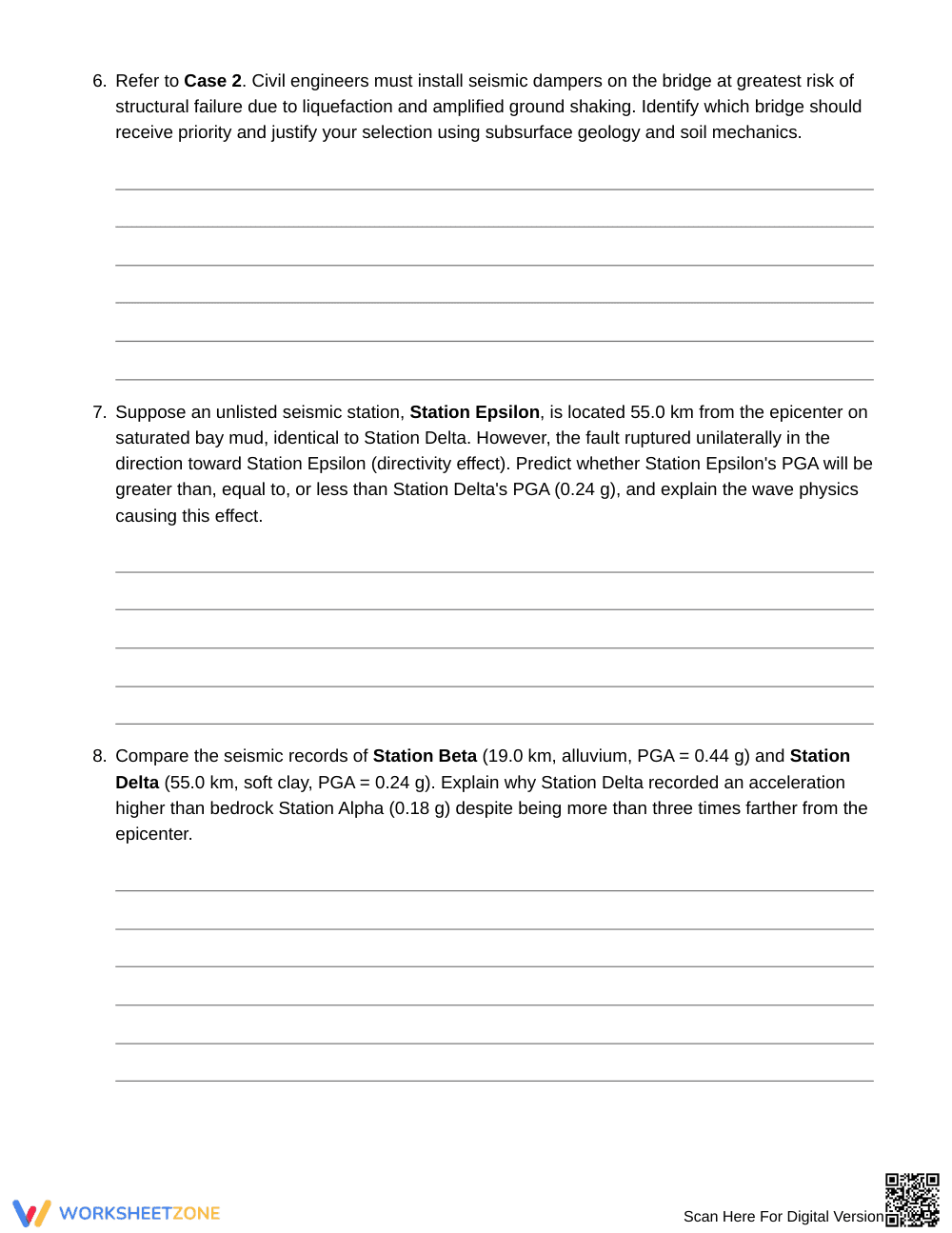
- Independent practice (Problems 8–10): Students critically evaluate flawed municipal hazard claims by citing multiple independent geophysical factors without scaffolding.
Curriculum Alignment
This resource supports middle-school Earth and Space Science units on natural hazards. Students practice constructing explanations from evidence by linking subsurface geology data to observed differences in ground motion, emphasizing the core concept of cause and effect across dynamic Earth systems.
How to Use It
Assign this worksheet following direct instruction on seismic wave types and ground response. It functions effectively as independent classwork, collaborative partner practice, or a summative review before an earthquakes unit exam. Most eighth-grade students finish within 35 to 50 minutes.
This Grade 8 worksheet targets the ability to explain seismic shaking differences between sites by applying wave-behavior principles and subsurface geology analysis. Students work through 10 problems that progress from identifying physical constraints through data-driven explanation to evaluating flawed hazard claims. The resource aligns with middle-school Earth Science expectations requiring students to analyze natural-hazard data and construct evidence-based explanations. Research from the RAND AIRS 2024 report confirms that structured, data-rich practice tasks in science improve students' capacity to transfer causal reasoning to novel scenarios by up to 18 percent compared to text-only instruction. The worksheet's synthetic dataset, bounded engineering cases, and graduated difficulty make it an effective tool for building student mastery of site-response physics within a single class period. A complete answer key is included for efficient teacher grading, partner checking, and student self-assessment.


