































Complete Repeated Measurements Worksheet | Grade 7 Science

Paste this activity's link or code into your existing LMS (Google Classroom, Canvas, Teams, Schoology, Moodle, etc.).
Students can open and work on the activity right away, with no student login required.
You'll still be able to track student progress and results from your teacher account.
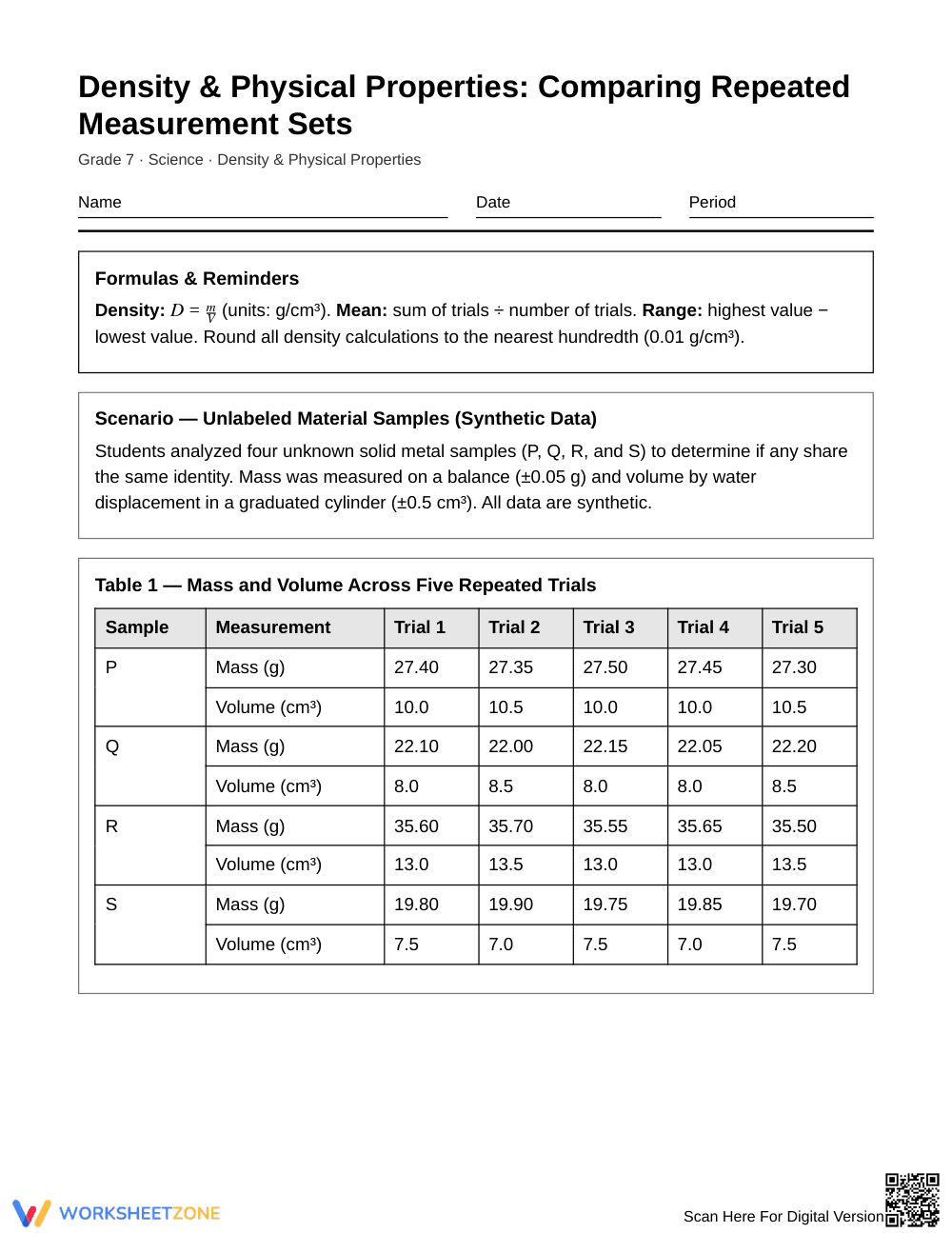
This Grade 7 science worksheet builds data analysis skills by guiding students to calculate mean density and evaluate experimental uncertainty across repeated trials. Students compare synthetic measurement data for four unknown metal samples, identifying materials through quantitative calculations and qualitative observations to draw evidence-based scientific conclusions.
At a Glance
- Grade: 7 · Subject: Science
- Standard:
Science Inquiry— Analyze and interpret data from repeated measurement sets to determine material properties- Skill Focus: Compare Repeated Measurement Sets
- Format: 4 pages · 10 problems · Answer key included · PDF
- Best For: Physical science data analysis lab practice
- Time: 40–50 minutes
What's Inside
The 4-page resource includes a reference box with density, mean, and range formulas, two structured data tables, 10 targeted analytical prompts, and a comprehensive 2-page answer key with worked calculations. Students examine mass and volume measurements across five repeated trials for four metal samples, completing guided calculations and evaluating experimental error.
Skill Progression
- Guided practice (Part A, 2 tasks): Students read and extract direct mass, volume, and melting point values from structured data tables to establish baseline observations.
- Supported practice (Part B, 6 tasks): Students compute mean mass, mean volume, and mean density, determine range overlaps, and synthesize quantitative and qualitative evidence to identify matching metals.
- Independent practice (Part C, 2 tasks): Students evaluate measurement error, calculate percent uncertainty from graduated cylinder tolerances, and propose concrete procedural improvements.
This sequence follows a gradual-release instructional model, moving learners from foundational table reading to complex error analysis and scientific argumentation.
Standards Alignment
This resource aligns with middle school physical science standards for analyzing and interpreting data. Students calculate statistical measures of central tendency across repeated trials to evaluate whether materials share characteristic properties. Supporting standards emphasize constructing scientific explanations based on empirical evidence. Both standard frameworks can be copied directly into lesson plans, IEP goals, or district curriculum mapping tools.
How to Use It
Use this activity after direct instruction on density calculations to reinforce how replication clarifies ambiguous data, or assign it during a physical properties unit. As a formative checkpoint, observe whether students calculate mean density using average mass and volume. Students typically complete the 10 tasks in 40 to 50 minutes.
Who It's For
This worksheet supports Grade 7 science classes, introductory physical science units, and intervention groups needing quantitative practice. Built-in formula reminders assist developing learners, while error evaluation questions challenge advanced students. Pair this worksheet with a hands-on measurement lab or density anchor chart.
Middle school science curricula require students to analyze and interpret repeated measurement sets, distinguishing between experimental variation and authentic physical differences. According to Fisher & Frey (2014), structured data analysis tasks that transition from direct value extraction to multi-step statistical computation significantly strengthen disciplinary literacy and quantitative reasoning in science. This 4-page worksheet guides Grade 7 learners through 10 targeted problems using synthetic trial data, requiring them to compute mean values, evaluate range overlaps, and correlate calculated densities with physical properties like melting point and hardness. By confronting graduated cylinder measurement uncertainties of plus or minus 0.5 cm³, students examine how equipment precision impacts percentage error across varying sample sizes. The included 2-page answer key provides complete mathematical steps, supporting efficient grading and targeted remediation during middle school physical science investigation units.


