































Complete Qualified Finding Worksheet | Grade 8 ELA

Paste this activity's link or code into your existing LMS (Google Classroom, Canvas, Teams, Schoology, Moodle, etc.).
Students can open and work on the activity right away, with no student login required.
You'll still be able to track student progress and results from your teacher account.
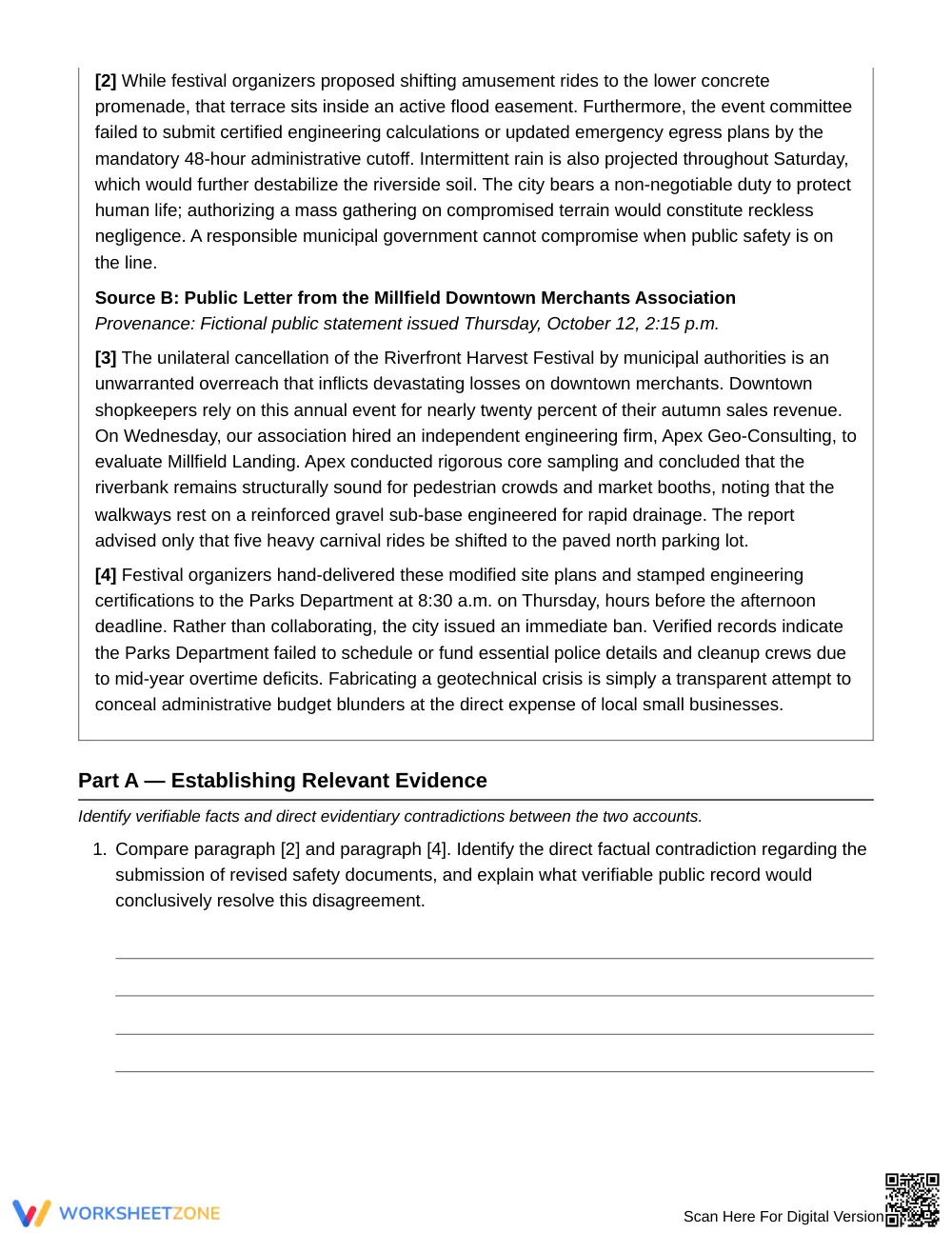
This Grade 8 informational text worksheet guides students through evaluating two conflicting accounts of a municipal event to construct an evidence-based, qualified finding. Students differentiate between verifiable factual contradictions and competing interpretations, weighing evidence across paired statements to synthesize a defensible conclusion.
At a Glance
- Grade: 8 · Subject: ELA
- Standard:
RI.8.9— Analyze conflicting accounts of an event and evaluate their differing evidence- Skill Focus: Defend a qualified finding from conflicting texts
- Format: 5 pages · 8 problems · Answer key included · PDF
- Best For: Paired-text informational analysis
- Time: 45–60 minutes
What's Inside
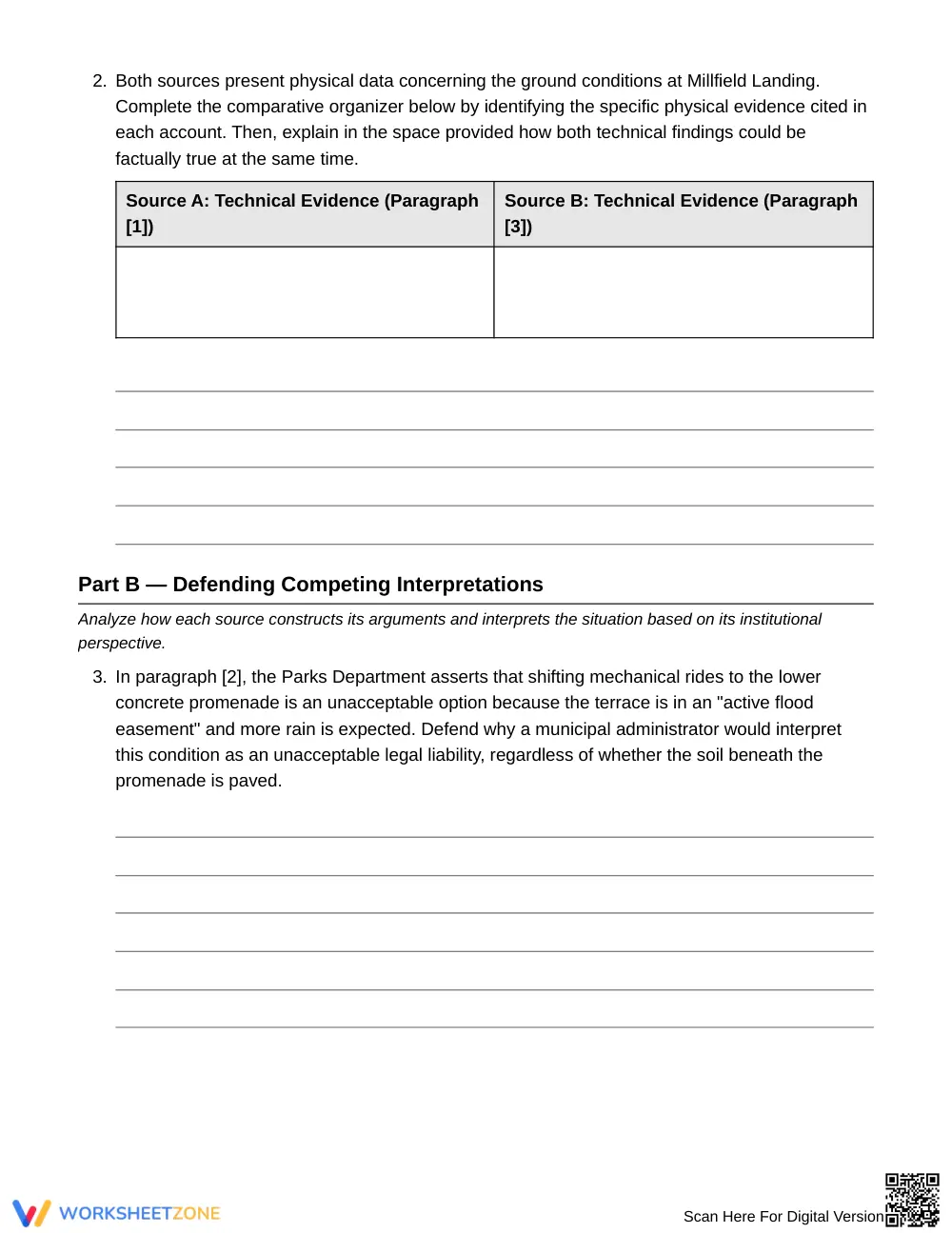
The 5-page worksheet provides a reasoning guide, two paired fictional press statements regarding a festival cancellation, and 8 structured analytical prompts. It features a comparative technical evidence table, short-response questions evaluating institutional bias, and a synthesis prompt. A detailed 4-page answer key provides complete model responses.
Skill Progression
- Guided Practice (Part A, Problems 1–2): Students identify direct factual contradictions and compare geotechnical data in a structured evidence organizer.
- Supported Practice (Part B, Problems 3–6): Students analyze institutional perspectives and defend how opposing financial and safety goals shape conflicting interpretations.
- Independent Practice (Part C, Problems 7–8): Students refute opposing claims and formulate a nuanced, 3-to-5 sentence qualified finding.
This sequence implements a gradual-release model from evidence extraction to rhetorical synthesis.
Standards Alignment
This worksheet aligns with RI.8.9: "Analyze a case in which two or more texts provide conflicting information on the same topic and identify where the texts disagree on matters of fact or interpretation." It also supports W.8.1.B by requiring evidence-based reasoning. Both standard codes can be copied directly into lesson plans, IEP goals, or district curriculum mapping tools.
How to Use It
Implement this worksheet during mid-unit instruction after introducing disagreements of fact versus interpretation. As a formative check during Part B, observe whether students identify institutional motives behind each author's claims. Expect completion in 45 to 60 minutes as paired partner work or an independent assessment.
Who It's For
Designed for Grade 8 ELA students and advanced Grade 7 readers developing non-fiction analytical skills. Sentence stems can be provided for English learners. Pair this resource with an anchor chart on author perspective or a lesson on rhetorical evaluation.
Middle school reading research documented by Fisher & Frey (2014) demonstrates that students develop advanced informational literacy when instructional tasks require them to adjudicate between multiple complex texts rather than analyzing isolated passages. Aligning precisely with standard RI.8.9, this classroom-ready resource trains learners to isolate disagreements of fact from disagreements of interpretation, representing a critical cognitive milestone for eighth-grade readers. By evaluating contradictory claims from two municipal stakeholder statements, students learn that rigorous argumentation requires acknowledging legitimate counterevidence rather than adopting simplistic binary conclusions. The 8 multi-tiered prompts move students systematically through source comparison, perspective defense, and qualified conclusion writing. Integrating structured paired non-fiction analysis into weekly instruction strengthens cross-textual synthesis skills, effectively preparing middle school learners for high school argumentative writing and document-based assessments across the social sciences.


