




























Views
Downloads




Complete Prism Volume & Packing Worksheet | Grade 6 Math

Paste this activity's link or code into your existing LMS (Google Classroom, Canvas, Teams, Schoology, Moodle, etc.).
Students can open and work on the activity right away, with no student login required.
You'll still be able to track student progress and results from your teacher account.
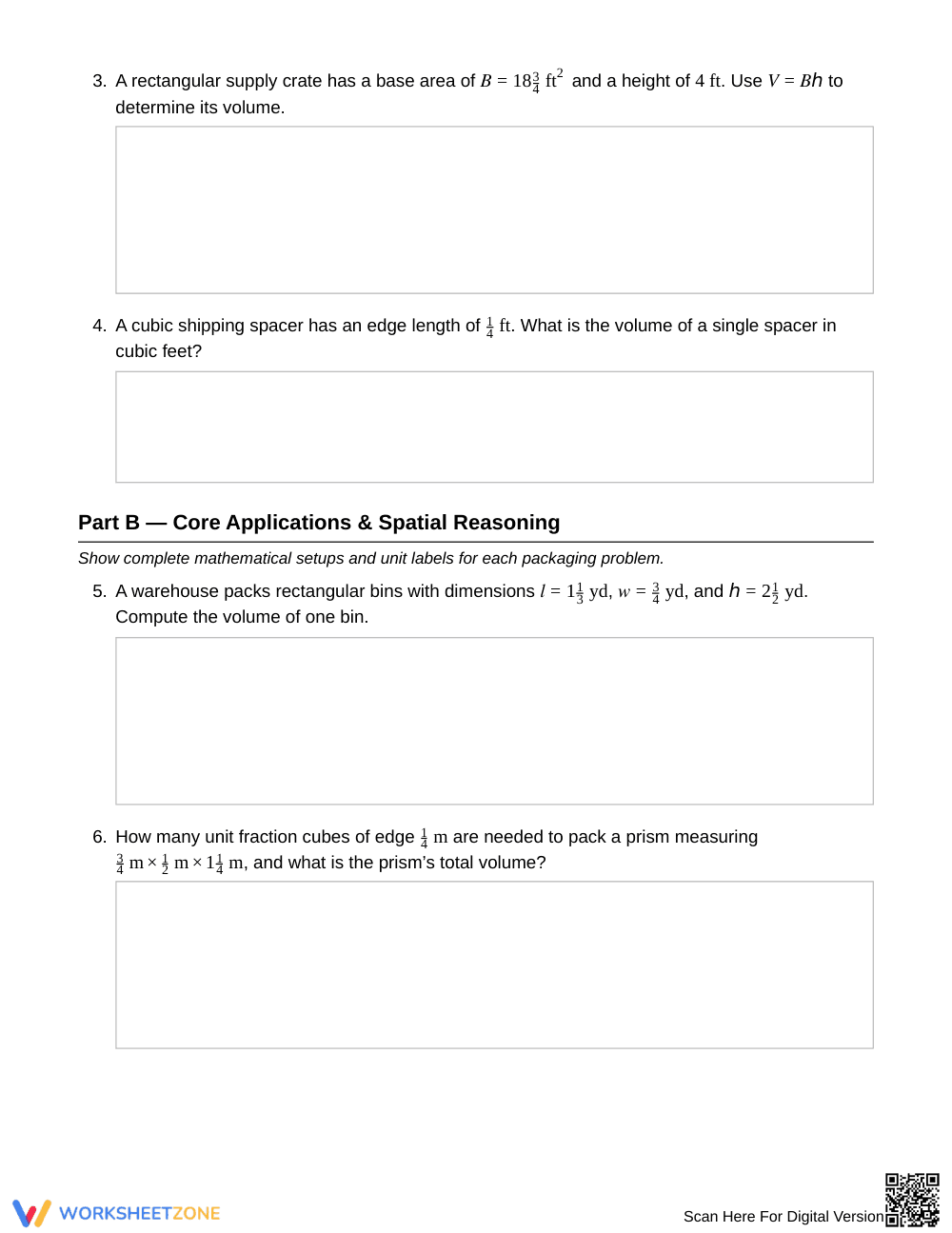
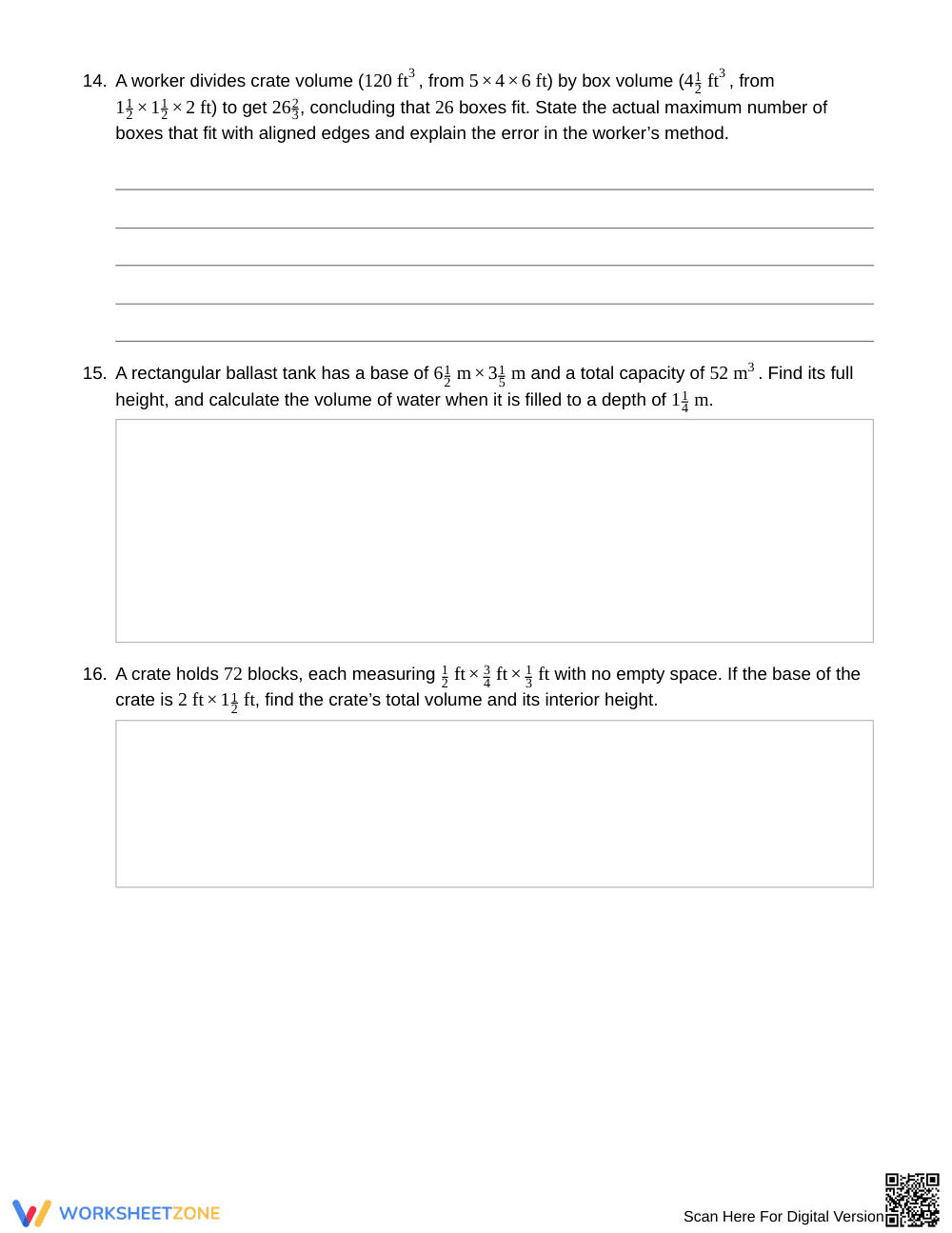
This Grade 6 math worksheet develops conceptual and computational fluency with rectangular prism volume and unit fraction packing. Students calculate fractional prism volumes, determine unit cube capacities, and evaluate real-world container packaging across 16 structured problems. The practice directly connects concrete unit cube models with formal three-dimensional volume formulas.
At a Glance
- Grade: 6 · Subject: Math
- Standard: Pack rectangular prisms with unit fraction cubes and compute fractional volumes
- Skill Focus: Rectangular prism volume and unit fraction packing
- Format: 5 pages · 16 problems · Full worked answer key included · PDF
- Best For: Guided math practice and spatial mastery
- Time: 45–60 instructional minutes
What's Inside
This 5-page printable document provides 16 multi-step math problems paired with a complete 3-page worked answer key. Students reference built-in volume formulas and packing rules before solving direct computations, spatial carton diagrams, conceptual explanations, and non-integer container packing challenges.
Skill Progression
- Guided practice (Part A, 4 problems): Scaffolded calculations where students apply volume formulas and unit cube dimensions to rectangular boxes and spacers.
- Supported practice (Part B, 8 problems): Intermediate spatial tasks involving diagrams, missing prism heights, box comparisons, and verbal explanations of fractional packing.
- Independent practice (Part C, 4 problems): Advanced multi-step problems featuring liquid ballast capacities and error analysis identifying why volume division fails in real packing.
This sequence implements a gradual-release framework, moving learners from guided calculation to independent mathematical analysis.
Standards Alignment
This worksheet aligns to the grade-level geometry expectation: `Find the volume of a right rectangular prism with fractional edge lengths by packing it with unit fraction cubes, and show that volume matches formula multiplication.` Students also apply fraction multiplication algorithms as a supporting standard. Both standard codes can be copied directly into lesson plans, IEP goals, or district curriculum mapping tools.
How to Use It
Use this worksheet after direct instruction for targeted partner practice, or as an independent mastery checkpoint. For formative assessment, check student reasoning on Part B packing tasks to ensure they evaluate edge dimensions rather than dividing raw volumes. Expected completion time is 45 to 60 minutes.
Who It's For
This activity serves Grade 6 math classrooms, advanced Grade 5 students, and Grade 7 intervention groups reinforcing volume foundations. Provide physical unit fraction cubes to support struggling learners, while challenging advanced peers with Part C error analysis. Pair this worksheet with an anchor chart illustrating unit fraction decompositions.
According to research by Fisher & Frey (2014), implementing structured gradual-release frameworks substantially enhances student competence when transitioning from concrete manipulatives to abstract mathematical algorithms. This 5-page Grade 6 volume resource operationalizes that pedagogy by systematically guiding middle school learners through rectangular prism volume calculations and unit fraction packing investigations. Rather than memorizing formulas in isolation, students evaluate how fractional unit cubes physically pack inside three-dimensional spaces, validating standard volume formulas through spatial decomposition across 16 rigorous exercises. The instructional sequence directly addresses documented middle grades spatial reasoning deficits by requiring students to justify edge-alignment constraints, calculate missing dimensions, and conduct multi-step packaging error analyses. Educators can implement these structured tasks during direct instruction, targeted intervention blocks, or collaborative problem-solving workshops to cultivate durable mathematical comprehension, ensure alignment with rigorous grade-level geometry expectations, and verify authentic spatial problem-solving mastery across diverse learning environments.


