































Complete Potential Energy Worksheet | Grades 8-12 Science

Paste this activity's link or code into your existing LMS (Google Classroom, Canvas, Teams, Schoology, Moodle, etc.).
Students can open and work on the activity right away, with no student login required.
You'll still be able to track student progress and results from your teacher account.
This science worksheet equips secondary students to read, calculate, and compare values from reaction coordinate diagrams. Learners evaluate exothermic and endothermic systems, determine activation energy and enthalpy changes, and explain catalyst mechanisms across 33 focused tasks. By moving from structured data tables to real-world applications, students master the connection between molecular energy barriers and observed reaction rates.
At a Glance
- Grade: Grades 8–12 · Subject: Science
- Standard: Science Core — Compare energy changes and activation barriers in chemical reactions using graphical models
- Skill Focus: Potential energy diagram analysis and comparison
- Format: 4 pages · 33 problems · Answer key included · PDF
- Best For: First-time chemistry instruction or unit review
- Time: 45–60 minutes
What's Inside
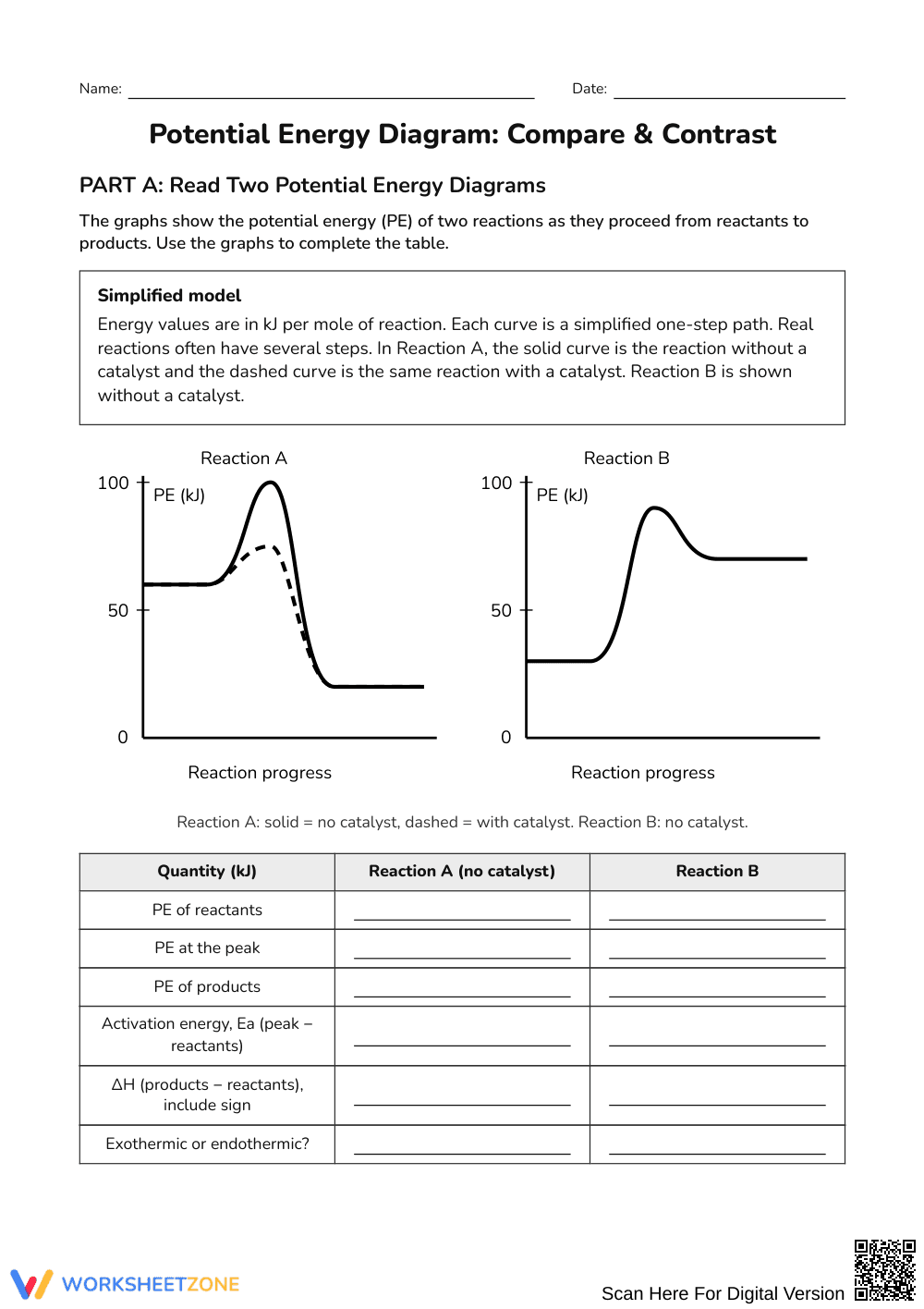
Across four student pages, this printable resource features side-by-side potential energy graphs comparing an uncatalyzed reaction, a catalyzed reaction, and an endothermic pathway. Students complete quantitative data tables, evaluate comparative statements, identify catalyzed curve shifts, and answer free-response application items involving hand warmers and cold packs. A full four-page answer key provides complete calculations and model conceptual explanations.
Skill Progression
- Guided Practice (Part A, 7 items): Students extract foundational baseline values directly from diagrams, calculating reactant potential energy, peak energy, activation energy (Ea), and reaction enthalpy (ΔH) with table prompts.
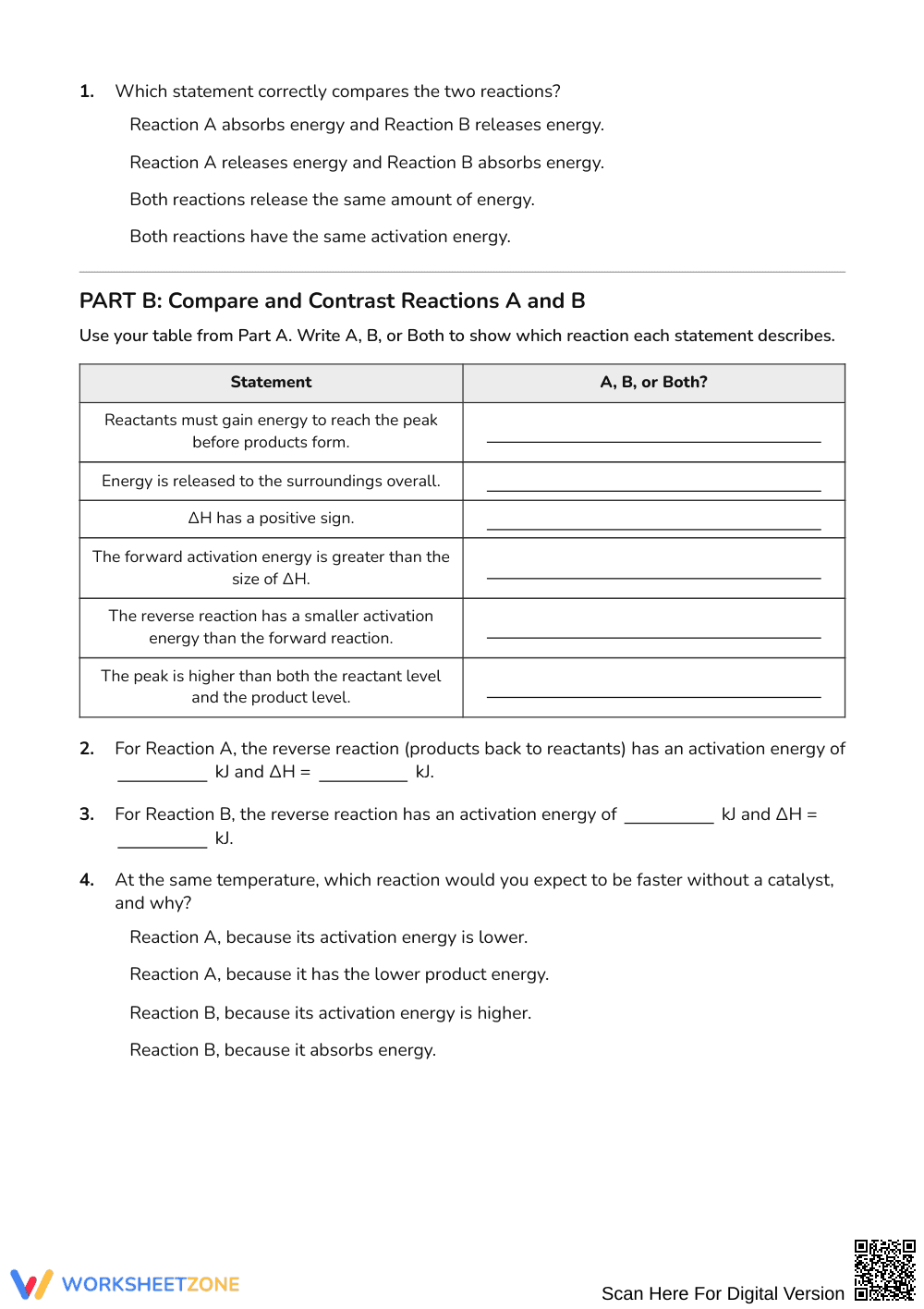
- Supported Practice (Parts B & C, 15 items): Learners evaluate comparative claims, assess reverse reaction barriers, and distinguish how catalysts lower activation energy without altering overall enthalpy.
- Independent Practice (Part D, 11 items): Students apply conceptual knowledge to multi-mole energy releases, classify consumer thermal packs, and refute common misconceptions about spontaneous reaction speeds.
This structured sequence follows the gradual release of responsibility model, guiding learners from basic diagram reading to independent chemical reasoning.
Standards Alignment
This worksheet aligns with secondary physical science standards requiring students to construct and interpret graphical displays of energy to describe the changes that occur when substances interact. Both conceptual modeling and quantitative enthalpy skills can be integrated directly into lesson plans, IEP progress tracking, and district curriculum mapping documents.
How to Use It
Introduce this resource during direct instruction on kinetics and thermochemistry, or deploy it immediately following lecture notes as guided partner work. While circulating, observe whether students calculate activation energy from the baseline or mistakenly measure it from zero. Expect 45 to 60 minutes for whole-class completion.
Who It's For
Designed for middle and high school physical science, general chemistry, and introductory AP Chemistry courses. The structured tables support developing learners, while multi-step reverse reaction prompts challenge advanced students. Pair this activity with an introductory anchor chart illustrating endothermic versus exothermic profile curves.
According to Fisher & Frey (2014), student mastery of complex scientific models accelerates when instruction combines structured schema acquisition with scaffolded evaluative tasks. Reading reaction coordinate graphs requires secondary students to negotiate multiple simultaneous variables, including baseline potential energy, transition states, and net thermodynamic yields. Research in science education indicates that learners frequently conflate thermodynamic favorability with kinetic speed, assuming that exothermic reactions proceed instantaneously without overcoming an activation barrier. This worksheet directly targets that misconception through deliberate comparative analysis of forward barriers, reverse pathways, and catalyzed pathways across 33 targeted items. By organizing graphical data into explicit comparison tables before requiring written justifications, the resource provides the cognitive scaffolding necessary for durable conceptual transfer. The resulting instructional sequence ensures students build rigorous quantitative reasoning aligned with high school physical science performance expectations.


