




























Complete Plate Tectonics Word Search | Grades 7–8 Science
Paste this activity's link or code into your existing LMS (Google Classroom, Canvas, Teams, Schoology, Moodle, etc.).
Students can open and work on the activity right away, with no student login required.
You'll still be able to track student progress and results from your teacher account.
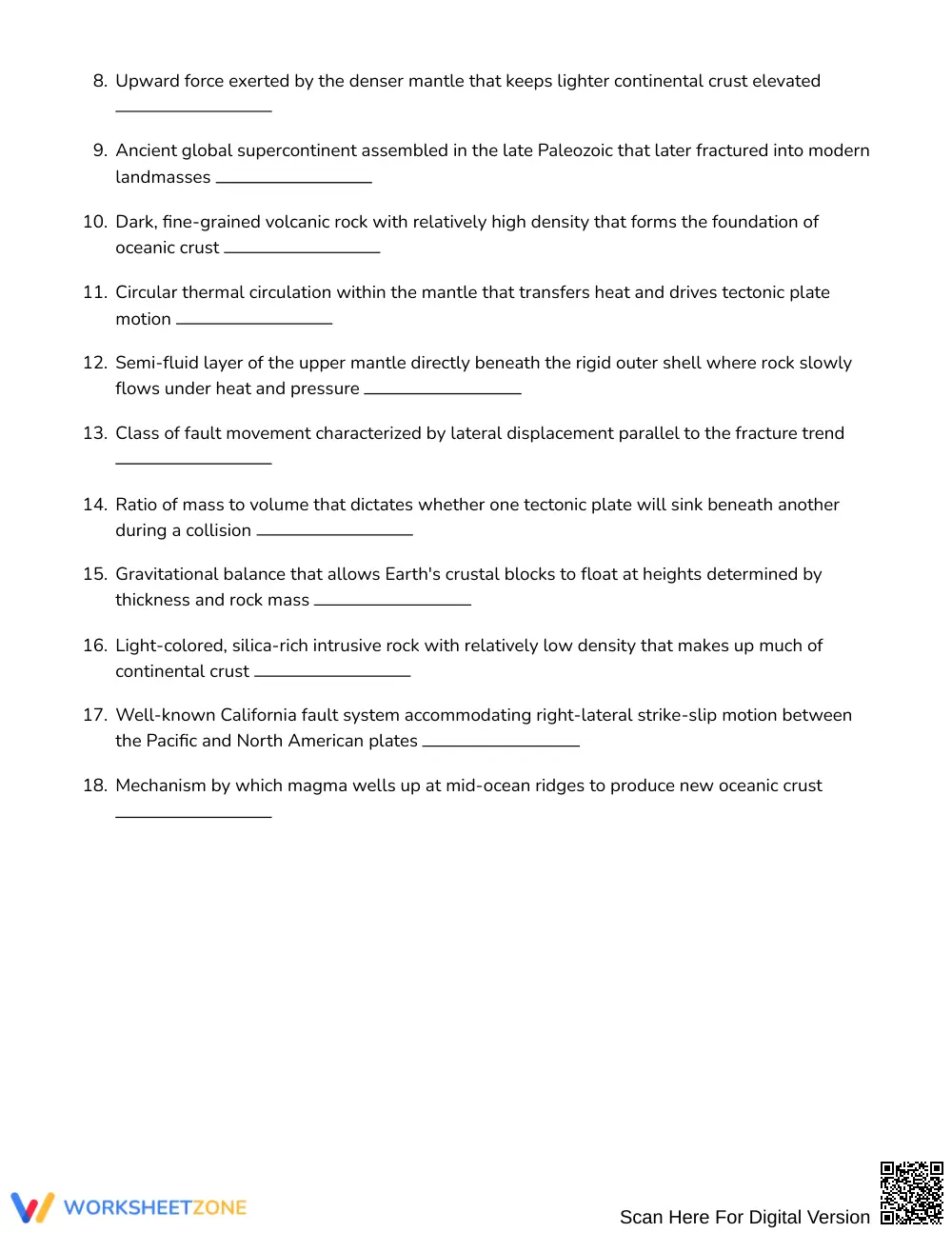
This Grade 7–8 science word search reinforces foundational earth science concepts by challenging students to identify and locate 18 core plate tectonics vocabulary terms. Working through definition-based clues, learners connect key geological processes to correct scientific terminology, solidifying structural concepts and academic vocabulary before cumulative assessments.
At a Glance
- Grade: Grades 7–8 · Subject: Science
- Standard: Not standards-assessed — vocabulary enrichment and geological concept review
- Skill Focus: Earth structures processes and evidence review
- Format: 3 pages · 18 hidden vocabulary words · Full answer key included · PDF printable
- Best For: Cumulative unit vocabulary review, fast-finisher work, and concept reinforcement
- Time: 25–35 minutes of focused student work
What's Inside
This 3-page printable science resource provides an 18-word puzzle accompanied by complete definitional clues and a shuffled word bank. Students read rigorous descriptions of plate boundaries, internal mantle mechanisms, and historical continental drift evidence before searching the grid. A thorough 4-page answer key provides clear word locations for swift evaluation.
How the Puzzle Works
The activity is built around a dense 20-by-20 letter grid designed to encourage careful visual scanning and pattern recognition. Terms are placed in all 8 possible orientations: north, northeast, east, southeast, south, southwest, west, and northwest. Students decode the clue definitions, reference the shuffled bank, and locate each hidden term.
Standards Alignment
This word search serves as a vocabulary enrichment activity and is not aligned to an assessed standard code. It targets foundational scientific literacy by reviewing critical concepts such as subduction, seafloor spreading, isostasy, and paleomagnetism, reinforcing classroom instruction through deliberate terminology recall.
How to Use It
Deploy this activity after direct instruction on plate boundaries as a mid-unit checkpoint, or assign it as a cumulative review prior to an exam. As students solve clues, circulate to note which terms—such as shear stress or isostasy—prompt hesitation, indicating areas needing reteaching. Most students will finish the puzzle within 25 to 35 minutes.
Who It's For
This resource is tailored for middle school science students in Grades 7–8 studying earth systems and dynamic crustal changes. For students needing support, pair the word bank with an illustrated plate boundary diagram or anchor chart. Advanced learners can explain how each found term connects to mantle convection currents.
Vocabulary acquisition in middle school science establishes the schema necessary for comprehending abstract geological phenomena. According to Fisher & Frey (2014), intentional exposure to disciplinary vocabulary through contextual definitions and retrieval practice directly enhances conceptual retention and reading comprehension in secondary content areas. This 3-page Grades 7–8 plate tectonics word search targets earth structures processes and evidence review without standard-specific assessment constraints, focusing on 18 foundational terms including lithosphere, subduction, asthenosphere, and seafloor spreading. By requiring learners to analyze technical clues before locating target vocabulary within a 20-by-20 grid, the task pairs semantic reasoning with visual retrieval. Because the resource prioritizes academic terminology reinforcement rather than formal testing, it provides science educators with an effective, zero-prep supplementary tool for pre-assessment review, independent practice, and structured vocabulary enrichment across diverse middle grade science classrooms.


