




























Complete Plate Boundaries Word Search | Grades 7–8 Science
Paste this activity's link or code into your existing LMS (Google Classroom, Canvas, Teams, Schoology, Moodle, etc.).
Students can open and work on the activity right away, with no student login required.
You'll still be able to track student progress and results from your teacher account.
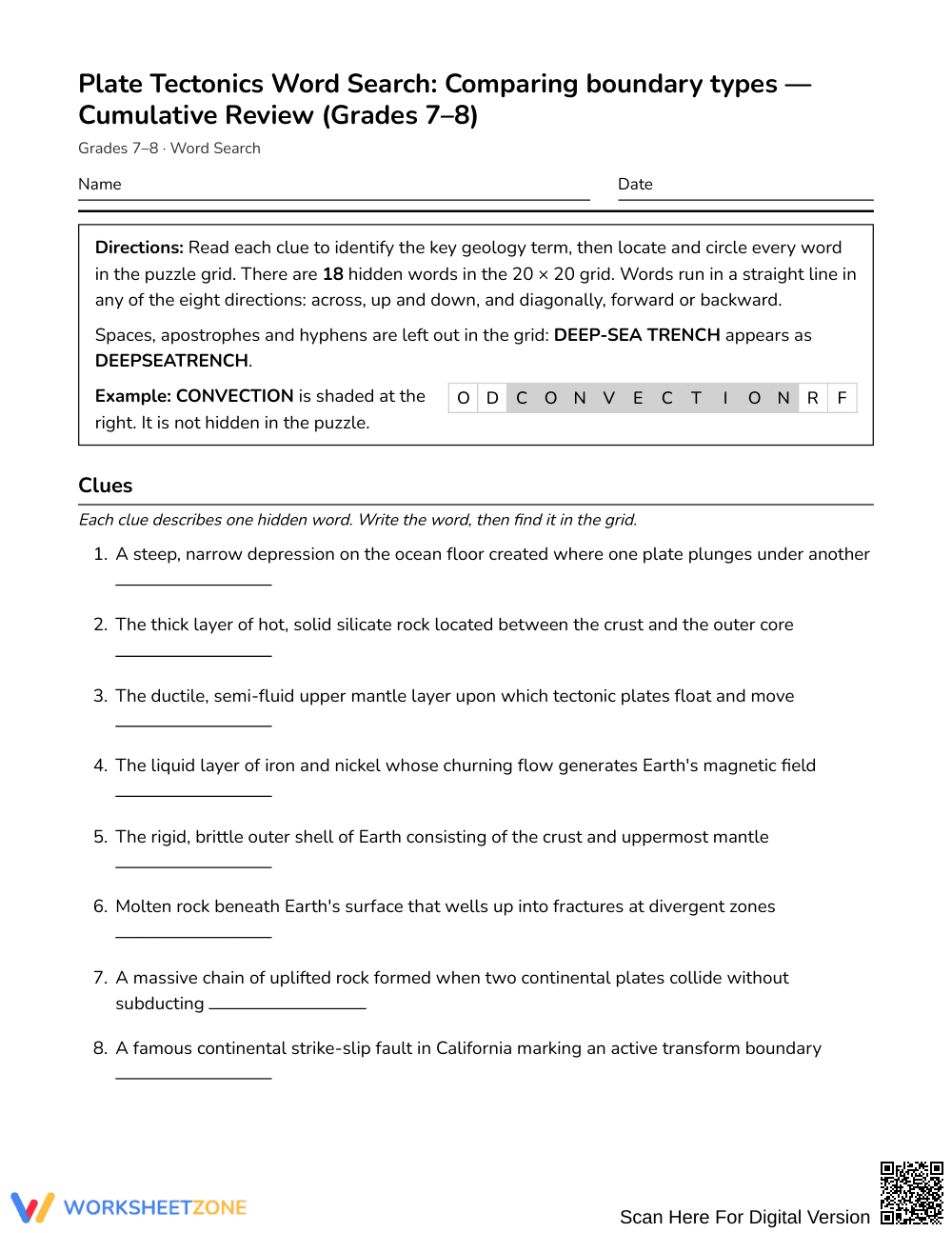
This Grades 7–8 science word search reinforces plate tectonics vocabulary through clue-based retrieval practice. Students read descriptive geological definitions to identify 18 terms spanning convergent, divergent, and transform boundaries, as well as Earth's interior layers. Matching definitions directly to target vocabulary strengthens conceptual retention and scientific literacy during geology units.
At a Glance
- Grade: Grades 7–8 · Subject: Middle School Science
- Standard: Not standards-assessed — vocabulary enrichment
- Skill Focus: Comparing tectonic plate boundary types, seafloor spreading, and interior Earth layers
- Format: 3 student pages · 18 hidden vocabulary words · Answer key included · PDF
- Best For: Vocabulary review and cumulative unit reinforcement
- Time: 20–30 minutes of independent or partner work
What's Inside
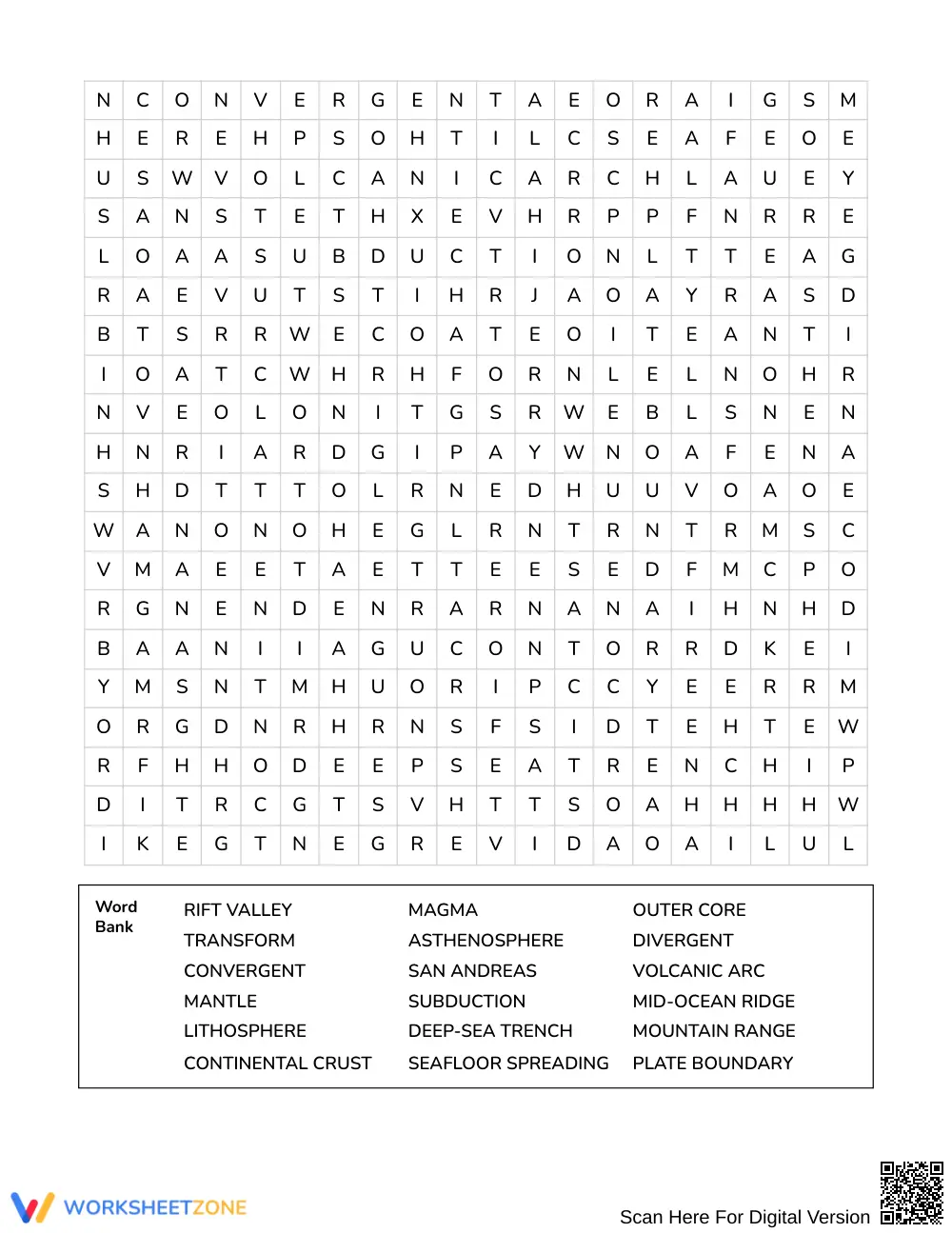
This 3-page printable resource features 18 hidden vocabulary terms in a dense puzzle grid. Rather than a basic word list, students read 18 geological clues to deduce each term before searching. A 4-page answer key provides circled solution grids that make self-checking and grading immediate and accurate.
Puzzle Mechanics and Structure
The puzzle features a 20 x 20 letter grid containing 18 hidden science terms. Students read conceptual clues describing boundary interactions and Earth layers, deduce the vocabulary word, and locate it in the puzzle. Words run in all 8 compass directions: North, Northeast, East, Southeast, South, Southwest, West, and Northwest, including diagonals and backwards placements. A shuffled word bank provides reference support without revealing clue pairings.
Standards Alignment
This resource serves as vocabulary enrichment and cumulative review rather than a standards-assessed test. It supports middle school Earth science units by building fluency with essential terms for plate boundaries, continental rifting, and planetary structure without formal standards reporting.
How to Use It
Use this word search after direct instruction on plate tectonics as an independent practice activity or review station. For formative assessment, observe whether students identify words directly from the conceptual clues or rely entirely on searching the letter grid, indicating whether definitions are mastered. Most students complete the activity within 20 to 30 minutes.
Who It's For
This activity is designed for Grades 7–8 science students studying Earth systems. To differentiate for struggling learners, pair the puzzle with a plate boundaries anchor chart illustrating fault types. Advanced learners can write sentences explaining how two discovered terms interact in crustal deformation.
Vocabulary acquisition in secondary science requires deliberate retrieval practice to transition complex terminology into working memory. This Grades 7–8 plate tectonics word search targets vocabulary enrichment across 18 essential terms, requiring students to define core geological concepts—such as subduction, seafloor spreading, deep-sea trenches, and boundary interactions—directly from descriptive clues before locating them in the puzzle grid. Research from Fisher & Frey (2014) highlights that structured domain-specific vocabulary activities provide essential cognitive anchors that facilitate complex conceptual learning in disciplinary literacy. By combining clue deciphering with systematic visual search patterns across eight directional orientations, the puzzle supports active retrieval rather than passive letter recognition. Educators can deploy this 3-page printable science resource as a high-engagement formative review tool, reinforcing Earth science terminology and strengthening the foundational knowledge base necessary for advanced geologic analysis.


