
































Complete Pangaea Evidence Worksheet | Grade 8 Science

Paste this activity's link or code into your existing LMS (Google Classroom, Canvas, Teams, Schoology, Moodle, etc.).
Students can open and work on the activity right away, with no student login required.
You'll still be able to track student progress and results from your teacher account.
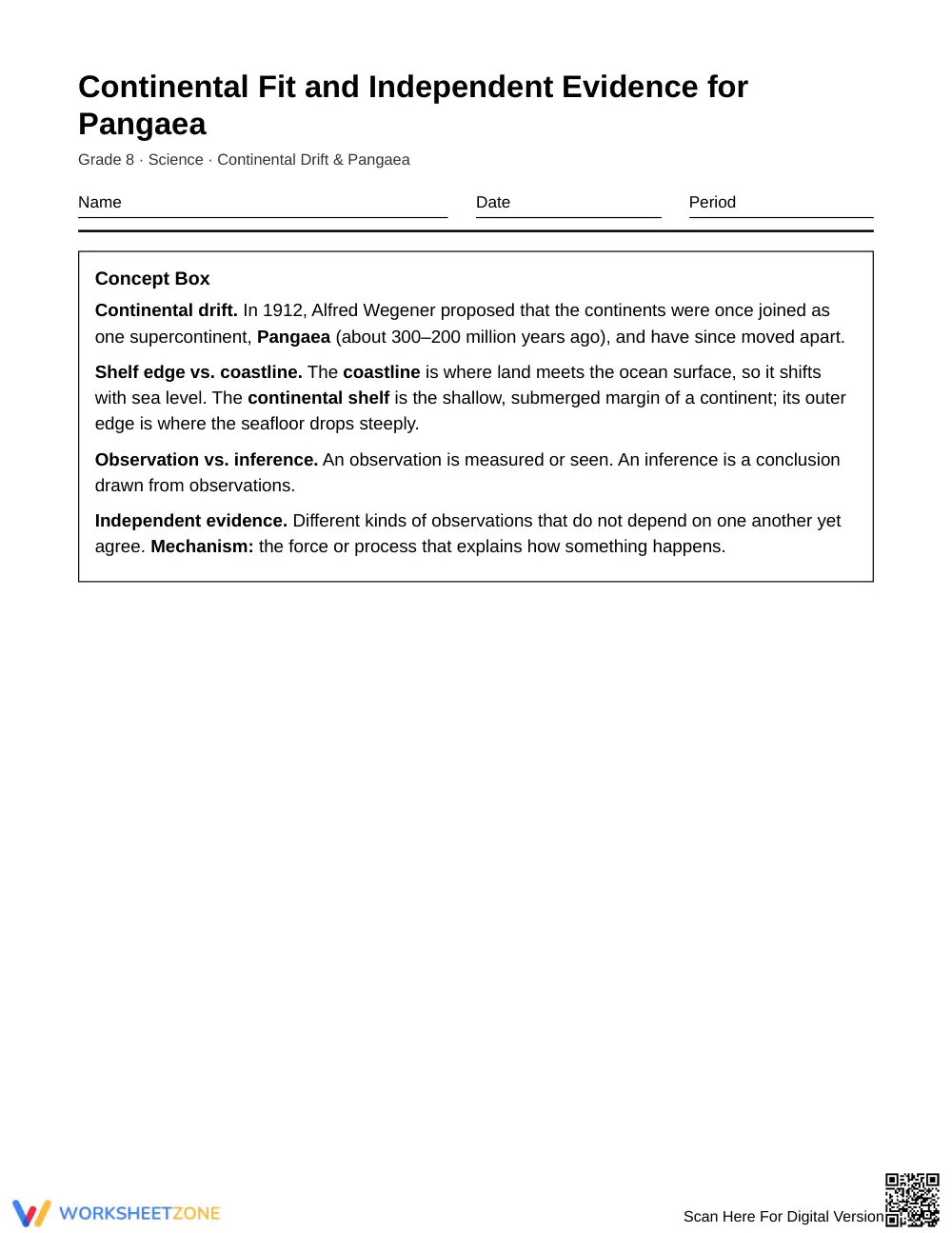
This worksheet helps Grade 8 students judge how well the continents fit together and why independent lines of evidence make the case for Pangaea stronger. Students separate observations from inferences, analyze fossil, rock, and fit data, and make justified predictions.
At a Glance
- Grade: 8 · Subject: Science
- Standard: Earth science evidence — use fossil, rock, and fit data to support continental drift
- Skill Focus: Continental fit and independent evidence
- Format: 5 pages · 12 problems · Answer key included · PDF
- Best For: Evidence-based reasoning in plate tectonics units
- Time: 40–50 minutes
What's Inside
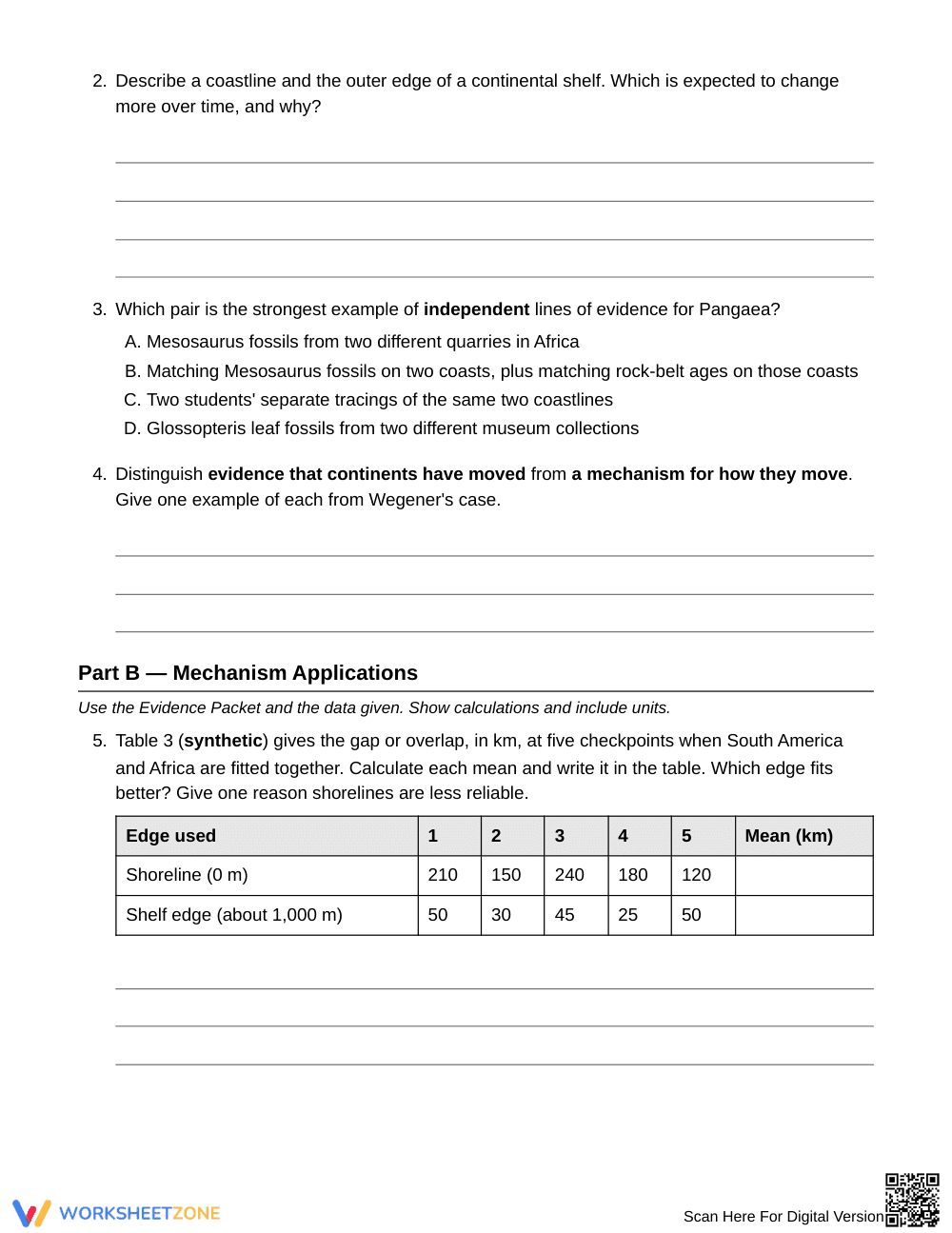
Students start with a Concept Box that defines continental drift, shelf edge versus coastline, observation versus inference, and independent evidence. An Evidence Packet follows, with a fossil table and a rock-belt table. The 12 tasks mix multiple choice, short explanations, mean calculations, rate-and-time math, and predictions. The 5-page PDF includes an answer key.
Skill Progression
- Guided practice: Part A has 4 concept tasks. The Concept Box and answer choices support students as they separate observation from inference and evidence from mechanism.
- Supported practice: Part B has 6 data tasks. Students use the Evidence Packet to compute means, compare age ranges, and calculate separation time, showing units.
- Independent practice: Part C has 2 prediction tasks. Students state a prediction, justify it, and name a result that would count against it.
The sequence follows gradual release: I Do, We Do, You Do.
Standards Alignment
No standard code was supplied for this worksheet, so none is listed. The content targets a core middle school Earth science skill: supporting a claim about past continental positions with several kinds of evidence, including fossils, rock type and age, continental shelf fit, and GPS measurements. Teachers can add their own state or district standard code in lesson plans, IEP goals, or curriculum mapping tools.
How to Use It
- After direct instruction: Assign it as classwork once students have met Wegener's proposal and the Pangaea timeline.
- As a formative check: Use it as homework or an exit assessment at the end of the unit.
While students work, watch Part B closely. Note whether they cite specific table values or fall back on general claims. Expect 40–50 minutes of completion time.
Who It's For
This worksheet suits Grade 8 Science students studying continental drift and plate tectonics. Students who need more support can work Part A with the Concept Box open and complete Part B in pairs. Pair it with a Pangaea map or an anchor chart on observation versus inference.
Continental Fit and Independent Evidence for Pangaea is a Grade 8 Science worksheet that teaches students to support the claim of continental drift with multiple, separate lines of evidence. Across 12 tasks on 5 pages, students distinguish observations from inferences, compare shoreline and shelf-edge fit using mean gap data, interpret matching Mesosaurus and Glossopteris fossils, compare rock ages with uncertainty, calculate separation time from a constant rate, and make justified predictions that name disconfirming results. The structure follows the gradual release model described by Fisher & Frey (2014), moving from guided concept checks to supported data analysis and then independent prediction. An answer key is included. The worksheet suits Grade 8 units on continental drift, plate tectonics, and scientific argumentation, and works as classwork, homework, or formative assessment in science classrooms.


