


























Views
Downloads


Complete Organizing Reasons Worksheet | Grade 6 ELA
Paste this activity's link or code into your existing LMS (Google Classroom, Canvas, Teams, Schoology, Moodle, etc.).
Students can open and work on the activity right away, with no student login required.
You'll still be able to track student progress and results from your teacher account.
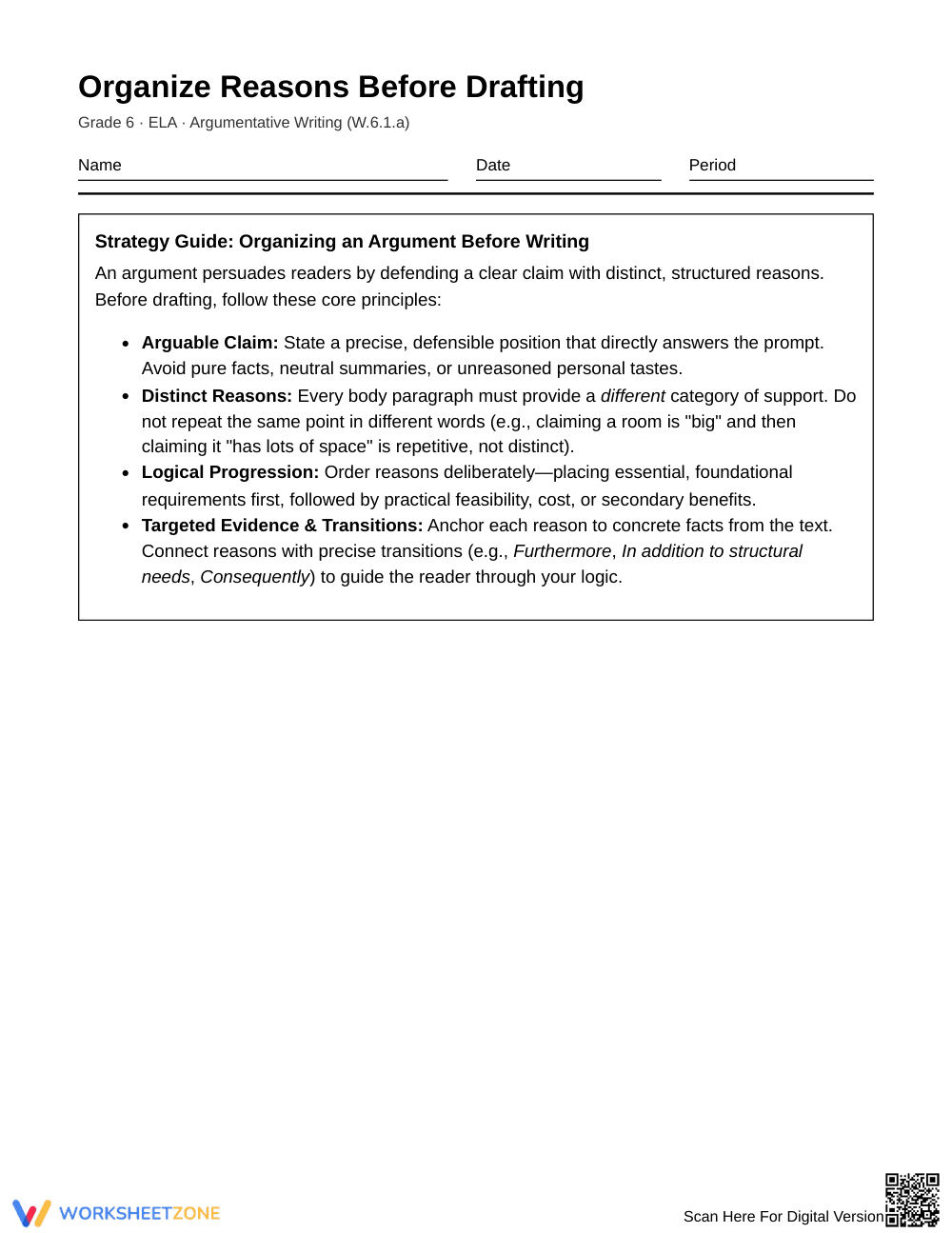
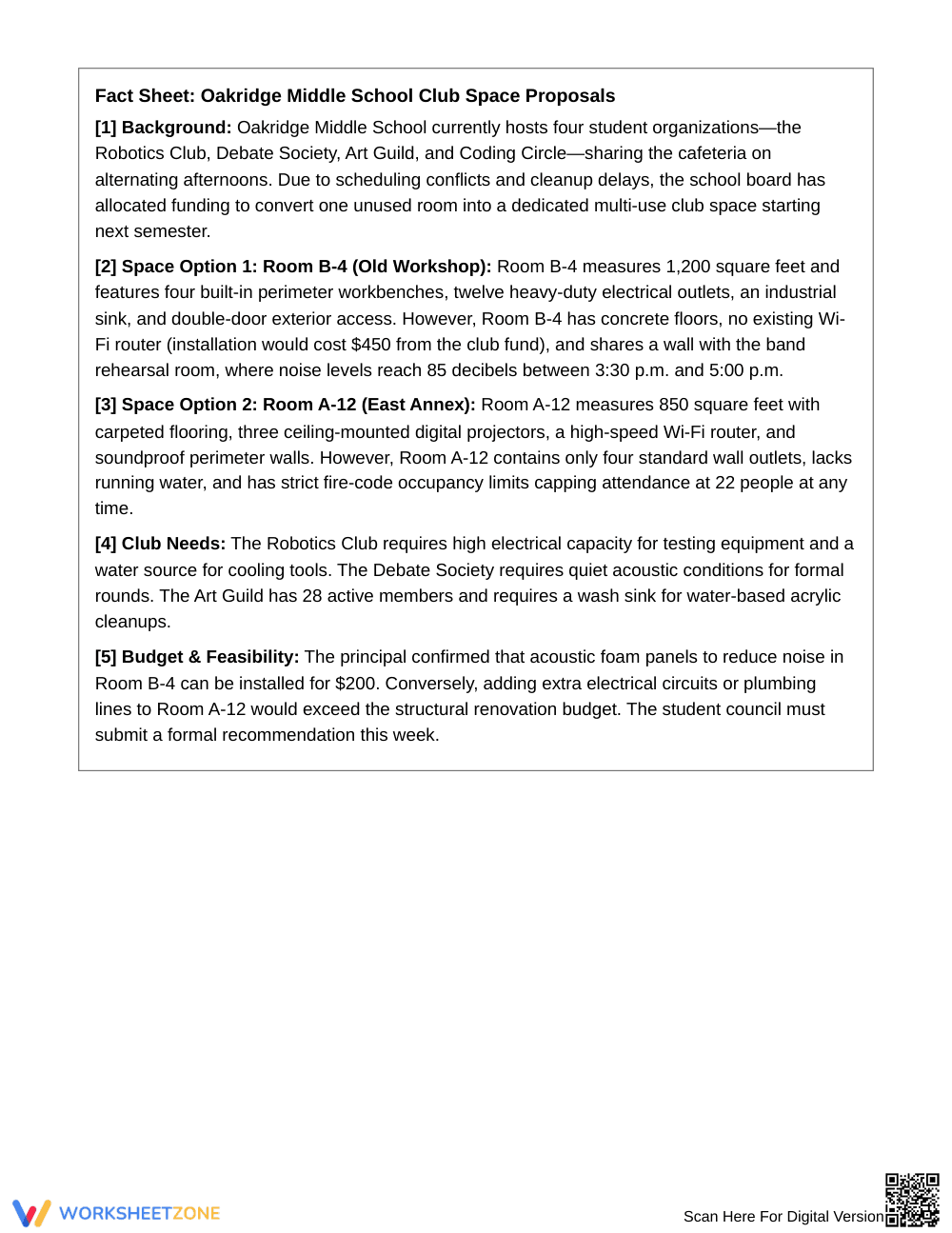
This Grade 6 argumentative writing worksheet guides middle school students to establish defensible claims, categorize nonrepetitive supporting reasons, and sequence logical evidence before drafting. By analyzing a realistic club space proposal scenario, learners build structured prewriting habits that eliminate redundancy and ensure coherent paragraph development across multi-paragraph essays.
At a Glance
- Grade: 6 · Subject: ELA
- Standard:
W.6.1.a— Introduce clear claims and organize reasons and evidence logically- Skill Focus: Organize reasons before drafting
- Format: 5 pages · 8 problems · Answer key included · PDF
- Best For: Argument writing prewriting and drafting practice
- Time: 45–60 minutes
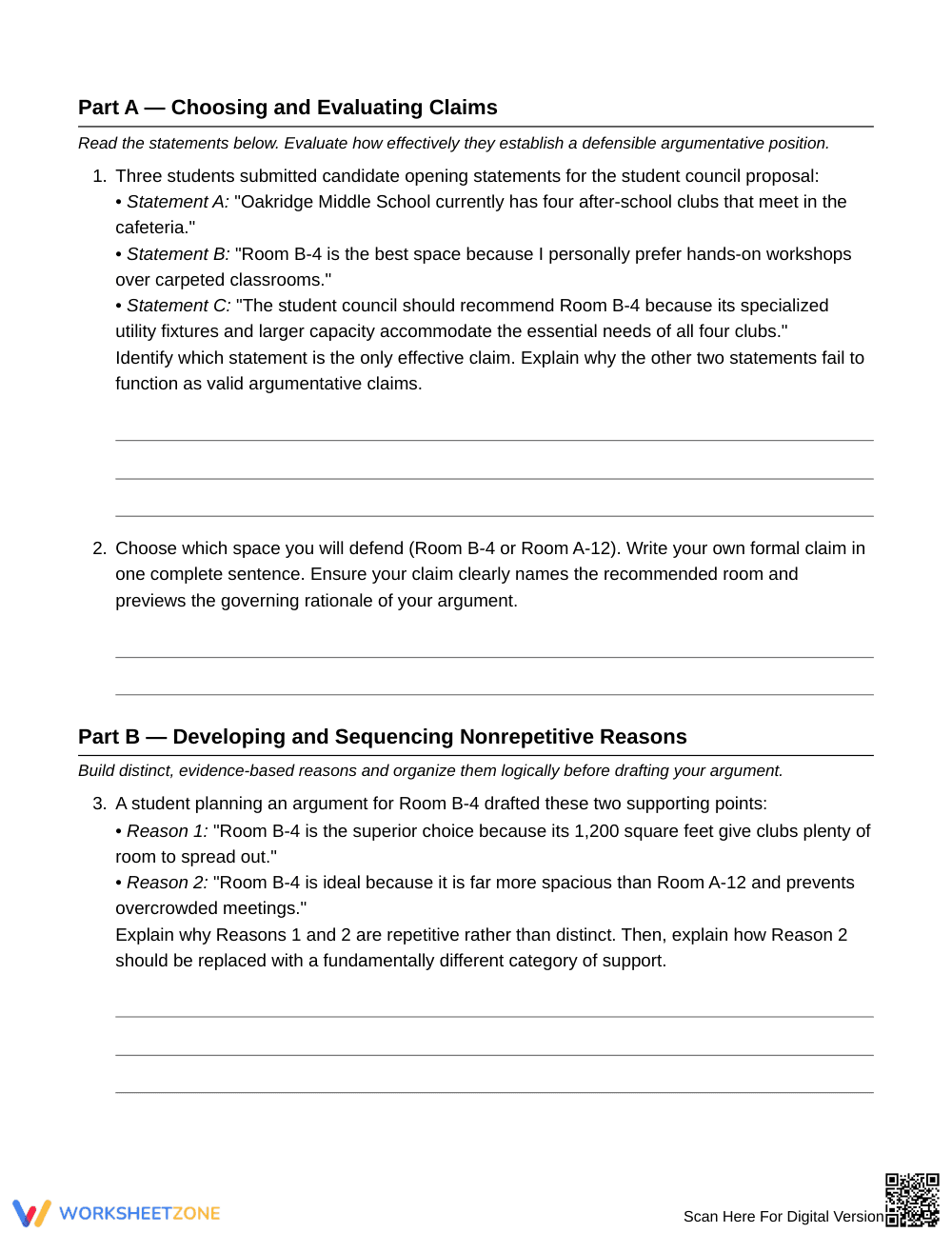
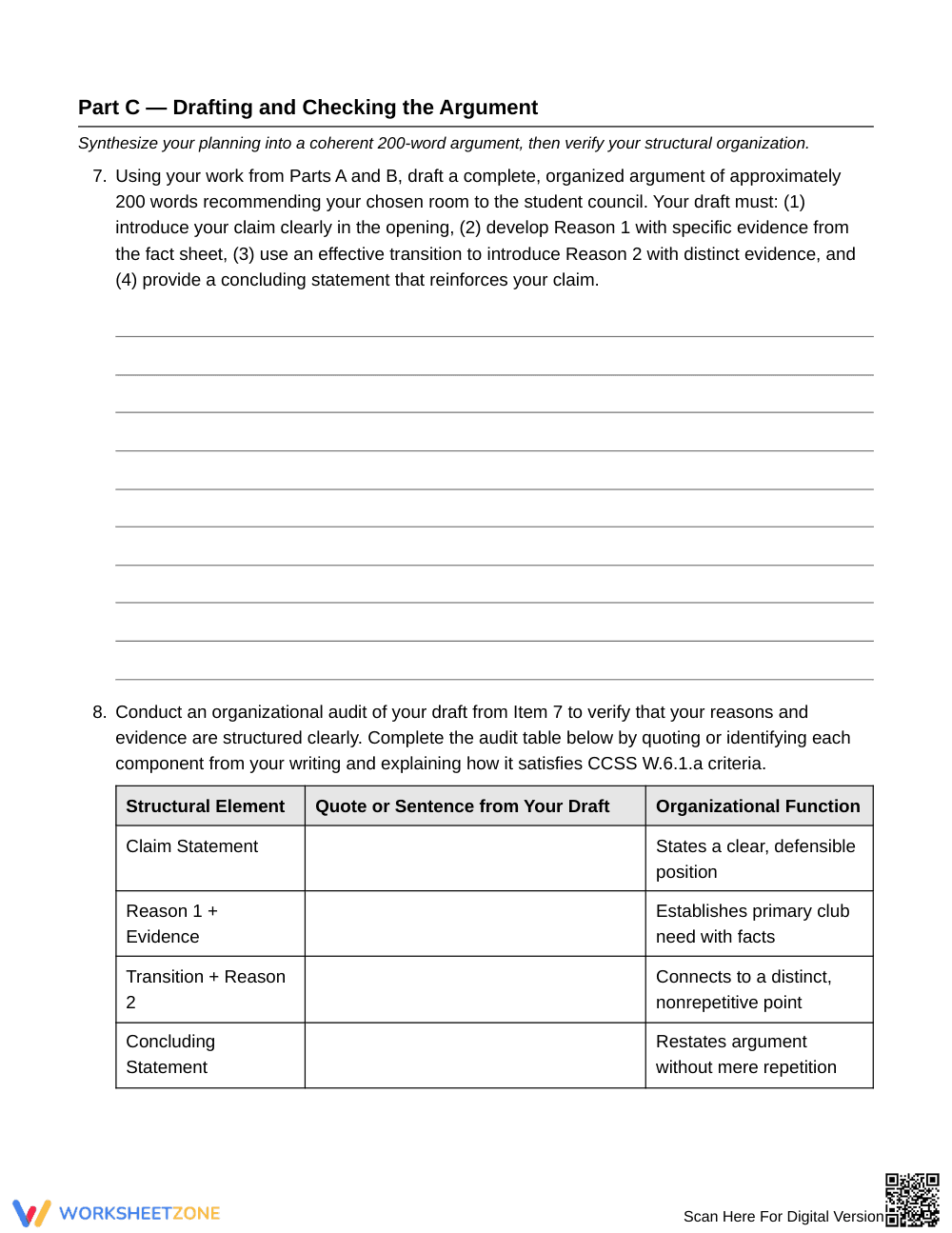
Students work through an informational strategy guide and a detailed factual scenario describing school club room proposals. Across 5 pages, the resource delivers 8 multi-step tasks including claim evaluation, reason differentiation exercises, transition generation, evidence integration, a 200-word drafting prompt, and an organizational self-audit table accompanied by a full 5-page answer key.
Skill Progression
- Guided practice (Items 1–2): Students analyze candidate claim statements to distinguish valid argumentative positions from simple facts and personal preferences, then formulate an initial defensible claim.
- Supported practice (Items 3–6): Learners diagnose repetitive reasons, craft two distinct categories of support, sequence them logically with transitional phrasing, and attach specific textual evidence.
- Independent practice (Items 7–8): Students draft a complete 200-word persuasive recommendation and execute an organizational audit table verifying their structural logic against standard criteria.
This scaffolded progression follows an explicit gradual-release model, transitioning students from analytical critique to independent composition.
Standards Alignment
This worksheet directly targets W.6.1.a: "Introduce claim(s) and organize the reasons and evidence clearly." It also supports W.6.1.c by requiring appropriate transitions to clarify relationships between distinct reasons. Both standard codes can be copied directly into lesson plans, IEP goals, or district curriculum mapping tools.
How to Use It
Deploy this activity during the prewriting phase of an argument unit immediately following direct instruction on claim structure. Alternatively, assign it as targeted small-group intervention for students struggling with repetitive body paragraphs. While monitoring, check whether students create separate conceptual categories for Reason 1 and Reason 2 rather than rewording the same point. Students typically finish within 45 to 60 minutes.
Who It's For
Designed for general education Grade 6 ELA classrooms, this worksheet also benefits English language learners and striving writers requiring concrete planning frameworks. Pair this resource with an anchor chart on argumentative transition words or a mini-lesson on distinguishing empirical evidence from subjective opinion.
According to Fisher & Frey (2014), explicit instruction in structural organization and scaffolded prewriting frameworks significantly enhances adolescent writing quality by reducing cognitive load during initial drafting phases. When students practice isolating distinct categories of supporting points and deliberate transitions prior to essay generation, they internalize the core competencies established in W.6.1.a, which requires sixth-grade writers to introduce clear claims and organize reasons logically. Research on secondary writing pedagogy confirms that guided analytical audits—such as the structured reflection table included in this 5-page resource—reinforce metacognitive monitoring and prevent common structural errors like circular reasoning or unsupported generalizations. By grounding argumentative practice in evidence-rich scenarios, teachers equip middle school learners with transferable organizational strategies that measurably improve writing coherence and standards mastery across all informational genres.


