

































Complete Orbital Periods Worksheet | Grade 12 Earth Science

Paste this activity's link or code into your existing LMS (Google Classroom, Canvas, Teams, Schoology, Moodle, etc.).
Students can open and work on the activity right away, with no student login required.
You'll still be able to track student progress and results from your teacher account.
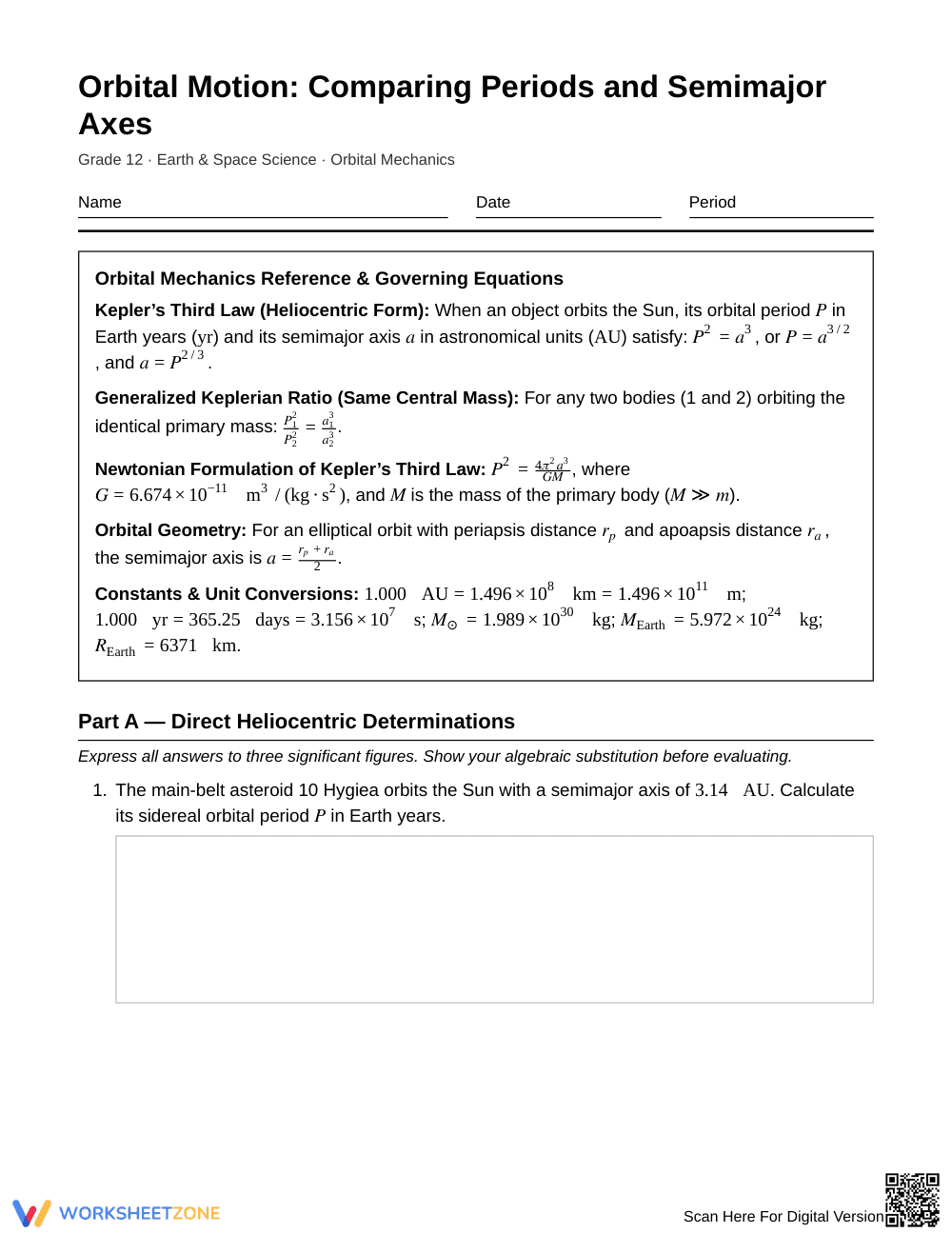
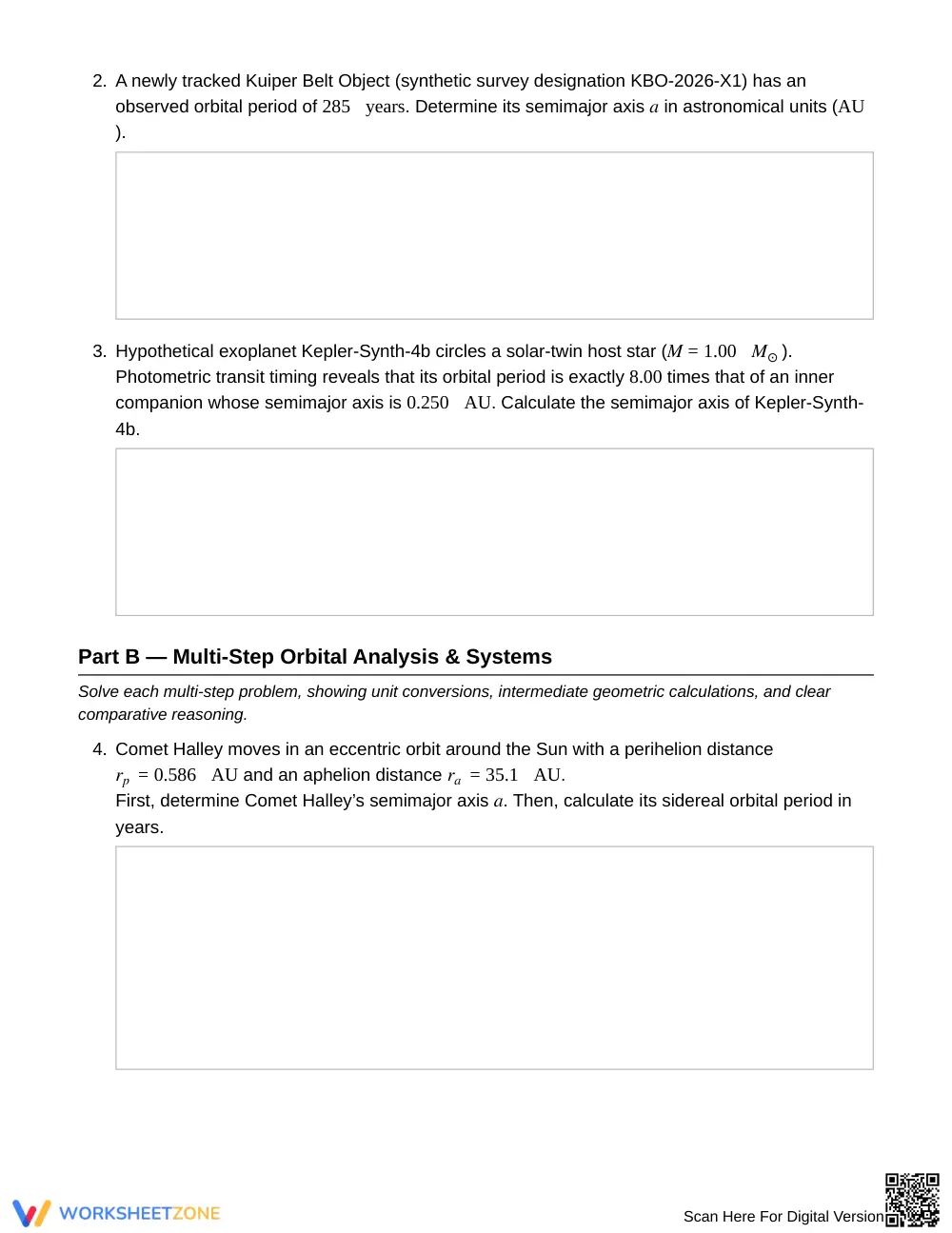
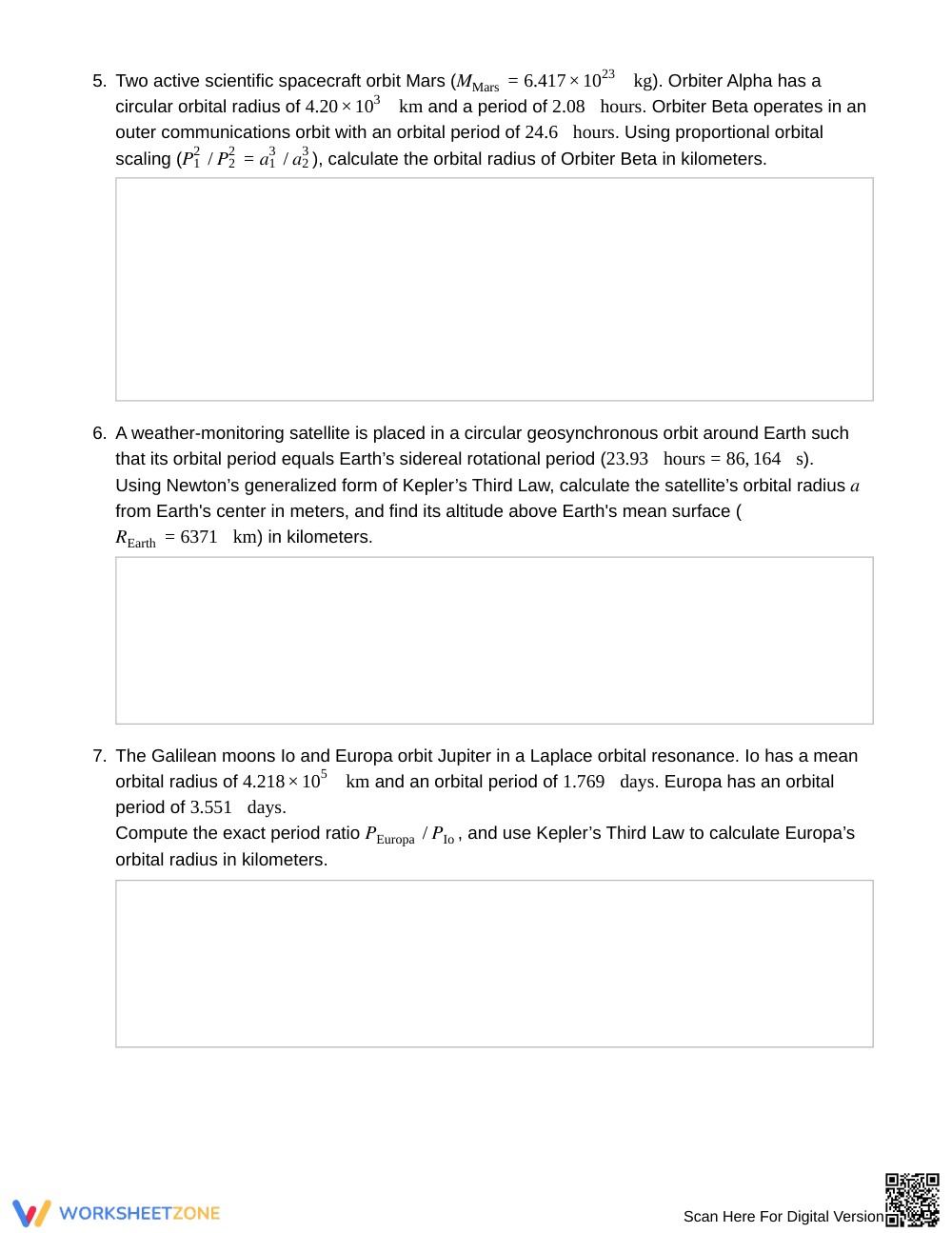
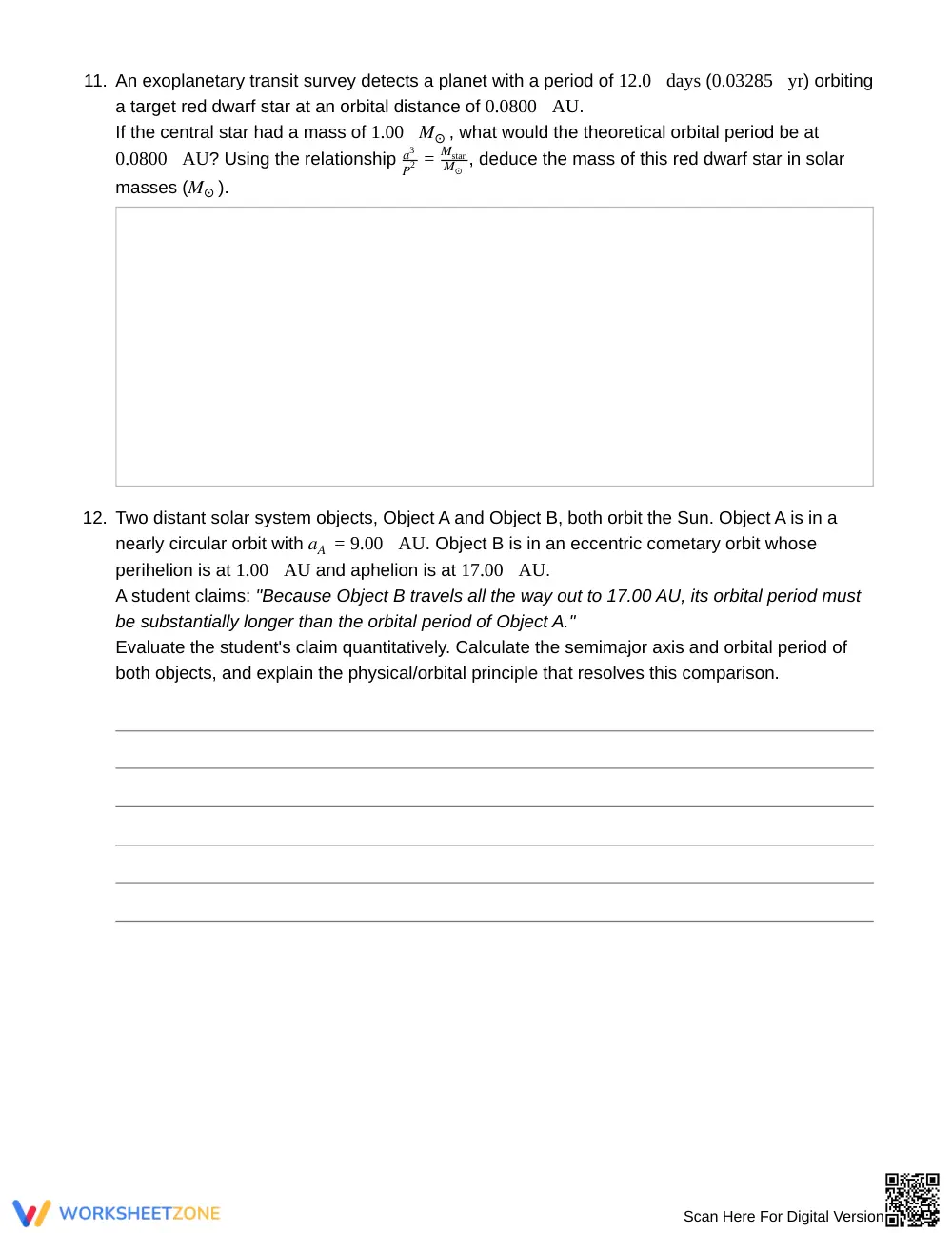
This Grade 12 Earth and Space Science worksheet strengthens quantitative reasoning by guiding students to calculate, analyze, and compare orbital periods and semimajor axes using Kepler's Third Law and Newtonian mechanics. Students solve 12 multi-step orbital mechanics problems spanning asteroids, planetary moons, artificial satellites, Hohmann transfer orbits, and exoplanetary systems.
At a Glance
- Grade: 12 · Subject: Earth & Space Science
- Standard: Mathematical representations of orbital motion and Kepler's laws
- Skill Focus: Compare orbital periods and semimajor axes
- Format: 6 pages · 12 problems · Answer key included · PDF
- Best For: Advanced physics and space science practice
- Time: 45–60 minutes
The 6-page printable resource includes a comprehensive governing equations reference sheet, 12 rigorous calculation and analysis items, and a complete 4-page answer key with worked solutions. Students work with realistic astronomical data, Keplerian ratios, Newton's universal gravitation formula, orbital eccentricity geometry, and exoplanet transit tables across three structured sections.
Skill Progression
- Guided practice (Part A, Problems 1–3): Students execute direct algebraic substitutions using the heliocentric form P^2=a^3 for asteroids, Kuiper Belt objects, and companion exoplanets with reference formulas provided.
- Supported practice (Part B, Problems 4–9): Learners tackle multi-step orbital systems, calculating Mars orbiter radii, geosynchronous satellite altitudes, Laplace orbital resonances, Hohmann transfer orbit transit times, and near-Earth asteroid perihelia.
- Independent practice (Part C, Problems 10–12): Students conduct exoplanetary transit data synthesis to detect anomalous survey observations, determine stellar masses, and evaluate conceptual claims regarding orbital eccentricity versus period.
This sequence follows a gradual-release instructional model that transitions students from formula execution to complex astronomical synthesis.
Standards Alignment
This resource reinforces orbital mechanics standards requiring students to use mathematical representations of Kepler's laws to predict the motion of orbiting objects in solar and extrasolar systems. Teachers can integrate these quantitative problem sets directly into high school Earth and space science or physics curriculum mapping tools.
How to Use It
Deploy this worksheet after direct instruction on Kepler's laws and orbital geometry. It serves effectively as a core guided practice assignment during an astrophysics unit or as an intensive collaborative problem-solving workshop. As a formative assessment tip, check student work in Part B for proper unit conversions between astronomical units, meters, days, and seconds. Expect completion in 45 to 60 minutes.
Who It's For
Designed for Grade 12 Earth and Space Science, Astronomy, or AP Physics students mastering celestial mechanics. For differentiated support, pair struggling learners with the provided governing equations reference box, while advanced students can derive stellar masses in Part C. Natural companion resources include orbital mechanics simulations and planetary transit light-curve diagrams.
According to research synthesized by Fisher & Frey (2014) on the gradual release of responsibility, structured problem sequences that transition from explicit computational scaffolding to complex evaluation accelerate high school STEM mastery. This Grade 12 Earth and space science worksheet operationalizes that framework across 12 analytical tasks focused on comparing orbital periods and distances. Students apply Keplerian scaling laws, Newtonian gravitation, and geometric orbital parameters to authentic astronomical bodies and exoplanetary survey data. The progression systematically builds from direct algebraic substitutions in Part A to multi-step transfer orbit calculations in Part B and empirical anomaly detection in Part C. By requiring students to calculate significant figures, reconcile orbital eccentricities, and critique quantitative claims, the resource ensures rigorous alignment with secondary orbital mechanics benchmarks while providing teachers with reliable diagnostic evidence of student analytical proficiency.


