




























Views
Downloads




Complete Orbital Motion Claims Worksheet | Grade 12 Science

Paste this activity's link or code into your existing LMS (Google Classroom, Canvas, Teams, Schoology, Moodle, etc.).
Students can open and work on the activity right away, with no student login required.
You'll still be able to track student progress and results from your teacher account.
Differentiating between areal velocity and linear path speed is fundamental to orbital mechanics. This 5-page Earth and space science worksheet equips Grade 12 students to evaluate and correct eight common Keplerian misconceptions. Students analyze eccentricity, interpret reference data, and write scientific explanations distinguishing equal-time sector sweeps from equal-distance paths.
At a Glance
- Grade: 12 · Subject: Earth & Space Science
- Standard: Keplerian Dynamics — Analyze orbital velocities and apply Kepler's laws to correct motion claims
- Skill Focus: Correct Equal-Time Equal-Distance Claims
- Format: 5 pages · 8 problems · Answer key included · PDF
- Best For: Orbital mechanics error analysis practice
- Time: 45–60 minutes
What's Inside
This 5-page resource features eight diagnostic analysis tasks supported by a 3-page answer key. It includes a reference summary of Kepler's three laws, a data table with solar system and synthetic orbit parameters, and a modeled error repair demonstrating how to diagnose and correct flawed claims.
Skill Progression
- Guided practice (Task 1): Students use the modeled repair to analyze Mars quadrant transit times, identifying how eccentricity invalidates equal-time claims.
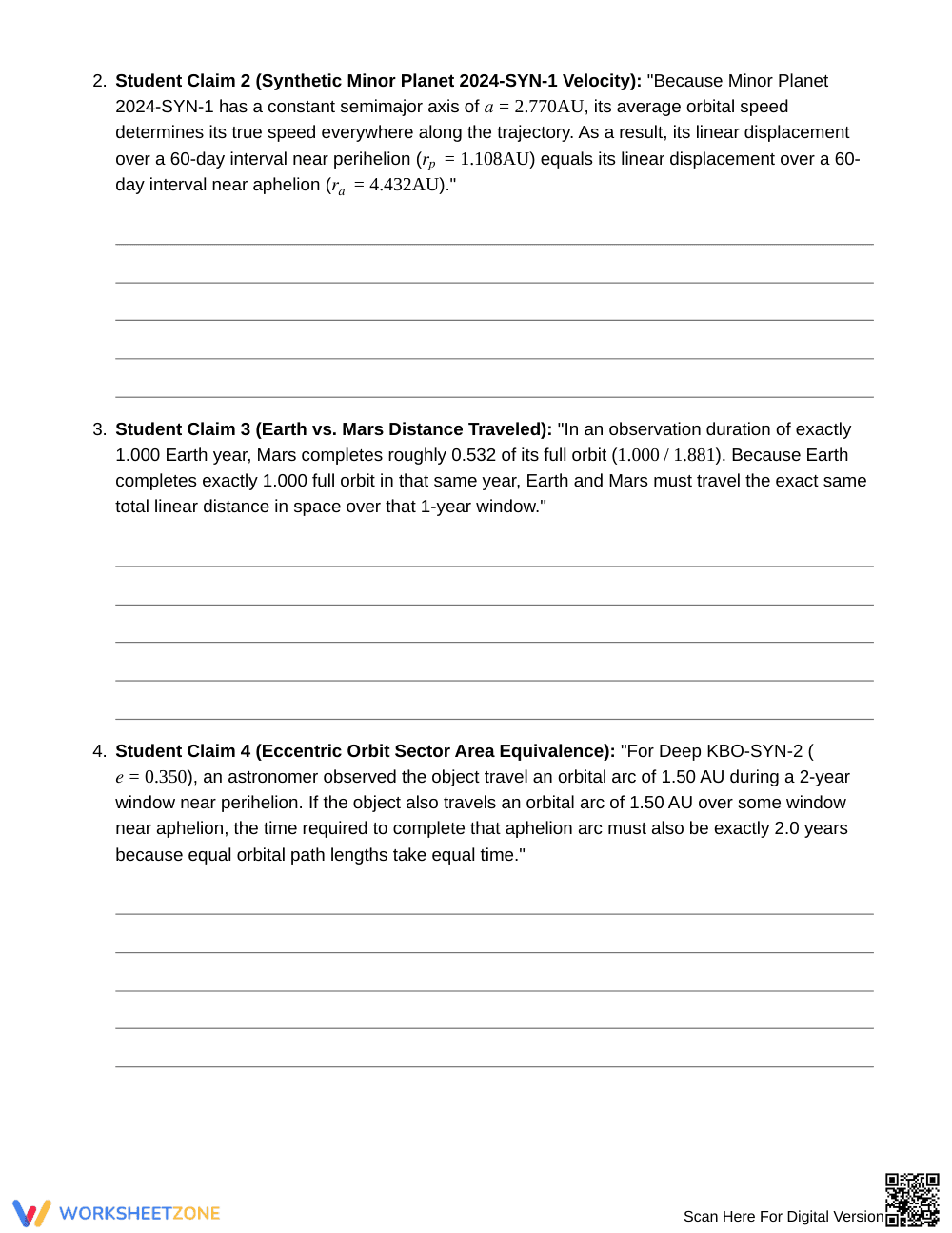
- Supported practice (Tasks 2–5): Students evaluate statements on displacement, 1-year transit distances, aphelion sector timing, and geometric center sweeps using reference orbit data.
- Independent practice (Tasks 6–8): Students independently refute claims regarding true anomaly angles, eccentricity variations under Kepler's Third Law, and transit duration symmetry.
This progression applies gradual release to build independent conceptual mastery.
Standards Alignment
This worksheet aligns with high school Earth and Space Science standards for orbital motion, gravitation, and Kepler's laws. Students use mathematical representations to show how gravitational forces govern planetary speeds. Both standard codes can be copied directly into lesson plans, IEP goals, or district curriculum mapping tools.
How to Use It
Use this worksheet after direct instruction on Keplerian orbits. Have student pairs analyze Tasks 1–4 collaboratively before whole-group discussion. Then assign Tasks 5–8 as an individual formative assessment. Watch for students confusing swept sector area with perimeter arc length. Anticipate 45–60 minutes for completion.
Who It's For
Designed for Grade 12 Earth and Space Science and physics students studying orbital mechanics. For differentiated support, provide an orbit diagram contrasting perihelion and aphelion areas. Advanced learners can compute exact apsis velocities from orbital parameters.
According to Fisher & Frey (2014), intentional error analysis accelerates conceptual mastery by prompting students to explain why intuitive assumptions fail alongside what is scientifically accurate. High school astronomy students frequently hold the persistent misconception that equal time intervals require identical orbital travel distances, confusing Kepler's equal areal velocity with uniform linear speed. By pairing observational data tables—featuring Earth, Mars, Comet 1P/Halley, and high-eccentricity synthetic survey targets—with structured diagnosis tasks, this worksheet connects conceptual logic with quantitative orbital dynamics. Students engage in rigorous scientific argumentation, deconstructing eight flawed claims and drafting evidence-based revisions that demonstrate how orbital eccentricity governs planetary speeds between perihelion and aphelion. The comprehensive three-page teacher answer key provides verbatim diagnosis and correction models, making this an effective, research-aligned resource for advancing secondary space science literacy and critical thinking.


