




























Complete Ocean Zones Word Search | Grades 6–7 Science
Paste this activity's link or code into your existing LMS (Google Classroom, Canvas, Teams, Schoology, Moodle, etc.).
Students can open and work on the activity right away, with no student login required.
You'll still be able to track student progress and results from your teacher account.
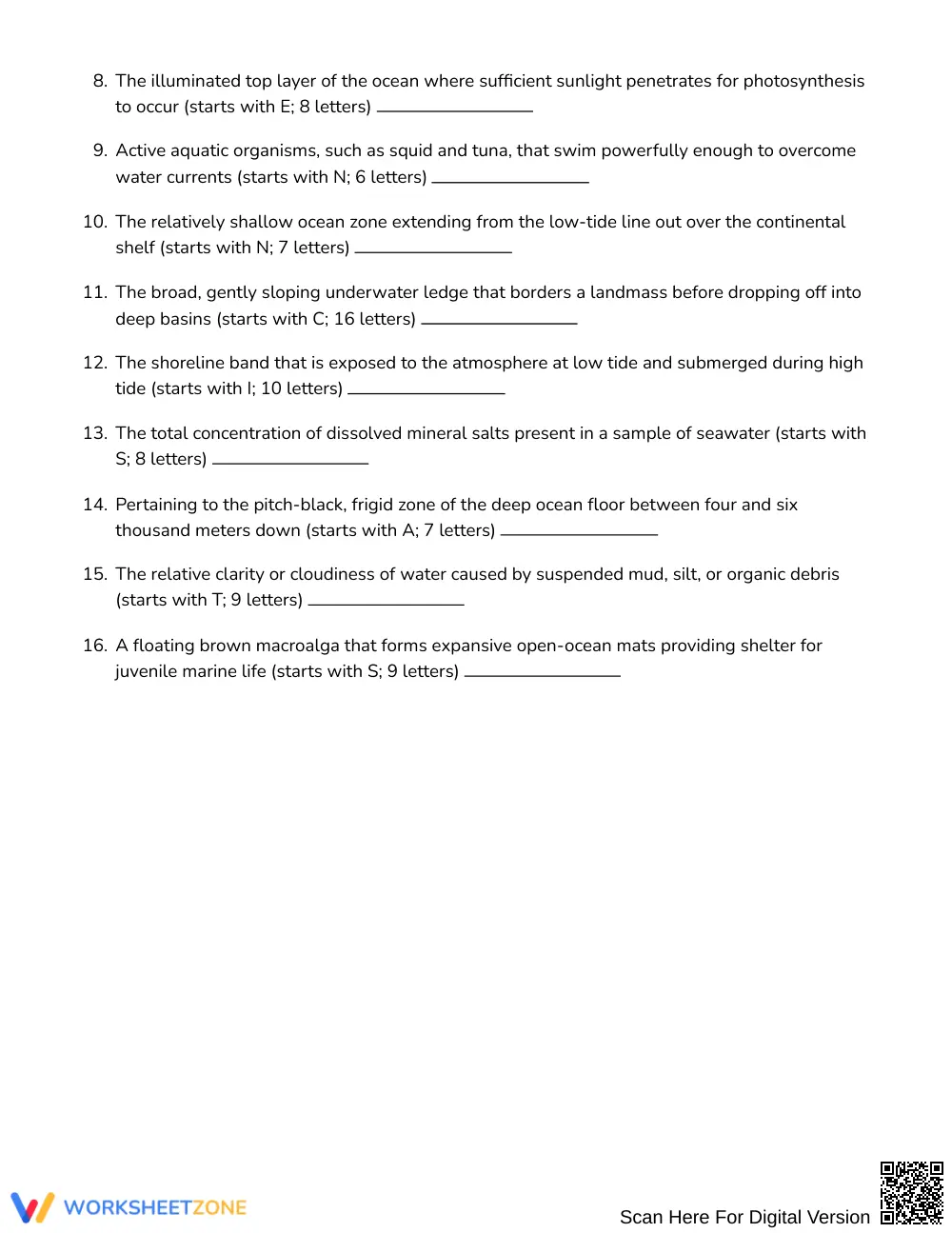
This Grades 6–7 marine science word search reinforces foundational earth science vocabulary through active retrieval. Students analyze descriptive ecological definitions to identify coastal and pelagic marine terms before locating them in a grid. The activity strengthens scientific literacy, contextual vocabulary recall, and conceptual understanding of diverse marine ecosystems without requiring rote memorization.
At a Glance
- Grade: Grades 6–7 · Subject: Science
- Standard: Not standards-assessed — vocabulary enrichment
- Skill Focus: coastal and open-ocean comparisons
- Format: 3 pages · 16 words · Answer key included · PDF
- Best For: Marine science vocabulary reinforcement and review
- Time: 25–35 minutes
What's Inside
This 3-page printable science resource features 16 vocabulary tasks organized around comparative ocean environments. Instead of a basic word bank, learners read detailed ecological clues covering marine zones, physical properties, and aquatic organisms. The package includes 4 answer key pages featuring full grid solution maps that make verification swift and straightforward for teachers or peer checkers.
Puzzle Mechanics and Structure
This challenge eliminates standard word lists to promote deep vocabulary processing. Students first read rigorous definitions to deduce target terminology, then search for those terms within an 18 x 18 letter grid. Hidden words run across all eight possible compass orientations: north, northeast, east, southeast, south, southwest, west, and northwest. This multidirectional search format requires sustained visual scanning and reinforces correct scientific spelling.
Standards Alignment
This resource serves as targeted vocabulary enrichment and is not aligned to a specific state or national standard. It supports general Earth Science, oceanography, and marine ecology units by expanding student mastery of domain-specific terminology across neritic, pelagic, and benthic environments.
How to Use It
Deploy this activity immediately after direct instruction on ocean zonation to cement newly introduced terminology, or assign it as an engaging mid-unit review station. During seatwork, circulate and observe whether students can identify zone boundaries such as neritic versus pelagic from the clue text alone before searching the puzzle matrix. Most middle school learners will complete the entire activity in 25 to 35 minutes.
Who It's For
This puzzle is designed for middle school students in Grades 6–7 studying oceanography, marine ecosystems, or general Earth Science. It offers natural differentiation for visual learners and independent workers seeking a rigorous vocabulary challenge. For optimal instruction, pair this activity with an ocean depth anchor chart or a comparative reading passage on marine life zones.
Vocabulary acquisition in secondary science demands deliberate engagement with domain-specific language rather than passive term recognition. According to Fisher & Frey (2014), structured word analysis and contextual clue retrieval support long-term retention and conceptual schema development across informational texts. By removing the traditional word bank and requiring middle school learners to derive 16 complex scientific terms—such as hydrothermal, phytoplankton, and intertidal—from functional definitions, this resource bridges the gap between basic recall and active comprehension. Students consolidate critical comparisons between coastal habitats and open-ocean zones while developing orthographic familiarity through multidirectional visual scanning across the 18 x 18 grid. The resulting practice strengthens science reading comprehension, equips students for subsequent marine ecology labs, and solidifies essential Earth Science terminology.


