































Complete Nets, Faces & Edges Worksheet | Grade 6 Math

Paste this activity's link or code into your existing LMS (Google Classroom, Canvas, Teams, Schoology, Moodle, etc.).
Students can open and work on the activity right away, with no student login required.
You'll still be able to track student progress and results from your teacher account.
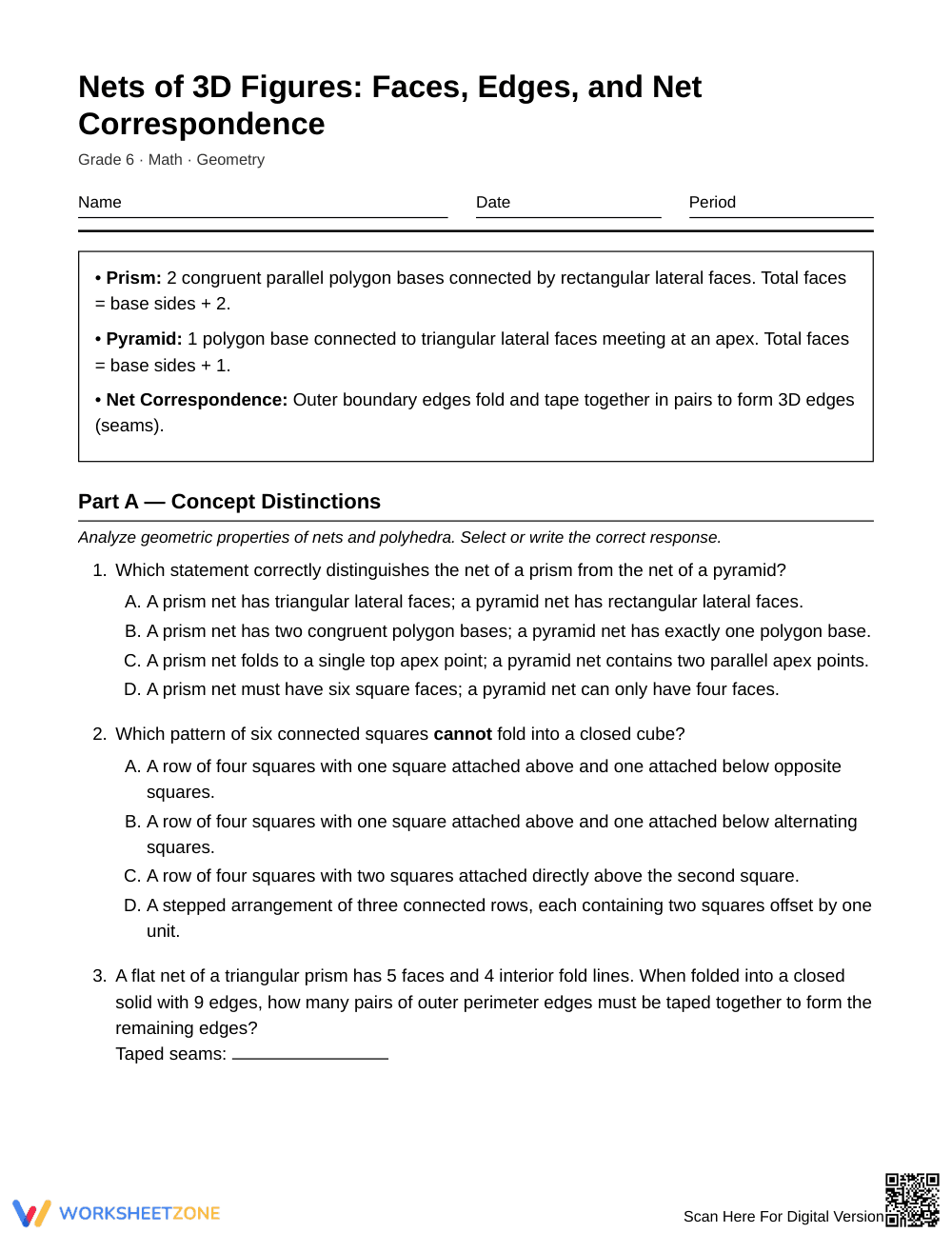
This geometry worksheet develops student mastery of three-dimensional nets, face-edge correspondences, and surface area calculations. Through 16 focused problems, sixth-grade learners connect two-dimensional nets to three-dimensional polyhedra, verify folding feasibility, map edge seams, and compute exact surface areas for prisms and pyramids.
At a Glance
- Grade: 6 · Subject: Math
- Standard:
6.G.A.4— Represent three-dimensional figures using nets and use nets to find surface area- Skill Focus: Faces, Edges, and Net Correspondence
- Format: 5 pages · 16 problems · Answer key included · PDF
- Best For: Geometry unit practice and formative assessment
- Time: 40–50 minutes
What's Inside
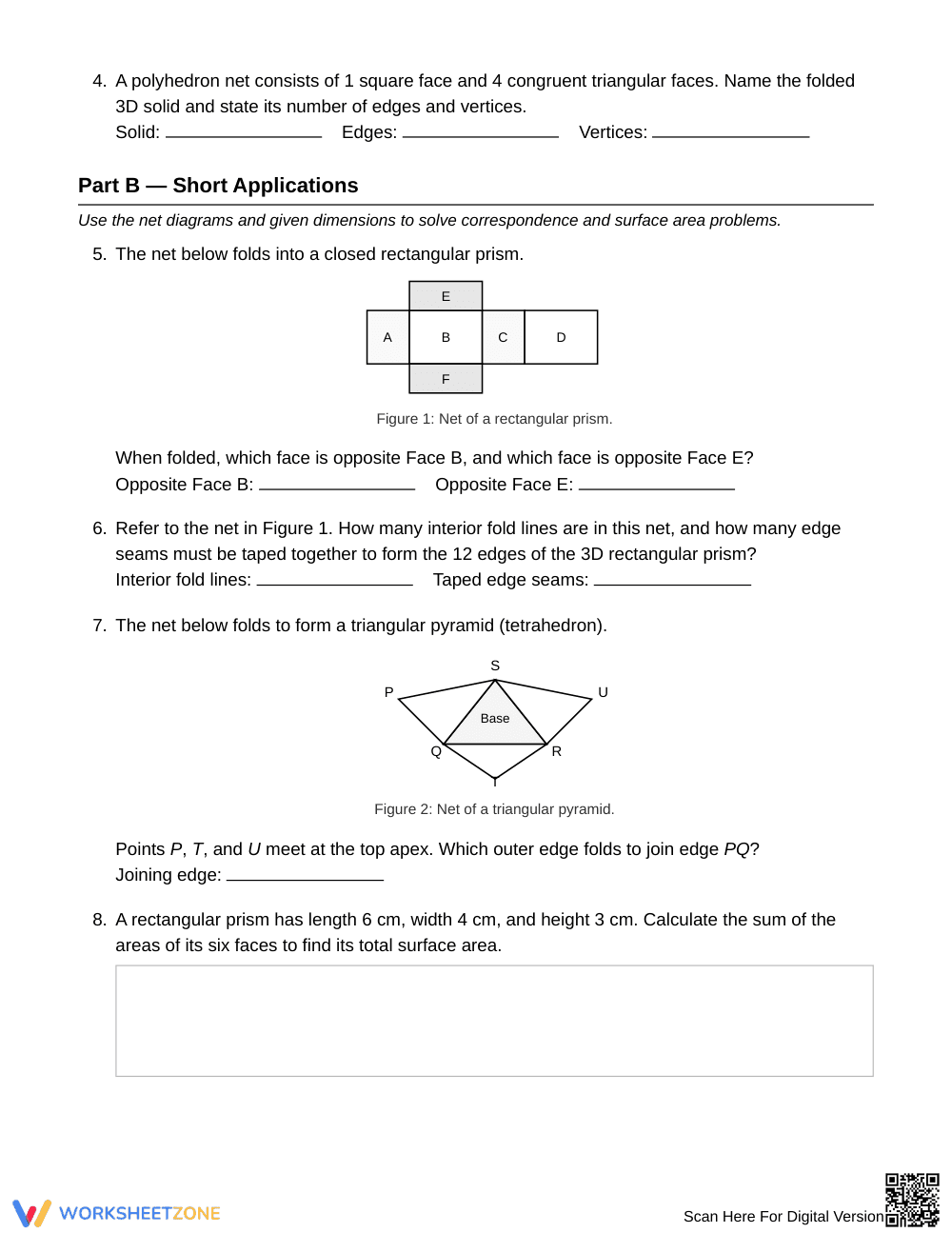
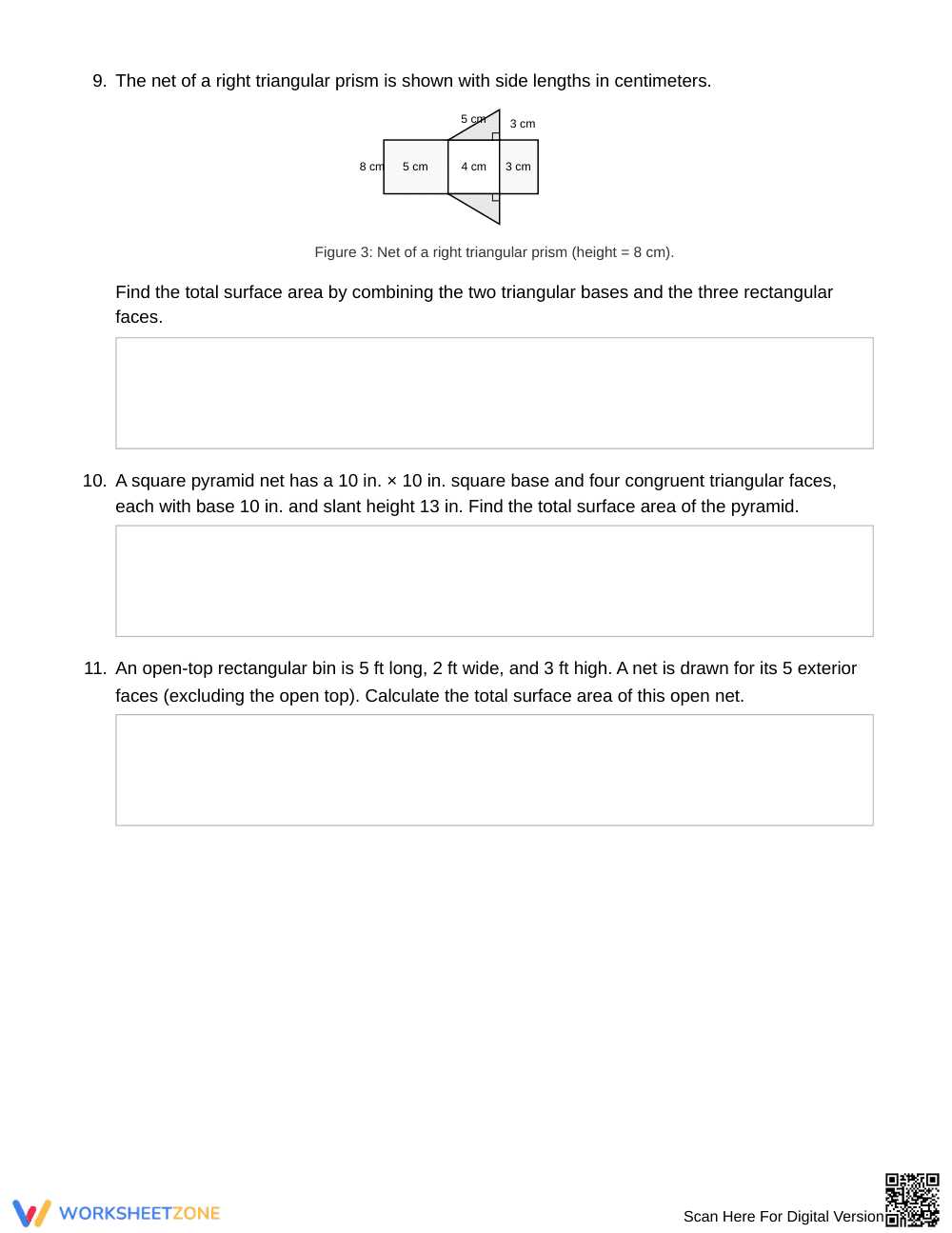
The 5-page worksheet includes geometric reference definitions, 2D-to-3D folding diagnostics, labeled diagrams, perimeter seam tracking, surface area computations, and non-standard net analysis. A complete 3-page answer key provides step-by-step calculations and visual edge-mapping solutions.
Skill Progression
- Guided Practice (Part A, Problems 1–4): Students evaluate core structural definitions, distinguish prism and pyramid nets, identify invalid cube configurations, and calculate edge seams using base geometry.
- Supported Practice (Part B, Problems 5–12): Students analyze multi-view diagrams, match corresponding vertices and folding edges, calculate total surface area from dimensions, and complete missing net faces.
- Independent Practice (Part C, Problems 13–16): Students write extended geometric explanations for overlapping faces, derive seam formulas, and solve composite surface area transfer problems.
This structured progression follows a gradual-release model, shifting students from foundational property recognition to spatial problem-solving.
Standards Alignment
Primary Standard: `6.G.A.4` — Represent three-dimensional figures using nets made up of rectangles and triangles, and use the nets to find the surface area of these figures in the context of solving real-world and mathematical problems. Both standard codes can be copied directly into lesson plans, IEP goals, or district curriculum mapping tools.
How to Use It
Use this resource after introducing 3D polyhedron nets during your geometry unit. It serves as an in-class practice set or a targeted review before summative testing. For formative assessment, examine student responses on Part A Problem 3 and Part B Problem 7 to check whether learners correctly count interior fold lines versus taped perimeter seams. Expected completion time is 40 to 50 minutes.
Who It's For
This worksheet is designed for Grade 6 general math classes, accelerated Grade 5 geometry modules, and Grade 7 intervention groups. Pair this activity with physical paper folding nets and geometric manipulatives to provide tactile support for visual-spatial learners.
According to Fisher & Frey (2014), structured spatial tasks that progress from guided identification to open-ended justification yield measurable gains in geometric reasoning and conceptual retention. Under standard 6.G.A.4, sixth-grade students must demonstrate that a three-dimensional solid's surface area equals the combined area of its disassembled two-dimensional faces. This worksheet reinforces this requirement by requiring students to identify vertices, track interior fold lines versus external taped seams, and calculate exact surface areas for prisms and pyramids. By engaging in rigorous spatial transformations and multi-step calculations, students build the foundational visualization skills required for high school geometry and engineering contexts.


