

































Complete Narrative Writing Worksheet | Grade 6 ELA

Paste this activity's link or code into your existing LMS (Google Classroom, Canvas, Teams, Schoology, Moodle, etc.).
Students can open and work on the activity right away, with no student login required.
You'll still be able to track student progress and results from your teacher account.
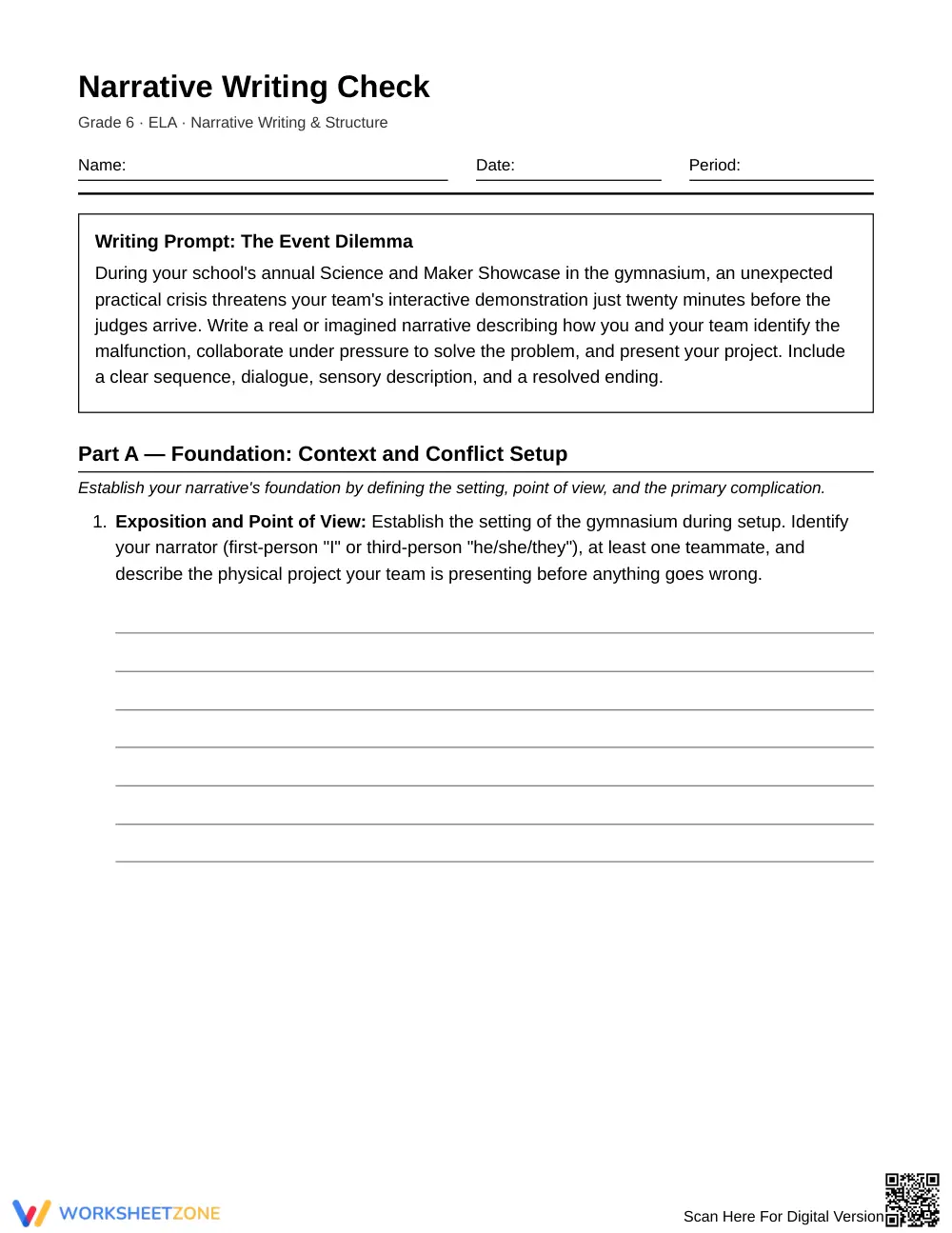
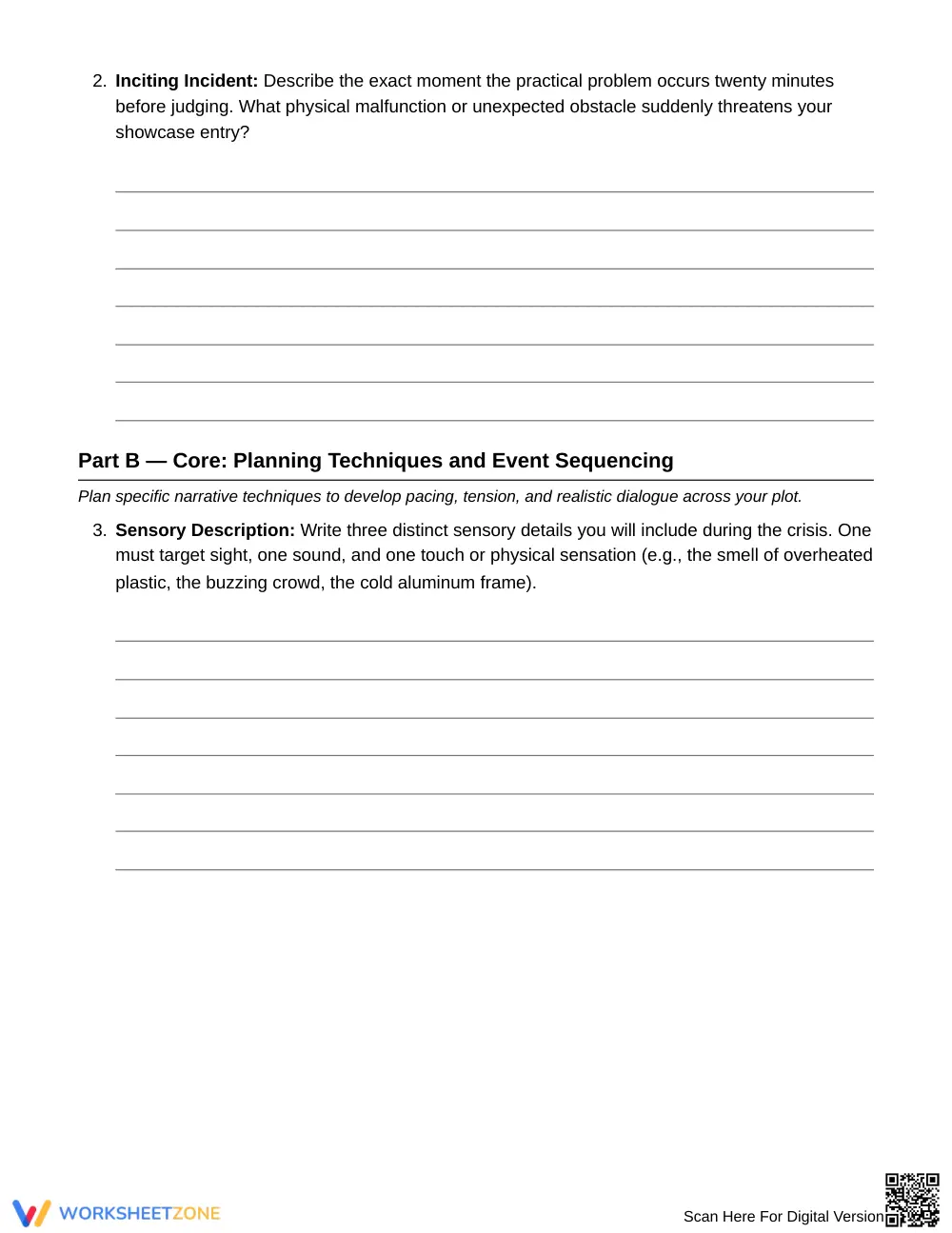
This comprehensive Grade 6 narrative writing worksheet guides middle school writers through the complete story development process. Students analyze an authentic event dilemma prompt, brainstorm exposition, craft dialogue, map transitions, draft a 250-word narrative, and self-assess their writing. The structured progression ensures students master core narrative techniques and reflective revision.
At a Glance
- Grade: 6 · Subject: ELA
- Standard: Narrative Writing — Write narratives to develop real or imagined experiences using effective technique and sequencing
- Skill Focus: Narrative Writing and Self-Assessment
- Format: 5 pages · 8 problems · Answer key included · PDF
- Best For: Narrative writing assessment or mid-unit check
- Time: 45–60 minutes
What's Inside
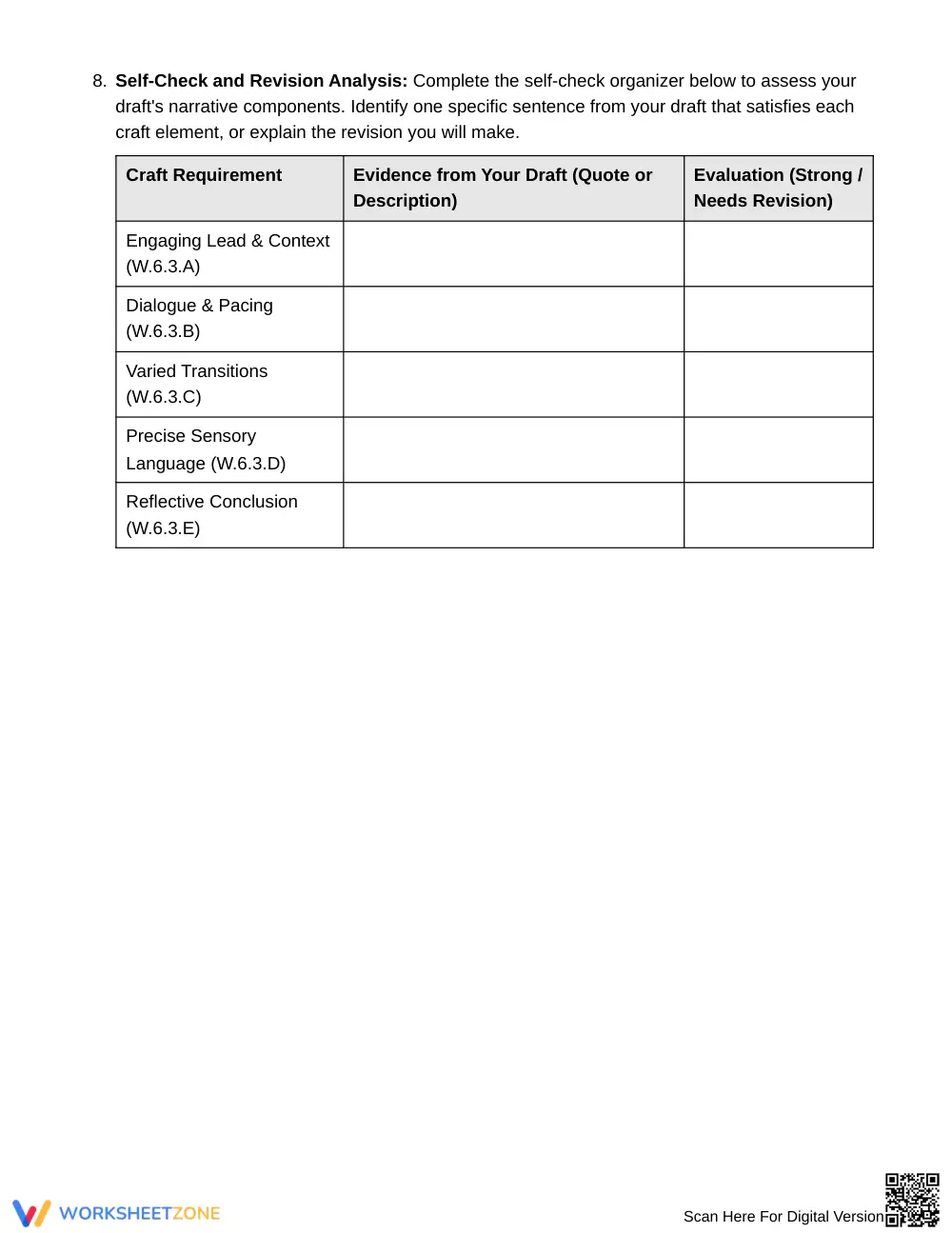
This 5-page instructional resource contains 8 sequential tasks divided into three distinct phases. Students receive a detailed STEM showcase crisis prompt, structured pre-writing organizers for sensory details and dialogue, a transition mapping table, an extended drafting section, and a five-point self-assessment rubric. A comprehensive 4-page answer key provides annotated exemplar responses and revision benchmarks.
Skill Progression
- Guided practice (Part A, Tasks 1–2): Students establish foundational story elements by defining point of view, physical setting, and the inciting incident under structured prompt constraints.
- Supported practice (Part B, Tasks 3–6): Students plan core craft elements with targeted scaffolding, generating three sensory details, a four-line dialogue exchange, transitional roadmap phrases, and a climactic turning point.
- Independent practice (Part C, Tasks 7–8): Students draft a complete 250- to 280-word narrative and independently evaluate their work using a craft requirement self-check table.
This sequence follows the gradual release of responsibility model, guiding writers from structured ideation to self-directed drafting and evaluation.
Standards Alignment
This resource aligns with Grade 6 English Language Arts standards for narrative composition. Students establish context, introduce characters, utilize dialogue and pacing, employ varied transitional words, use precise sensory language, and provide a reflective conclusion. Standard expectations can be copied directly into lesson plans, IEP goals, or district curriculum mapping tools.
How to Use It
Administer this worksheet during or after a unit on narrative craft as a summative assessment or multi-day writing workshop project. During the drafting phase, circulate to observe how students apply dialogue punctuation and transitional phrases, offering targeted feedback before final revisions. Allocate 45 to 60 minutes across one or two class periods for thorough pre-writing, drafting, and self-evaluation.
Who It's For
This activity is designed for general education Grade 6 ELA classrooms, advanced Grade 5 writers, or Grade 7 students needing structured narrative review. Differentiate by providing sentence starters for English learners or allowing extended time for emerging writers. Pair this resource naturally with an anchor chart on narrative pacing and transition words.
Explicit instruction in narrative writing strategies significantly improves middle school writing fluency and structural competence. According to Fisher & Frey (2014), structured scaffolds such as graphic organizers, dialogue frames, and transition roadmaps support novice writers as they transition from guided ideation to autonomous composition. This 5-page worksheet targets Grade 6 narrative writing by breaking down complex writing tasks into 8 distinct, manageable components. Students develop realistic character interactions, sensory imagery, and logical plot sequencing before synthesizing their ideas into a multi-paragraph draft. Incorporating self-assessment organizers reinforces metacognitive monitoring, enabling students to critically evaluate craft elements including leads, pacing, transitions, descriptive language, and reflective conclusions against objective criteria. Educational research consistently shows that integrating deliberate pre-writing tasks with structured self-evaluation leads to measurable gains in overall text quality, student engagement, and standardized writing performance across diverse middle school classroom environments.


