































Complete Muscles & Bones Word Search | Grades 6–7 Science

Paste this activity's link or code into your existing LMS (Google Classroom, Canvas, Teams, Schoology, Moodle, etc.).
Students can open and work on the activity right away, with no student login required.
You'll still be able to track student progress and results from your teacher account.
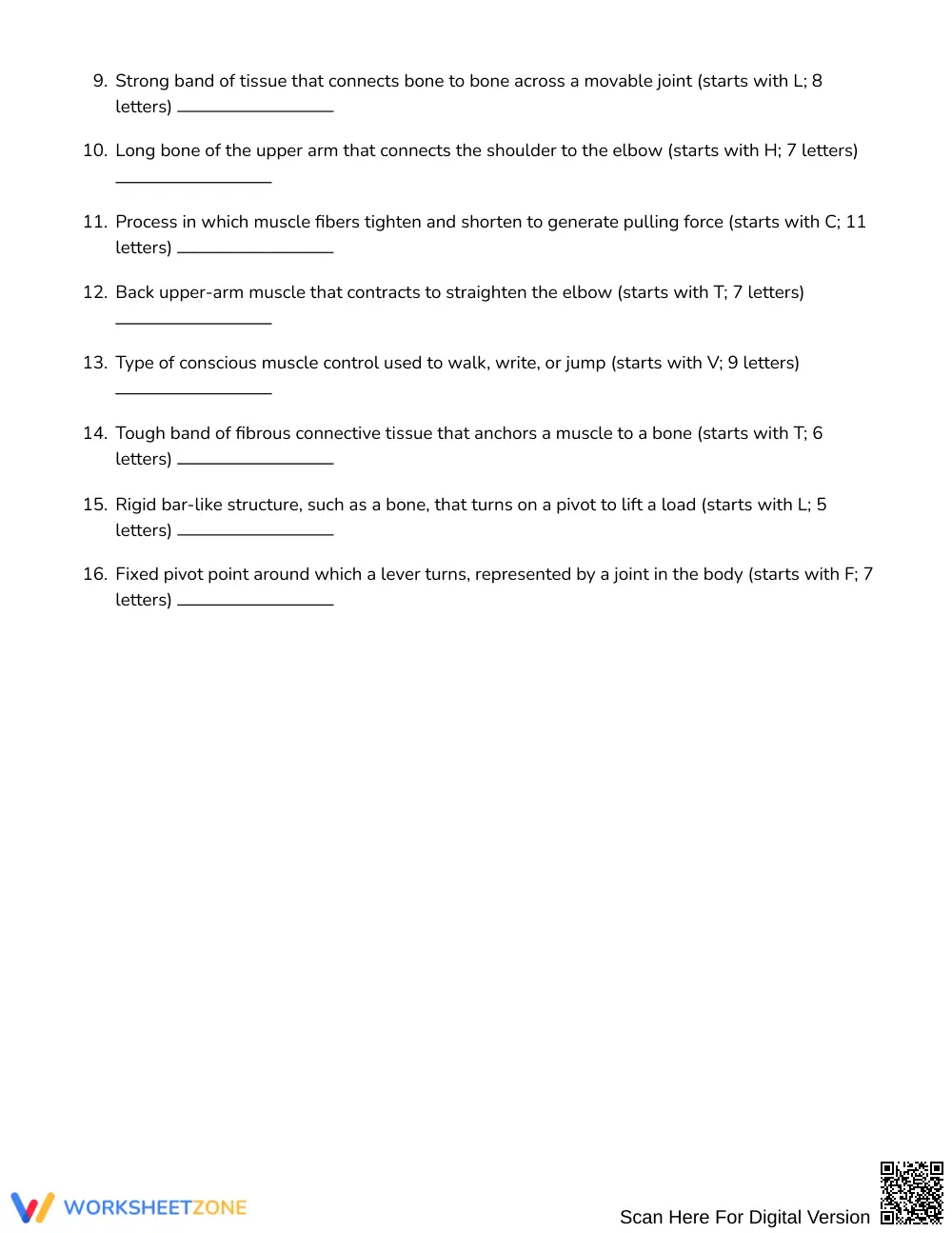
This skeletal system word search reinforces how muscles and bones collaborate to create movement across the human body. Students read 16 physiological clues, identify the target anatomical terms without a word bank, and locate each term within an 18 x 18 grid, building muscular-skeletal vocabulary through active retrieval.
At a Glance
- Grade: Grades 6–7 · Subject: Science
- Standard: Not standards-assessed — vocabulary enrichment for middle school life science
- Skill Focus: Musculoskeletal interactions and biomechanical movement
- Format: 3 student and solution pages · 16 words · Full answer key included · Printable PDF
- Best For: Independent vocabulary review, science stations, and biomechanics reinforcement
- Time: 25–35 minutes
What's Inside
This 3-page printable science resource provides a no-bank vocabulary puzzle with an accompanying 3-page answer key. Students read 16 anatomical clues describing connective tissues, lever principles, and opposing muscle pairs like flexors and extensors. After deducing each scientific term, students locate it in the puzzle. The solution key displays every word's coordinate placement for rapid grading.
Puzzle Mechanics and Structure
This puzzle emphasizes active recall over passive pattern matching:
- No-Bank Clues: Learners solve 16 definition clues covering tendons, ligaments, fulcrums, and antagonistic pairs before searching.
- 18 x 18 Grid: The letters are arranged in an 18 x 18 grid requiring sustained visual tracking.
- Omnidirectional Paths: Words run in all 8 compass directions (N, NE, E, SE, S, SW, W, NW), forward and backward.
Standards Alignment
This resource serves as vocabulary enrichment and is not aligned to a formal academic standard. It reinforces middle school human body units by building mastery of essential physiological terminology ahead of comprehensive summative assessments.
How to Use It
Use this word search during or after direct instruction on the musculoskeletal system. Have students complete the clues independently as a mid-unit check, observing whether they identify terms like "periosteum" without assistance to assess retention. It also works as a collaborative review station during test prep. Students typically complete the puzzle in 25 to 35 minutes.
Who It's For
This activity is designed for Grades 6–7 life science students. For differentiated support, offer striving learners a first-letter word list or reference diagrams. Advanced learners can explain the mechanical action of each joint-muscle pair after completing the grid. Pair this activity with a skeletal diagram or lever lesson to connect terminology to physical structures.
Middle school science vocabulary acquisition requires deliberate retrieval routines to build long-term retention of complex physiological concepts. Research synthesized by Fisher & Frey (2014) emphasizes that vocabulary learning deepens when students actively process domain-specific definitions rather than passively copying glossaries. This non-standardized vocabulary enrichment word search supports Grades 6–7 life science curricula by focusing on the core functional skill of how muscles and bones work together. By removing standard word banks and requiring learners to solve 16 rigorous anatomical clues across an 18 x 18 grid, the resource prompts direct cognitive retrieval of biomechanical terms including flexors, extensors, fulcrums, and ligaments. Integrating structured, clue-based puzzles into musculoskeletal science units reinforces scientific literacy, strengthens spatial recognition, and verifies foundational terminology retention across general education and differentiated life science classrooms while preparing middle grade students for subsequent summative assessments.


