


























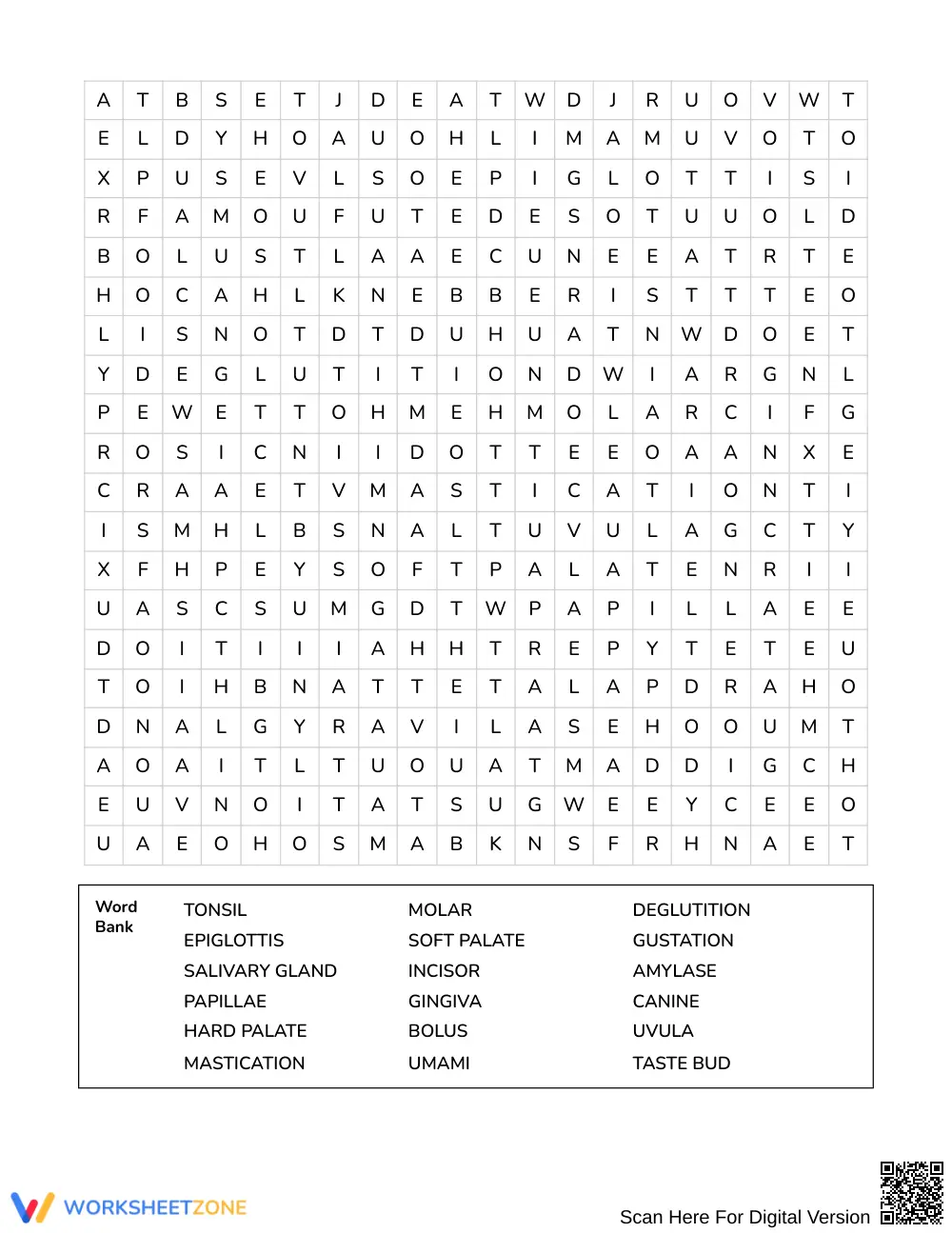

Complete Mouth Anatomy Word Search | Grades 7–8 Science
Paste this activity's link or code into your existing LMS (Google Classroom, Canvas, Teams, Schoology, Moodle, etc.).
Students can open and work on the activity right away, with no student login required.
You'll still be able to track student progress and results from your teacher account.
Reinforce human digestive system terminology with this focused mouth structures review. Students examine anatomical definitions and match physiological roles to oral structures before locating terms within the puzzle grid. This activity strengthens vocabulary retention, supports conceptual understanding of mechanical and chemical digestion, and helps learners connect specific oral parts with their bodily functions.
At a Glance
- Grade: Grades 7–8 · Course: Science · Human Anatomy
- Standard: Not standards-assessed — vocabulary enrichment
- Skill Focus: Matching oral cavity mouth structures to digestive and sensory functions
- Format: 3 student pages · 18 words · 4 answer key pages · Printable PDF
- Best For: Middle school human anatomy vocabulary review and unit reinforcement
- Time: 20–30 minutes
This 3-page science resource presents 18 mouth-related terms paired with clear functional clues rather than a simple word list. Students read descriptive definitions covering mechanical digestion, enzymatic breakdown, mucosal protection, and taste reception. After identifying the correct anatomical term, learners search for each item. A comprehensive 4-page answer key clearly highlights every word location for quick verification.
How the Puzzle Works
This activity challenges students to decode definitions and locate terminology across a dense letter field:
- Grid Dimensions: A spacious 20 x 20 letter grid provides rigorous visual scanning practice.
- Search Orientations: The 18 words run in all 8 compass directions: North, Northeast, East, Southeast, South, Southwest, West, and Northwest.
- Clue-Based Search: Rather than copying from an alphabetized list, students read functional descriptions to identify target terms before finding them.
Standards Alignment
This resource serves as targeted vocabulary enrichment and is not aligned to a specific standard. It supplements general middle school life science and human anatomy curricula by deepening student familiarity with specialized biological terminology and organ functions.
How to Use It
Deploy this activity during the middle of a digestive system unit to consolidate terminology after direct instruction on oral anatomy. Students actively process functional definitions before searching, making it an effective warm-up or independent seatwork assignment. For formative assessment, circulate as students match clues to verify that learners accurately distinguish mechanical chewing structures from enzymatic saliva components. Typical completion time spans 20 to 30 minutes.
Who It's For
This review is designed for life science students in Grades 7–8 studying human body systems. It supports English language learners and developing readers through contextual clues that define complex terms like deglutition and mastication. Pair this puzzle with an oral cavity diagram labeling worksheet or an introductory laboratory activity exploring salivary amylase digestion.
Educational research from Fisher & Frey (2014) highlights that purposeful vocabulary acquisition in secondary science requires deliberate opportunities to connect domain-specific words with their functional definitions. This Grades 7–8 human anatomy word search reinforces 18 critical biological terms, including mastication, salivary gland, and epiglottis, through clue-based retrieval. Rather than passively scanning for isolated letter strings, students must first comprehend physiological descriptions of mechanical processing, chemical digestion, and oral sensory reception. Engaging with these concepts through structured definition-matching prompts active cognitive processing, strengthening conceptual memory pathways before summative unit assessments. As students decode complex Latin and Greek root terminology, they build scientific literacy necessary for advanced coursework. In a 20 x 20 grid spanning 8 directional paths, the resource provides 20 to 30 minutes of rigorous anatomical term reinforcement that supports text comprehension in life science textbooks and laboratory investigations.


