


























Views
Downloads




Complete Misleading Transitions Worksheet | Grade 7 ELA
Paste this activity's link or code into your existing LMS (Google Classroom, Canvas, Teams, Schoology, Moodle, etc.).
Students can open and work on the activity right away, with no student login required.
You'll still be able to track student progress and results from your teacher account.
This informational text structure worksheet helps seventh-grade students master how transitions clarify relationships between ideas. Students read a nonfiction text about a community tool library, diagnose misleading transitions in student drafts, and rewrite them with accurate signal words supported by textual evidence to build structural coherence.
At a Glance
- Grade: 7 · Subject: ELA
- Standard:
RI.7.5— Analyze how major sections contribute to the whole text structure- Skill Focus: Repairing Misleading Transitions
- Format: 5 pages · 10 problems · Answer key included · PDF
- Best For: Nonfiction text structure and revision practice
- Time: 35–45 minutes
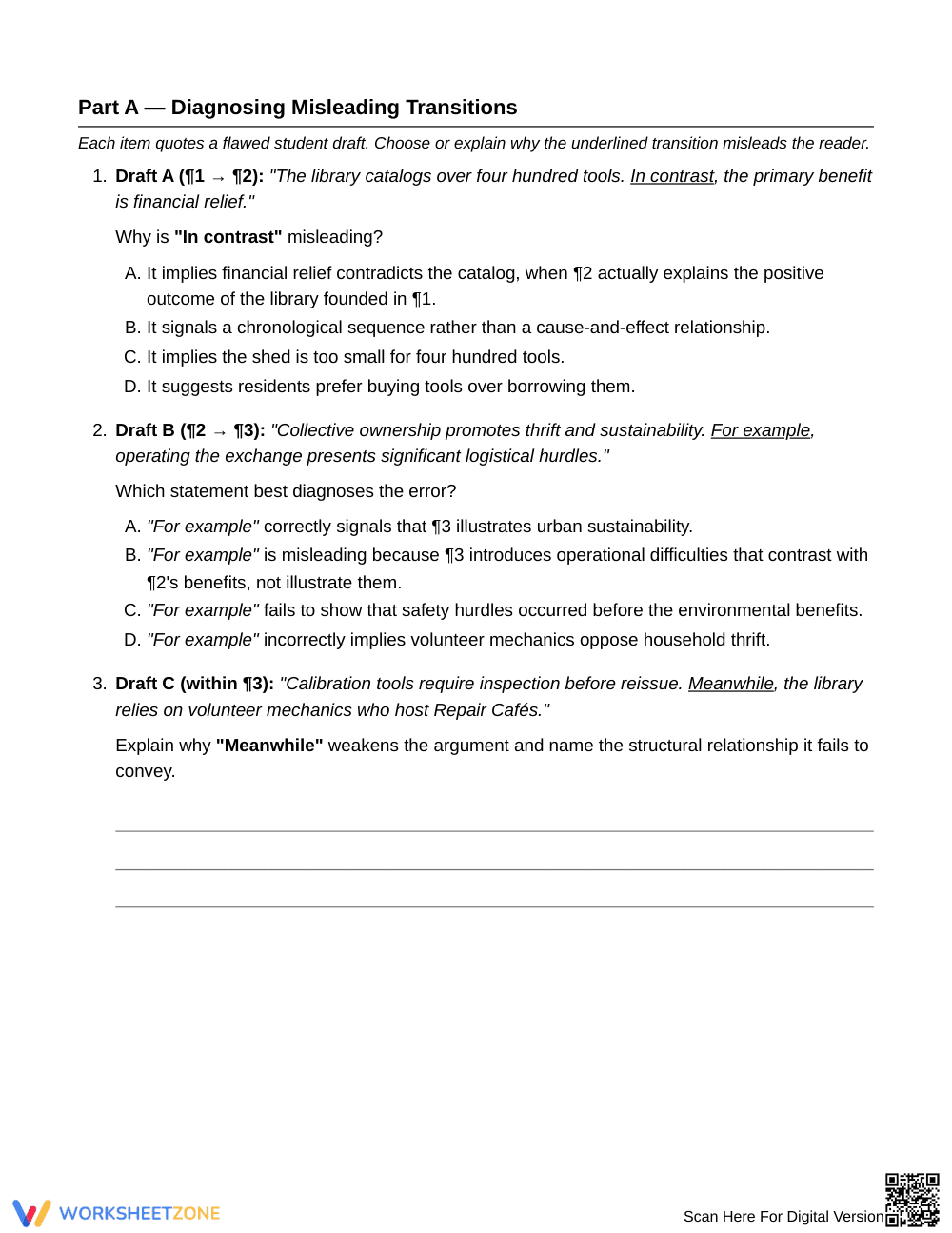
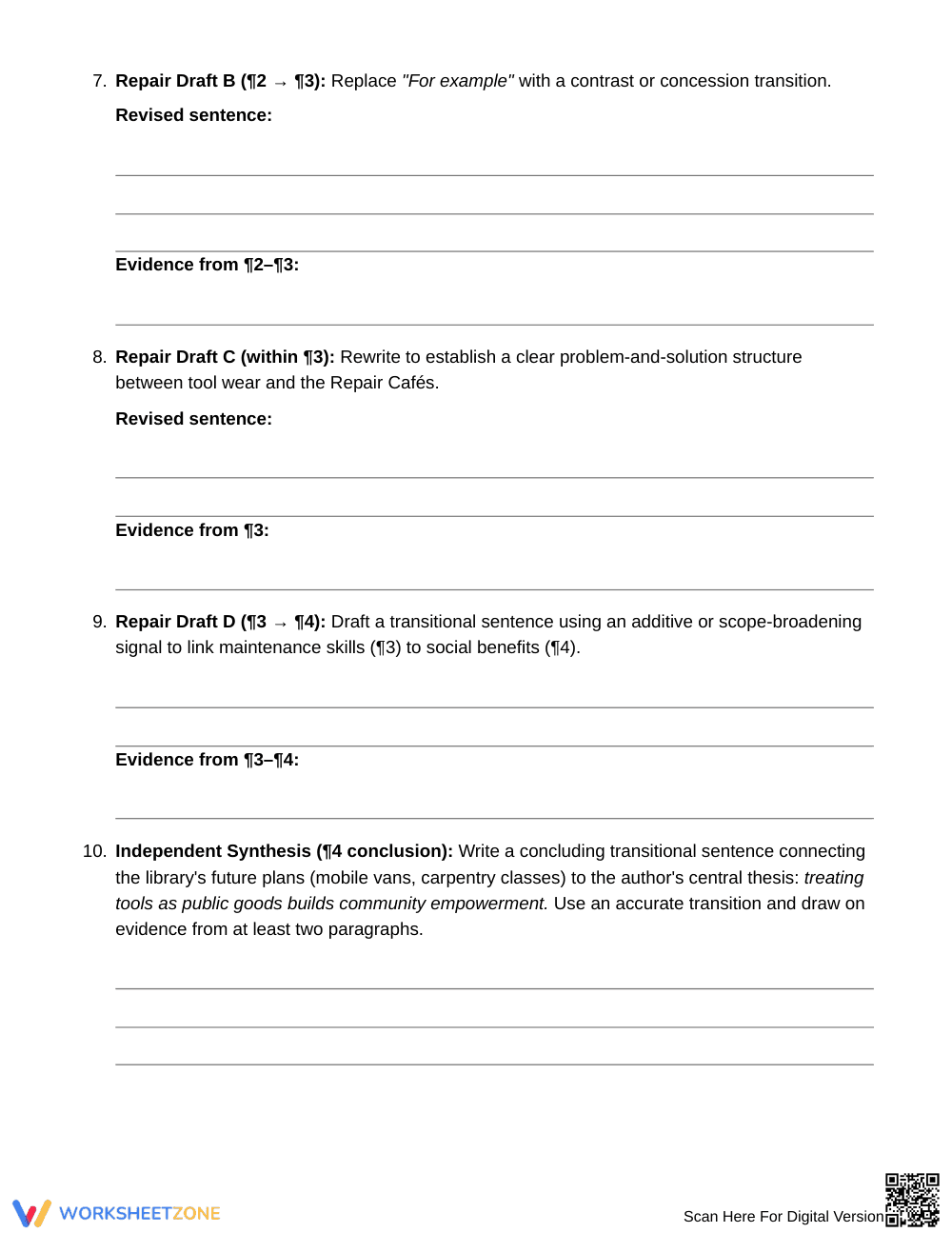
This 5-page printable resource features a transition reference table covering four structural relationships: elaboration, contrast, causality, and problem-solution. It includes an informational passage on the Oakridge Tool Library, a complete worked example, 5 multiple-choice and short-answer diagnostic tasks in Part A, 5 evidence-based revision prompts in Part B, and a 3-page answer key.
Skill Progression
- Guided practice: A worked example models the diagnostic process by analyzing why a faulty cause-and-effect transition distorts paragraph meaning before modeling a repair.
- Supported practice: In Part A (tasks 1–5), students evaluate flawed drafts using diagnostic multiple-choice and short-answer prompts supported by the reference table.
- Independent practice: In Part B (tasks 6–10), students rewrite flawed sentences, cite paragraph evidence, and synthesize overall text structure in an independent concluding statement.
This gradual release progression guides learners from identifying transitional errors to generating accurate structural repairs.
Standards Alignment
This resource aligns to RI.7.5: Analyze the structure an author uses to organize a text, including how major sections contribute to the whole. It also supports W.7.2.C by teaching students to use appropriate transitions that clarify relationships among ideas. Both standard codes can be copied directly into lesson plans, IEP goals, or district curriculum mapping tools.
How to Use It
Assign this worksheet following direct instruction on nonfiction text structure or during an informational writing revision unit. As students work, check Part A Draft C and Part B Draft B to assess whether learners distinguish between addition and contrast. Students typically finish all 10 tasks in 35 to 45 minutes.
Who It's For
This resource serves grade 7 ELA classes, writing intervention groups, and multilingual learners who benefit from explicit transition scaffolds. The reference table supports developing writers, while the synthesis task offers rigor for advanced students. Pair this activity with an anchor chart on organizational text structures.
Mastering structural signposts is essential for middle school reading comprehension and informational writing fluency. This 5-page educational resource directly supports CCSS RI.7.5 by training grade 7 students in the skill of repairing misleading transitions in nonfiction texts. According to Fisher & Frey (2014), explicit instruction in text cohesion combined with guided diagnostic modeling substantially improves students' ability to construct meaning across paragraph boundaries. The 10 included tasks require learners to identify flawed relational signals—such as misapplied contrast, faulty causality, and weak elaboration—and replace them with precise transitional phrases backed by direct textual citations. By engaging with an authentic four-paragraph passage and referencing a structured four-category transition chart, seventh graders build the metacognitive awareness required to evaluate text architecture and articulate clear logical connections across complex informational prose in secondary English language arts.


