




























Complete Mesozoic Word Search | Grades 6–7 Science
Paste this activity's link or code into your existing LMS (Google Classroom, Canvas, Teams, Schoology, Moodle, etc.).
Students can open and work on the activity right away, with no student login required.
You'll still be able to track student progress and results from your teacher account.
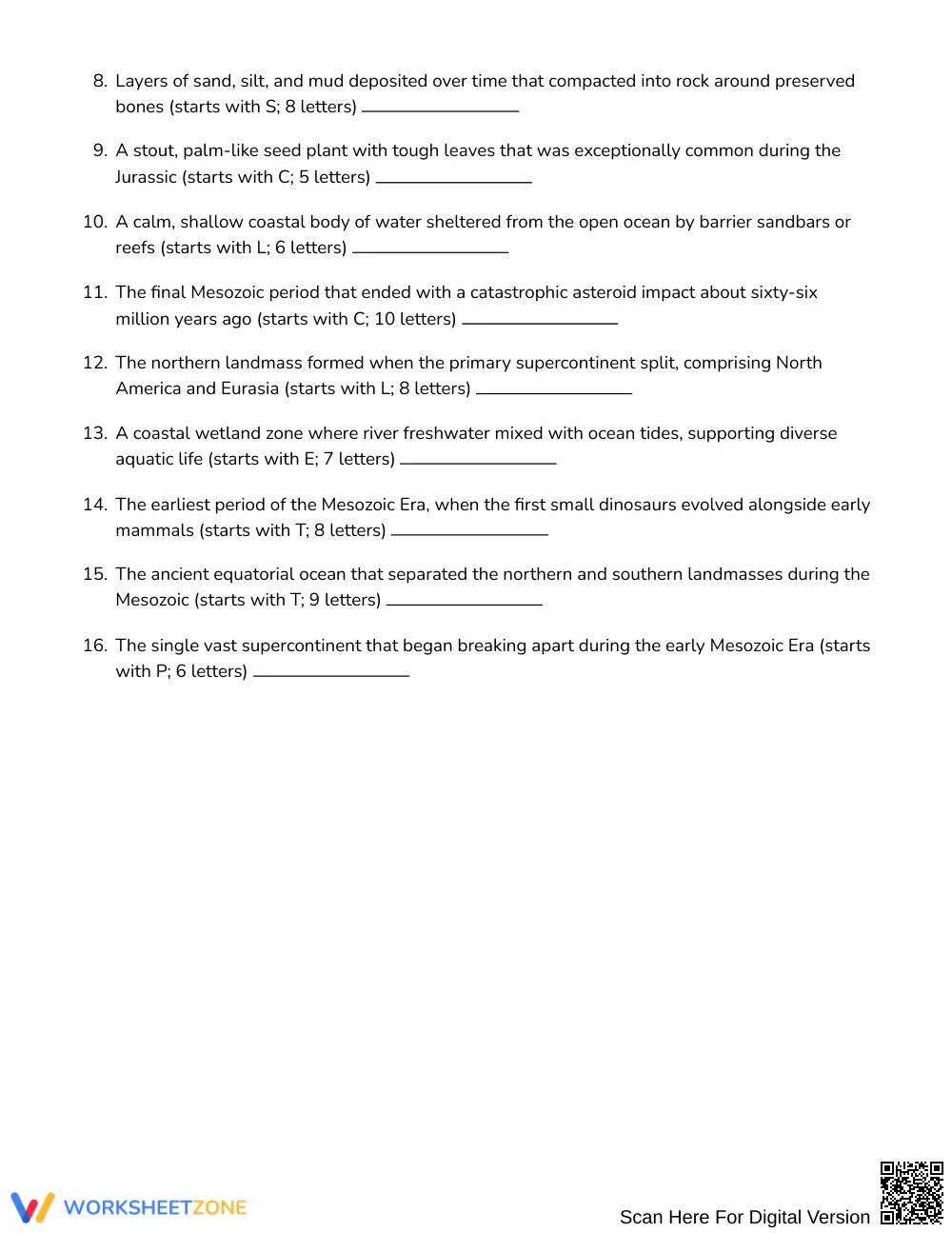
This Mesozoic periods and environments word search reinforces earth science vocabulary for Grades 6–7 through active clue-solving. Students read descriptive definitions of prehistoric geologic periods, climate states, and ancient ecosystems, identifying each term before finding it hidden in the puzzle. The no-word-bank format builds retention and demands genuine recall of core concepts.
At a Glance
- Grade: Grades 6–7 · Subject: Science
- Standard: Not standards-assessed — vocabulary enrichment
- Skill Focus: Mesozoic periods and environments
- Format: 3 pages · 16 words · Answer key included · PDF
- Best For: Independent vocabulary review and unit reinforcement
- Time: 25–35 minutes
This 3-page science resource presents 16 targeted vocabulary words embedded in an expansive letter layout. Instead of a passive word list, the activity features 16 content-rich clues defining terms such as Triassic, Pangea, conifer, and greenhouse climate. A full 4-page answer key provides clear letter highlighting for rapid verification.
Puzzle Mechanics and Layout
The activity challenges students with an 18 x 18 grid containing 16 hidden terms. Words run in all 8 compass directions: north, northeast, east, southeast, south, southwest, west, and northwest. Because there is no word bank, learners must solve each informational clue to deduce the target term before locating it across intersecting letters.
Standards Alignment
This resource serves as vocabulary enrichment and is not aligned to a specific standard. It supports middle school geologic time curriculum by reinforcing domain-specific terms related to Mesozoic climate, supercontinents, and paleontology through definition-based word identification.
How to Use It
Use this word search after direct instruction on the Mesozoic Era to evaluate conceptual recall. During independent practice, observe whether students identify terms directly from clues or require scaffolding with class notes. The puzzle also functions well as an engaging warm-up before a paleontology lab, requiring 25 to 35 minutes to complete.
Who It's For
This puzzle is designed for Grades 6–7 science students exploring Earth history and prehistoric life. Provide struggling readers with a partner or sticky notes to record answers before searching the grid. Pair this print-and-go activity with an interactive geologic time scale diagram or fossil record reading passage to deepen conceptual comprehension.
Content-area vocabulary acquisition is essential for middle school comprehension in Earth and space science. According to Fisher & Frey (2014), intentional exposure to domain-specific academic language through varied contextual retrieval strengthens conceptual memory far more effectively than isolated memorization drills. This Grades 6–7 science word search applies that research by removing the conventional word bank and requiring learners to interpret substantive clues describing Mesozoic periods, supercontinents, and prehistoric ecosystems before searching the letter grid. When students identify terms such as Laurasia, Cretaceous, and sediment from functional definitions, they engage in active cognitive retrieval that solidifies scientific understanding. Designed as a flexible vocabulary enrichment tool spanning three student pages, this printable resource supports meaningful engagement across science classrooms, providing an accessible yet rigorous supplement to comprehensive geologic time units without requiring specialized teacher preparation or complicated instructional adaptations.


