































Complete Meiosis & Variation Worksheet | Grade 10 Biology

Paste this activity's link or code into your existing LMS (Google Classroom, Canvas, Teams, Schoology, Moodle, etc.).
Students can open and work on the activity right away, with no student login required.
You'll still be able to track student progress and results from your teacher account.
This Grade 10 biology worksheet provides rigorous, comprehensive practice on meiotic division, chromosome mechanics, and genetic variation. Students analyze ploidy changes, track crossing over events, calculate theoretical gamete combinations, and evaluate synthetic recombination data. The structured resource guides high school learners toward deep conceptual and quantitative mastery of inheritance principles.
At a Glance
- Grade: 10 · Subject: Biology
- Standard: Heredity — Model how meiotic division generates novel genetic combinations
- Skill Focus: Meiosis-and-Variation Check
- Format: 5 pages · 12 problems · Answer key included · PDF
- Best For: Formative check and unit exam review
- Time: 45–55 minutes
What's Inside
This 5-page student assignment features 12 multi-part items distributed across three focused sections. The worksheet opens with a core principles reference box defining centromere counting and recombination rules. Students engage with multiple-choice conceptual checks, comparison tables, algebraic probability formulas, free-response biological claims, and a synthetic testcross offspring dataset supported by a thorough 3-page answer key.
Skill Progression
- Guided practice (Items 1–3): Students anchor their understanding using explicit centromere rules, comparing Meiosis I and II ploidy shifts in a structured table and refuting S-phase chromosome duplication misconceptions.
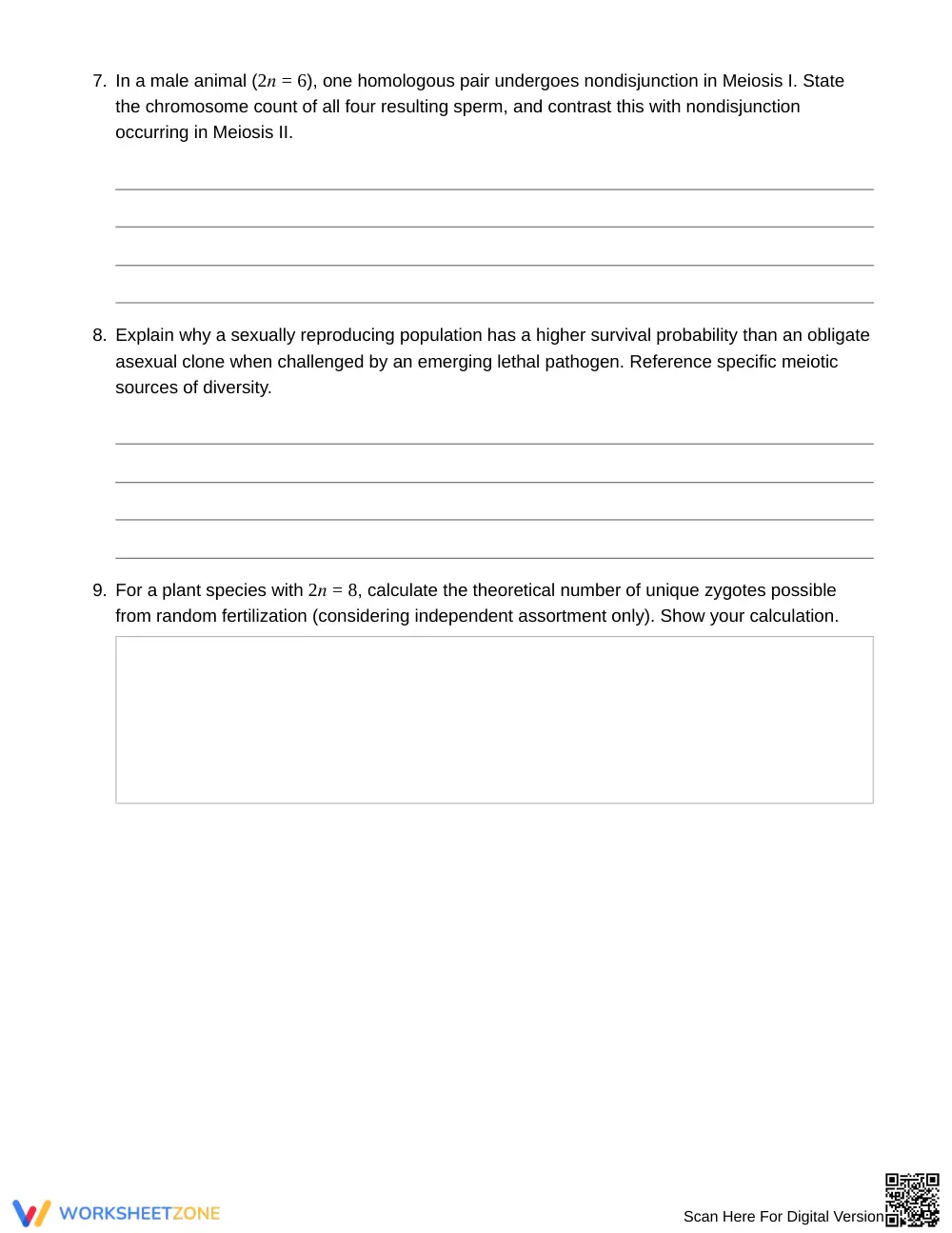
- Supported practice (Items 4–9): Learners calculate independent assortment combinations, diagram single crossovers, trace nondisjunction in gametes, and defend evolutionary benefits of variation under pathogen stress.
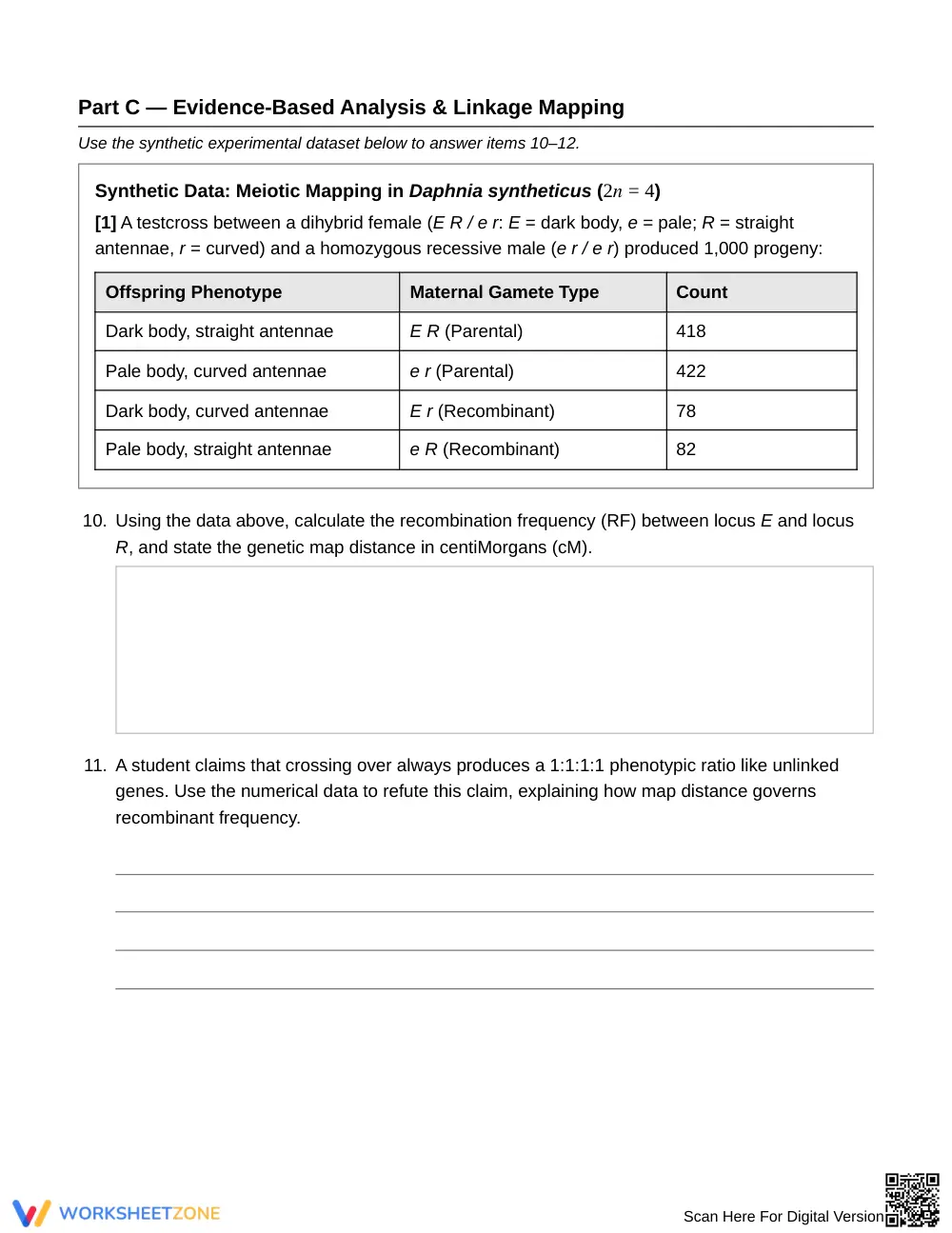
- Independent practice (Items 10–12): Students independently calculate recombination frequencies, derive map distances in centiMorgans from Daphnia testcross data, and synthesize mechanisms preserving species chromosome counts.
This structured progression reflects the gradual-release framework, guiding students from foundational terminology to autonomous quantitative problem-solving.
Standards Alignment
This resource aligns with high school life science standards requiring students to model how meiosis and fertilization produce genetic variation in organisms. Supporting benchmarks address chromosome replication, nondisjunction, and gene linkage mapping in inherited traits. Both standard codes can be copied directly into lesson plans, IEP goals, or district curriculum mapping tools.
How to Use It
Administer this worksheet after direct instruction on meiosis and independent assortment. For mid-unit formative assessment, collect Part A and Part B to detect whether students confuse chromatids with chromosomes. For summative review before an inheritance exam, assign the entire packet for collaborative paired work. Expected student completion time ranges between 45 and 55 minutes.
Who It's For
This assignment targets tenth-grade general and honors biology students mastering cellular reproduction. To differentiate, provide struggling learners with colored chromosome manipulatives during Part B modeling, while challenging advanced students to calculate two-point interference from the Daphnia mapping data. Pair this packet directly with an interactive chromosome simulation or teacher-led karyotype demonstration.
Mastering meiotic chromosome tracking and genetic variation demands structured opportunities for deliberate biological reasoning. According to Fisher & Frey (2014), instructional scaffolding that moves purposefully from explicit modeling to independent analysis helps secondary students successfully internalize complex cellular mechanics. This 12-task biology worksheet implements that evidenced model by scaffolding chromosome counts, crossing over, and linkage analysis across five clear pages. High school life science benchmarks emphasize explaining how meiotic recombination and random assortment establish biodiversity within populations. By confronting common misunderstandings—such as confusing sister chromatids with distinct chromosomes or assuming all linked genes assort independently—this resource equips students to evaluate empirical genetic data systematically. Biology educators can readily use this rigorous exercise to document standards-based growth, provide targeted remediation, and ensure that every learner establishes firm conceptual foundations before advancing to complex Mendelian and molecular inheritance units.


