




























Views
Downloads


Complete Material Predictions Worksheet | Grade 6 Science

Paste this activity's link or code into your existing LMS (Google Classroom, Canvas, Teams, Schoology, Moodle, etc.).
Students can open and work on the activity right away, with no student login required.
You'll still be able to track student progress and results from your teacher account.
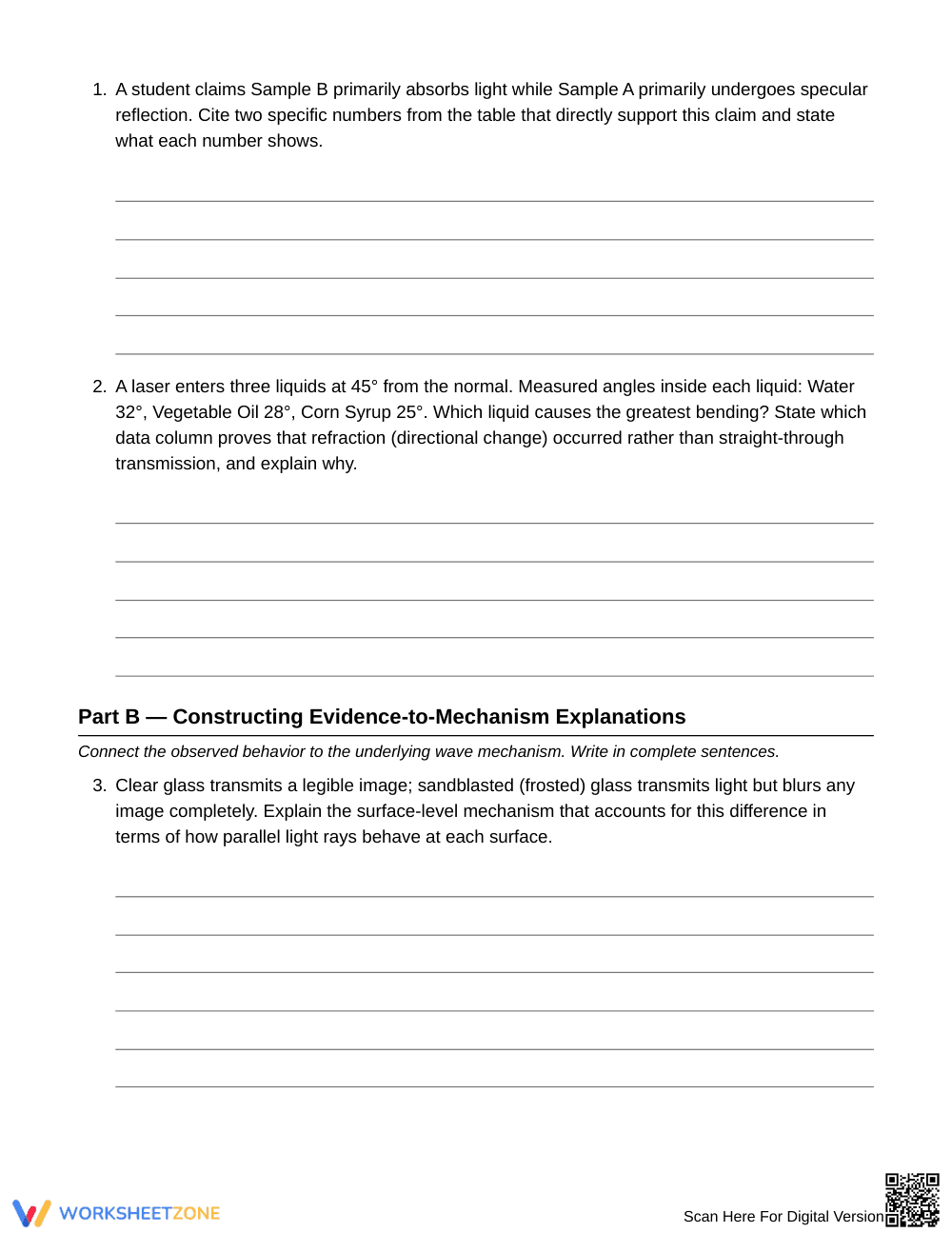
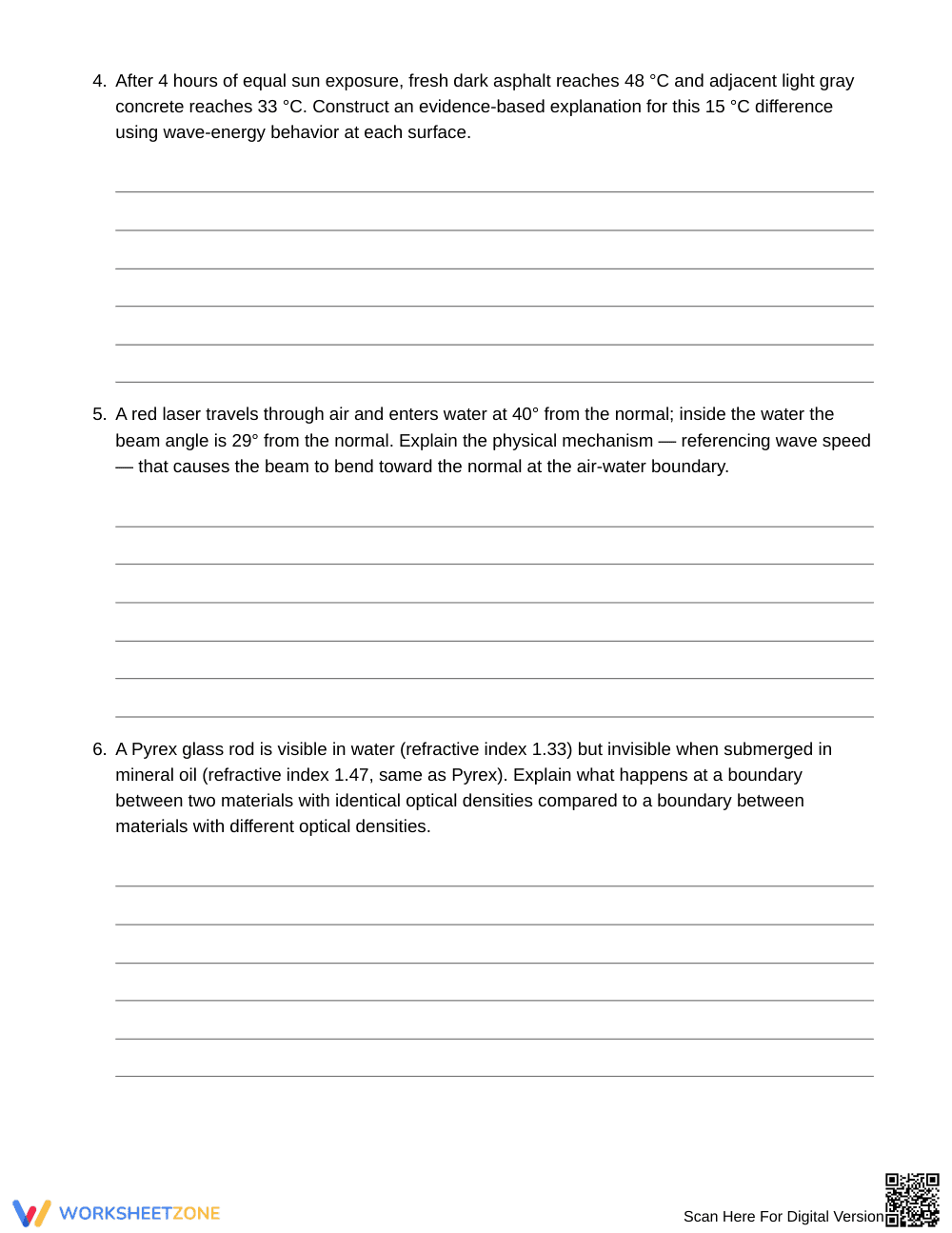
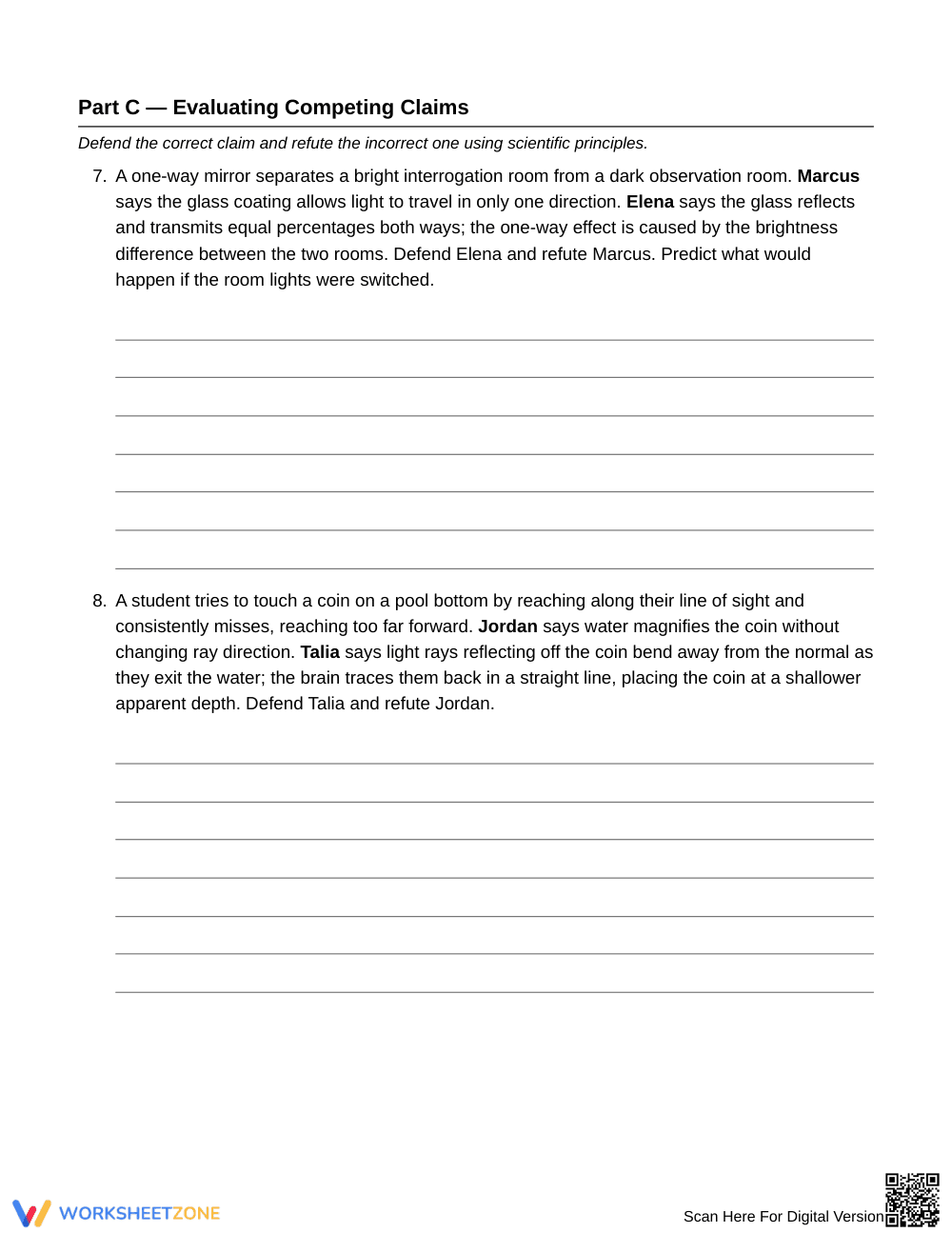
This Grade 6 physical science worksheet trains middle school students to defend material-based predictions by linking empirical data to underlying wave behaviors. Students evaluate how light reflects, absorbs, transmits, and refracts across diverse surfaces. Through eight rigorous analysis items, learners cite quantitative evidence, explain wave mechanisms, and evaluate competing scientific claims to achieve conceptual mastery.
At a Glance
- Grade: 6 · Subject: Science
- Standard: Physical Science: Waves — Defend predictions about how light interacts with matter using observable evidence
- Skill Focus: Defend a Material-Based Prediction
- Format: 4 pages · 8 problems · Answer key included · PDF
- Best For: Light wave conceptual mastery and assessment
- Time: 45–55 minutes
Across 4 structured pages, this resource features eight challenging, multi-part tasks accompanied by an integrated student reference box and a 3-page explanatory answer key. Students interpret synthetic experimental data tables measuring lux and thermal rise, write mechanistic explanations of wave speed and surface texture, and critique authentic student arguments regarding optical phenomena like refraction and one-way mirrors.
Skill Progression
- Guided Practice (Part A): Students examine synthetic laboratory data tables to identify quantitative evidence supporting claims about specular reflection, absorption, and refraction angles across 2 structured questions.
- Supported Practice (Part B): Learners write 4 evidence-to-mechanism explanations, connecting surface structures and changing wave speeds to thermal absorption, image diffusion, and optical density.
- Independent Practice (Part C): Working independently, students analyze 2 real-world optical scenarios, defending accurate scientific claims while refuting misconceptions using wave interaction principles.
This sequence mirrors the gradual-release model, transitioning students from scaffolded data interpretation to independent scientific argumentation.
Standards Alignment
This worksheet aligns with middle school physical science standards for waves and light interactions, requiring students to develop and use models explaining that wave reflection, absorption, and transmission depend on the medium. Both standard codes can be copied directly into lesson plans, IEP goals, or district curriculum mapping tools.
How to Use It
Deploy this 4-page worksheet immediately after direct instruction on wave reflection, refraction, and absorption. For mid-unit formative assessment, observe Part B responses to verify whether students attribute bending to wave speed shifts rather than density alone. Students typically complete the 8 tasks within 45 to 55 minutes during classwork or paired problem-solving sessions.
Who It's For
This activity serves general Grade 6 science classrooms, advanced Grade 5 students, and Grade 7 review groups. Sentence frames and the introductory reference guide provide targeted differentiation for developing writers. Pair this worksheet directly with a hands-on ray-box lab or light absorption demonstration for maximum conceptual impact.
Mastering scientific argumentation requires students to connect empirical observations directly to invisible physical mechanisms. According to Fisher & Frey (2014), structured argumentation tasks that prompt students to defend valid claims and refute plausible misconceptions significantly strengthen conceptual retention compared to passive definition recall. This Grade 6 physical science worksheet provides deliberate practice defending material-based predictions across 8 rigorous tasks. Learners synthesize quantitative data from reflection and absorption experiments, describe how wave speed variations govern refraction, and resolve competing claims about optical density and transmission. By requiring students to articulate evidence-based rationales rather than merely selecting answers, the resource embeds essential disciplinary literacy within core wave mechanics. Teachers obtain actionable diagnostic data regarding student mastery of light-matter interactions, ensuring learners build durable reasoning skills foundational for subsequent secondary physical science coursework and standardized assessments.


