































Complete Matching Nets to Solids Worksheet | Grade 6 Math

Paste this activity's link or code into your existing LMS (Google Classroom, Canvas, Teams, Schoology, Moodle, etc.).
Students can open and work on the activity right away, with no student login required.
You'll still be able to track student progress and results from your teacher account.
Help sixth-grade math students master spatial reasoning and geometry with this structured worksheet on matching two-dimensional nets to three-dimensional solids. Students analyze face shapes, verify edge lengths, and evaluate folding patterns to connect flat nets with prisms and pyramids, building the foundational skills needed for surface area calculations.
At a Glance
- Grade: 6 · Subject: Math
- Standard:
6.G.A.4— Represent three-dimensional figures using nets made up of rectangles and triangles- Skill Focus: Match a Net to a Solid
- Format: 4 pages · 12 problems · Answer key included · PDF
- Best For: Geometry skill practice and review
- Time: 35–45 minutes
What's Inside
This 4-page printable resource contains 12 focused geometry tasks, visual net diagrams, and reference property charts for prisms and pyramids. Students work with rectangular prisms, triangular prisms, square pyramids, and tetrahedrons. A complete 2-page answer key provides step-by-step solutions, edge correspondence proofs, and explanations for counterexamples.
Skill Progression
- Guided Practice: Tasks 1–4 use missing-step fill-ins and labeled diagrams to help students identify face pairings, verify dimension matches, and recognize invalid net arrangements.
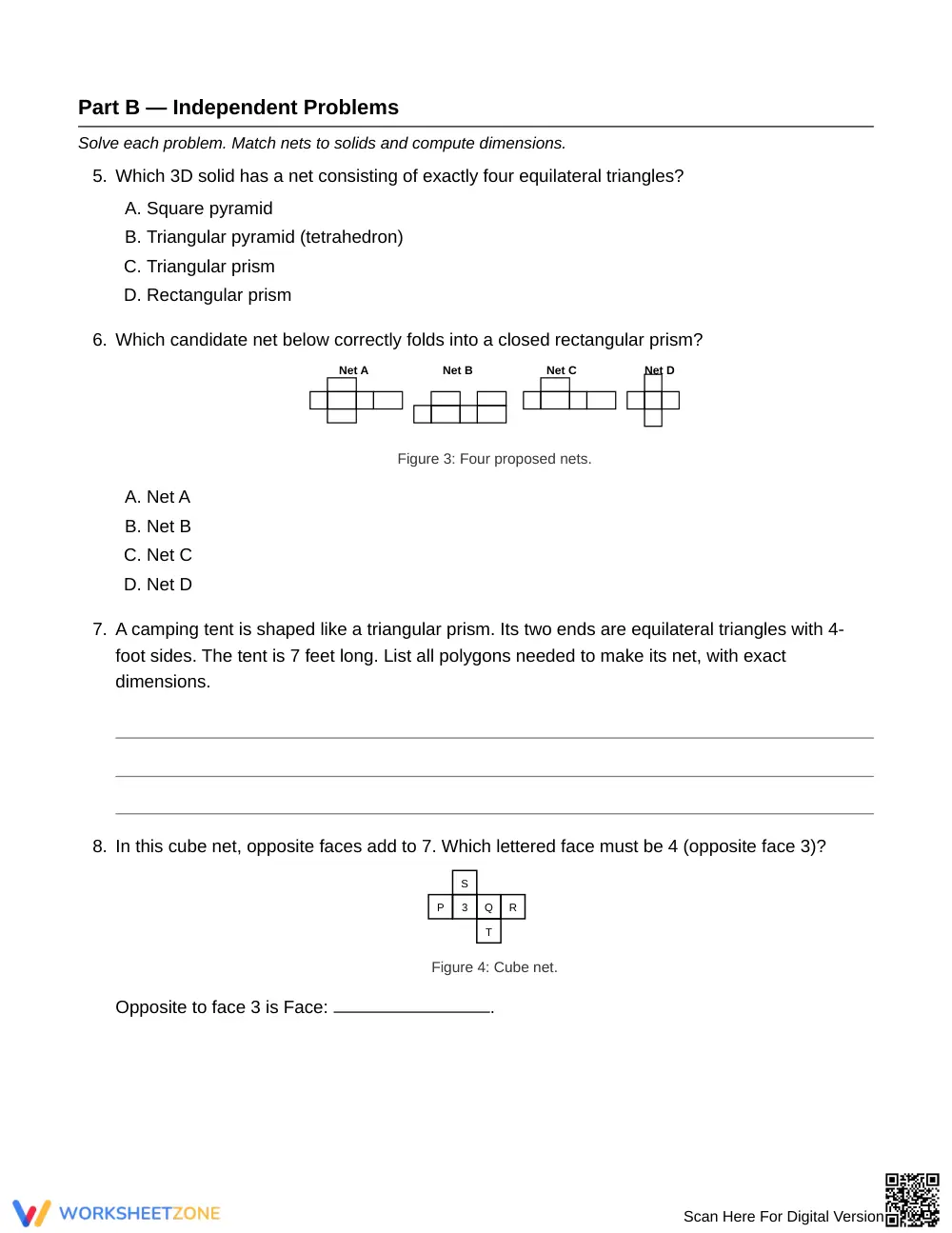
- Supported Practice: Tasks 5–10 challenge students with multiple-choice identification, dimensional tent modeling, cube net logic, and surface area calculations.
- Independent Practice: Tasks 11–12 require extended mathematical justifications to evaluate misconceptions and prove whether custom nets fold without overlap.
This sequence implements a gradual-release framework (I Do, We Do, You Do) that guides learners from concrete visual analysis to abstract geometric reasoning.
Standards Alignment
This resource aligns directly to 6.G.A.4: Represent three-dimensional figures using nets made up of rectangles and triangles, and use the nets to find the surface area of these figures. Both standard codes can be copied directly into lesson plans, IEP goals, or district curriculum mapping tools.
How to Use It
Use this worksheet after direct instruction on three-dimensional solids or during small-group remediation. To formatively assess student understanding, observe how learners verify edge correspondences in Part A before allowing them to tackle the reasoning proofs in Part C. The complete set requires approximately 35 to 45 minutes of instructional time, making it suitable for single-period practice or split-day partner tasks.
Who It's For
This practice set is designed for Grade 6 general education students, introductory geometry units, and targeted intervention groups. For students needing additional visual support, pair this activity with hands-on folding manipulatives or an interactive solid-geometry anchor chart illustrating face correspondences before beginning independent work.
According to instructional research by Fisher & Frey (2014) on the gradual release of responsibility, middle school students develop deeper geometric reasoning when instructional scaffolds deliberately transition them from guided component analysis to independent justification. Aligned to Common Core standard 6.G.A.4, this Grade 6 mathematics resource develops essential spatial visualization skills by requiring learners to represent three-dimensional figures using nets made up of rectangles and triangles. Students systematically examine edge correspondences, verify congruent face alignments, and evaluate mathematical counterexamples across twelve targeted tasks. By pairing visual models with structured missing-step completions and analytical explanations, the worksheet ensures students connect two-dimensional net layouts directly to three-dimensional solids and surface area calculations. This research-based sequence offers teachers an effective tool for tracking conceptual mastery across general instruction, small-group intervention, and ongoing standards-based progress monitoring routines.


