

































Complete Literary Criticism Worksheet | Grade 12 English IV

Paste this activity's link or code into your existing LMS (Google Classroom, Canvas, Teams, Schoology, Moodle, etc.).
Students can open and work on the activity right away, with no student login required.
You'll still be able to track student progress and results from your teacher account.
This literary criticism worksheet equips Grade 12 English IV students to interrogate complex prose through Marxist, New Historicist, and Formalist analytical lenses. Students examine an original historical industrial narrative, tracing how class conflict, civic mythmaking, and narrative indeterminacy shape meaning to produce rigorous, textually supported claims grounded in advanced literary theory.
At a Glance
- Grade: 12 · Subject: English IV
- Standard:
RL.11-12.1— Cite strong textual evidence to support analysis and evaluate textual uncertainties- Skill Focus: Critical theoretical analysis and narrative ambiguity
- Format: 6 pages · 12 problems · Answer key included · PDF
- Best For: Advanced literary analysis and AP prep
- Time: 45–60 minutes
What's Inside
The 6-page printable resource includes an anchor narrative, "The Weight of the Casting," paired with 12 targeted analytical tasks spanning multiple-choice lens checks, targeted text citations, short-answer evaluations, and a multi-perspective synthesis prompt. A concise theory reference guide defines the three theoretical lenses directly on the page, and a comprehensive 3-page explanatory answer key provides model evidence and interpretive rationale for every prompt.
Skill Progression
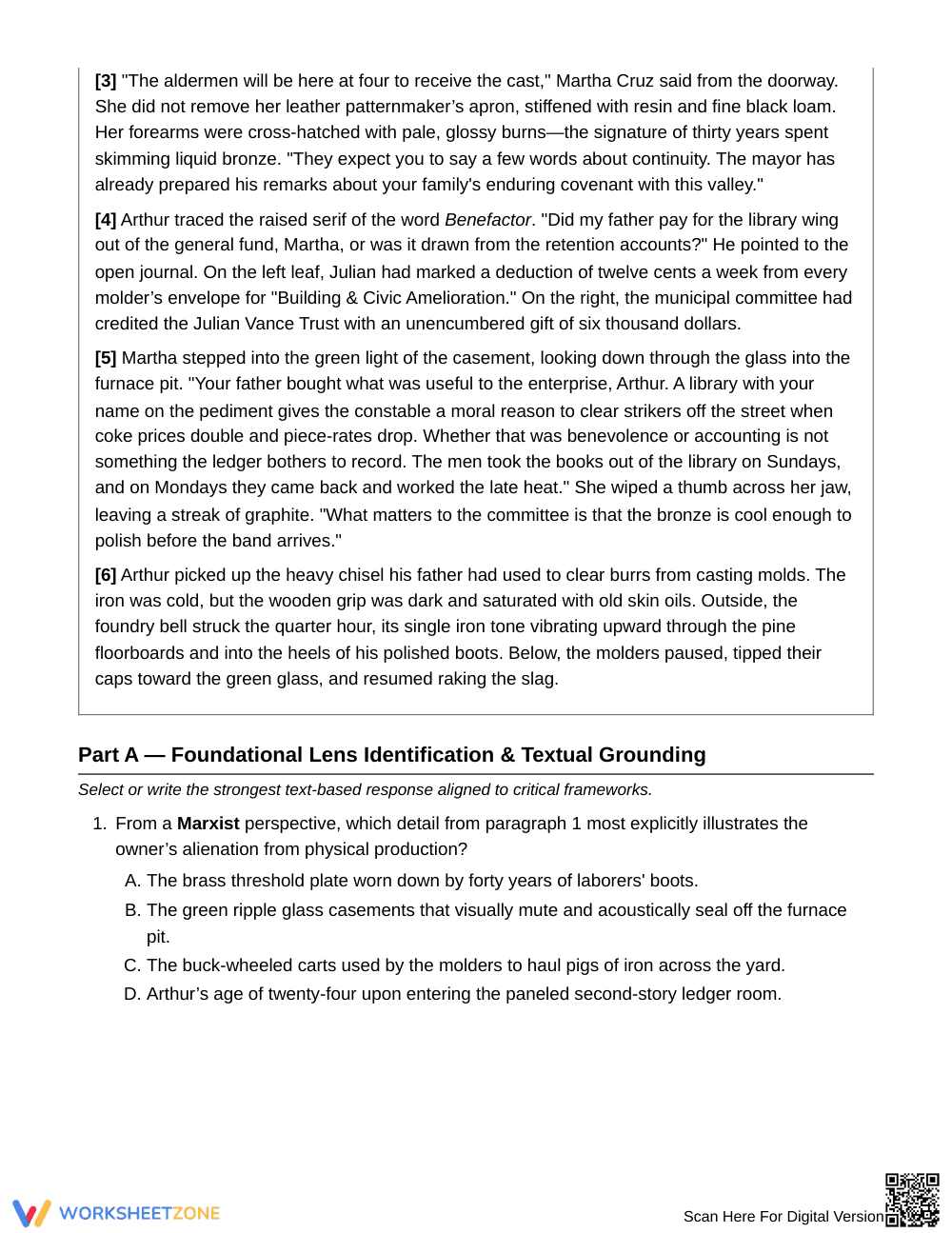
- Guided practice: Tasks 1–3 establish foundational recognition, prompting students to isolate specific details in the exposition that demonstrate labor alienation, municipal mythmaking, and formal paradox.
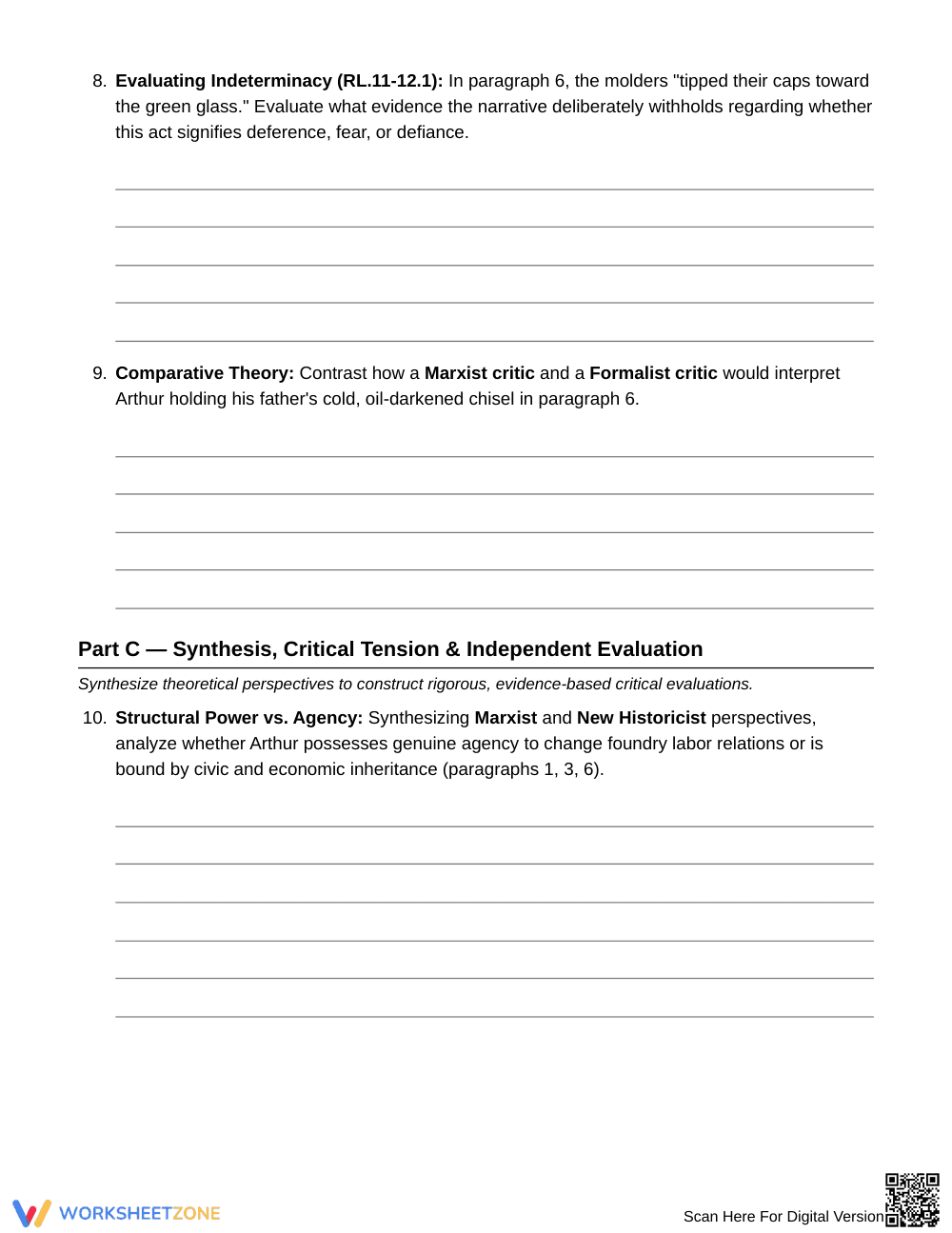
- Supported practice: Tasks 4–9 require deeper textual excavation, directing students to analyze structural juxtaposition, commodified philanthropy, and deliberately withheld narrative motives across multiple paragraphs.
- Independent practice: Tasks 10–12 demand high-level synthesis, where students evaluate narrative silence, contrast theoretical methodologies, and construct an authoritative evaluative claim.
This structured progression reflects the gradual release of responsibility model, transitioning students systematically from framework identification to sophisticated independent critique.
Standards Alignment
This worksheet directly targets RL.11-12.1, requiring learners to cite strong, thorough textual evidence to support analysis of what the text says explicitly as well as inferences drawn from the text, including determining where the text leaves matters uncertain. Additionally, it addresses supporting standard RL.11-12.3 by analyzing the impact of authorial structural choices on thematic development. Both standard codes can be copied directly into lesson plans, IEP goals, or district curriculum mapping tools.
How to Use It
Deploy this resource during the application phase following direct instruction on critical theory, or assign it as an intensive seminar preparation activity before Socratic discussions. As a formative assessment observation tip, monitor Task 5 and Task 8 to verify whether students recognize textual gaps as deliberate craft decisions rather than comprehension errors. Typical completion time spans 45 to 60 minutes.
Who It's For
Designed for Grade 12 English IV, AP Literature, and honors secondary classrooms tackling advanced textual critique. The explicit lens reference box supports on-grade readers encountering theoretical critique for the first time, while the synthesis prompts offer rigorous depth for advanced scholars. It pairs naturally with anchor lessons on historical contextualization and critical Marxist or historicist essays.
According to research synthesized by Fisher & Frey (2014) on close reading and disciplinary literacy, high school students develop superior analytical autonomy when instructional tasks prompt them to systematically interrogate narrative gaps, perspective, and ideological framing. Aligned to Common Core standard RL.11-12.1, this Grade 12 resource operationalizes these findings by guiding students to evaluate explicit textual evidence alongside structural indeterminacy. Rather than treating narrative ambiguity as an interpretive obstacle, the 12 problems scaffold critical theoretical thinking across Marxist, New Historicist, and Formalist paradigms. By evaluating what an author deliberately withholds, students construct nuanced, evidence-based literary arguments that meet the demands of college-level textual inquiry.


