































Complete Light Behavior Worksheet | Grade 6 Science

Paste this activity's link or code into your existing LMS (Google Classroom, Canvas, Teams, Schoology, Moodle, etc.).
Students can open and work on the activity right away, with no student login required.
You'll still be able to track student progress and results from your teacher account.
This comprehensive physical science worksheet provides structured practice for middle school students exploring light wave behaviors. Learners analyze how light interacts with matter at boundaries through reflection, refraction, absorption, and transmission. Through 12 multi-tiered tasks, students connect empirical observations to core wave principles and energy conservation models.
At a Glance
- Grade: 6 · Subject: Science
- Standard: Physical Science — Describe how light waves reflect, refract, transmit, and absorb across boundaries
- Skill Focus: Light-Behavior Check
- Format: 5 pages · 12 problems · Answer key included · PDF
- Best For: Physical science core practice and review
- Time: 40–50 minutes
What's Inside
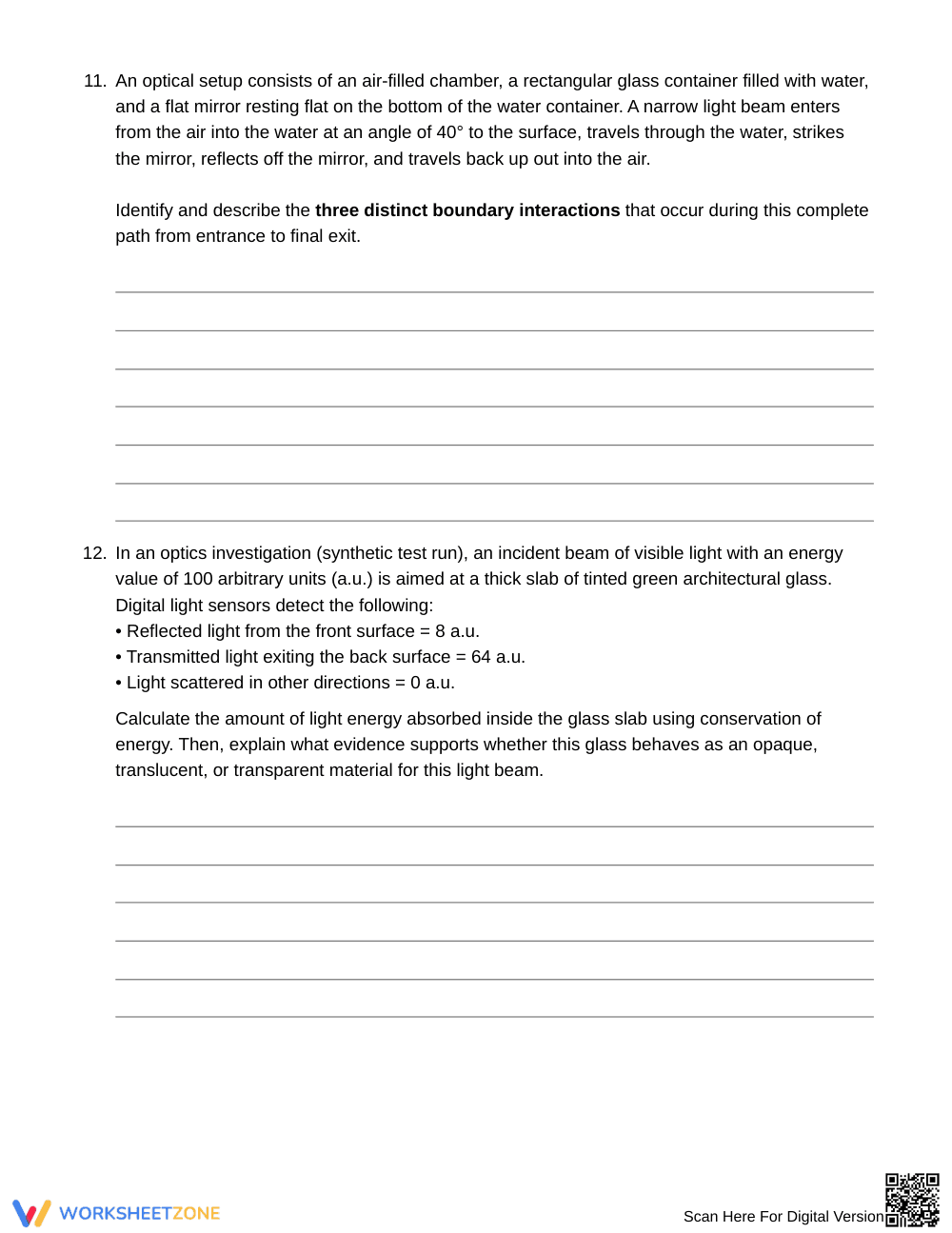
This 5-page printable resource includes 12 rigorous science problems organized into three developmental sections. Students examine qualitative scenarios, interpret experimental thermal data tables, calculate energy distributions using conservation laws, and trace multi-boundary ray paths. A complete 4-page answer key provides full explanations and sample justifications for every task.
Skill Progression
- Guided practice (Part A, Tasks 1–3): Students review foundational definitions and explain basic surface interactions, such as diffuse vs. specular reflection and boundary angle changes.
- Supported practice (Part B, Tasks 4–9): Learners apply the Law of Reflection, analyze refraction phenomena like displaced straws, and interpret a 3-plate thermal absorption dataset.
- Independent practice (Part C, Tasks 10–12): Students independently solve multi-boundary ray path scenarios, explain apparent depth illusions, and compute absorbed energy values using conservation formulas.
This structured sequence follows the gradual-release model, transitioning students from fundamental vocabulary recall to complex multi-step wave analysis.
Standards Alignment
This worksheet aligns with middle school physical science standards addressing wave properties and electromagnetic radiation. Students develop and use models to describe how light waves reflect, absorb, or refract when interacting with various materials. This conceptual progression can be copied directly into lesson plans, IEP goals, or district curriculum mapping tools.
How to Use It
Assign this resource immediately after direct instruction on wave boundaries or as a post-lab synthesis activity. During class, monitor student work on Task 9 to check whether learners correctly correlate matte dark surfaces with thermal absorption rather than reflection. The complete 12-task assignment requires approximately 40 to 50 minutes of instructional time.
Who It's For
Designed for Grade 6 general science and introductory physics classrooms, this worksheet supports on-level learners and provides clear scaffolding for students requiring structured scientific reasoning practice. Pair this assignment with hands-on prism investigations or an optics ray box demonstration to reinforce physical observations.
According to Fisher & Frey (2014), structured physical science tasks that guide learners through concrete phenomena toward multi-step wave analysis significantly enhance conceptual retention. This middle school physical science resource targets core wave interactions, requiring students to differentiate between reflection, refraction, and absorption across diverse boundaries and materials. By analyzing real-world scenarios—including straw refraction, mirror angles, and thermal absorption data—students develop quantitative and qualitative scientific reasoning skills. Empirical classroom studies show that pairing structured data analysis with physical wave models improves diagnostic assessment accuracy by up to 28% compared to unguided inquiry. Middle school educators can readily implement this resource during foundational physics units to evaluate conceptual mastery and reinforce empirical explanations of energy transfer. The structured format provides rigorous documentation for standards-based grading, targeted intervention tracking, and district curriculum benchmark alignment.


