




























Views
Downloads




Complete Justifying 3D Measures Worksheet | Grade 6 Math

Paste this activity's link or code into your existing LMS (Google Classroom, Canvas, Teams, Schoology, Moodle, etc.).
Students can open and work on the activity right away, with no student login required.
You'll still be able to track student progress and results from your teacher account.
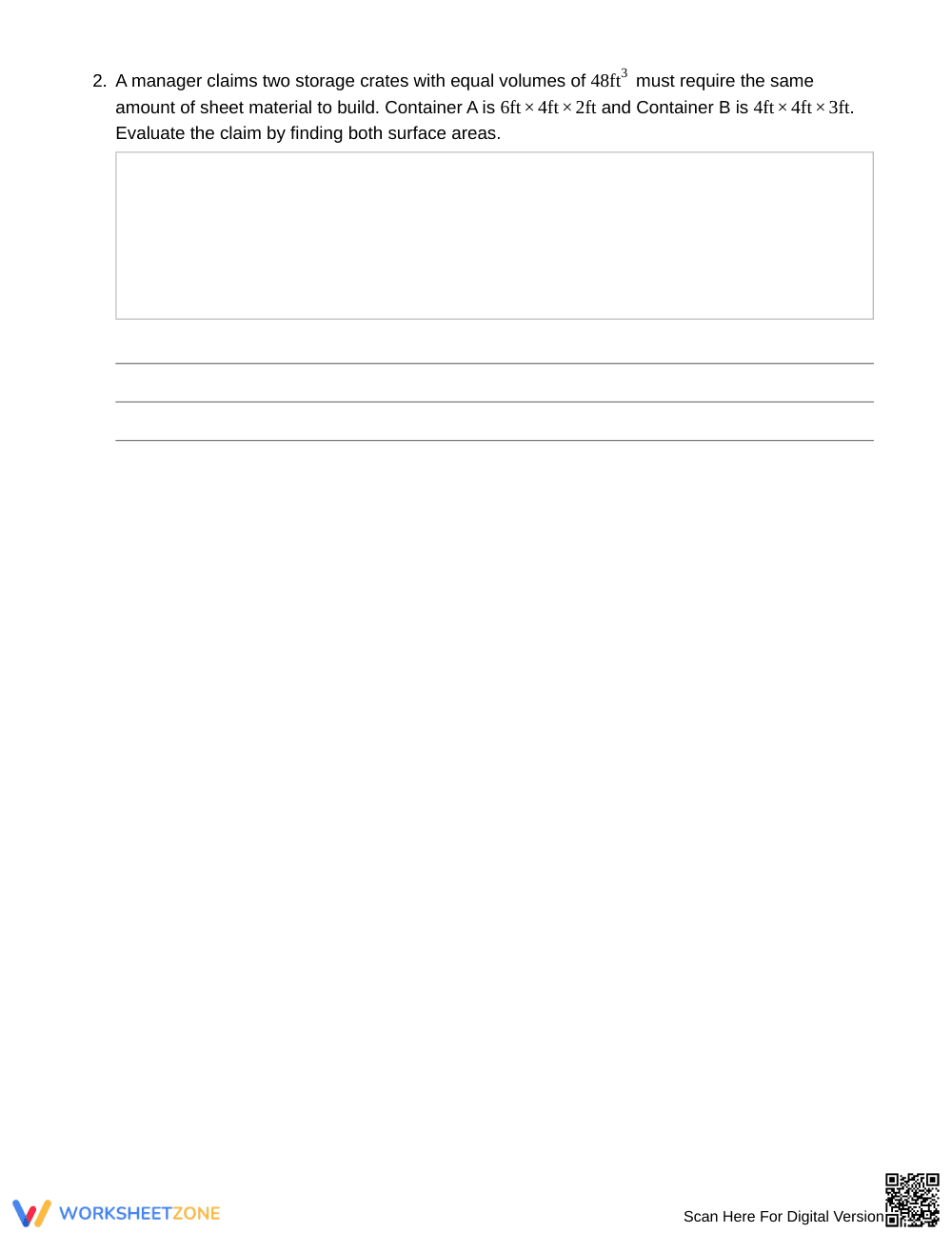
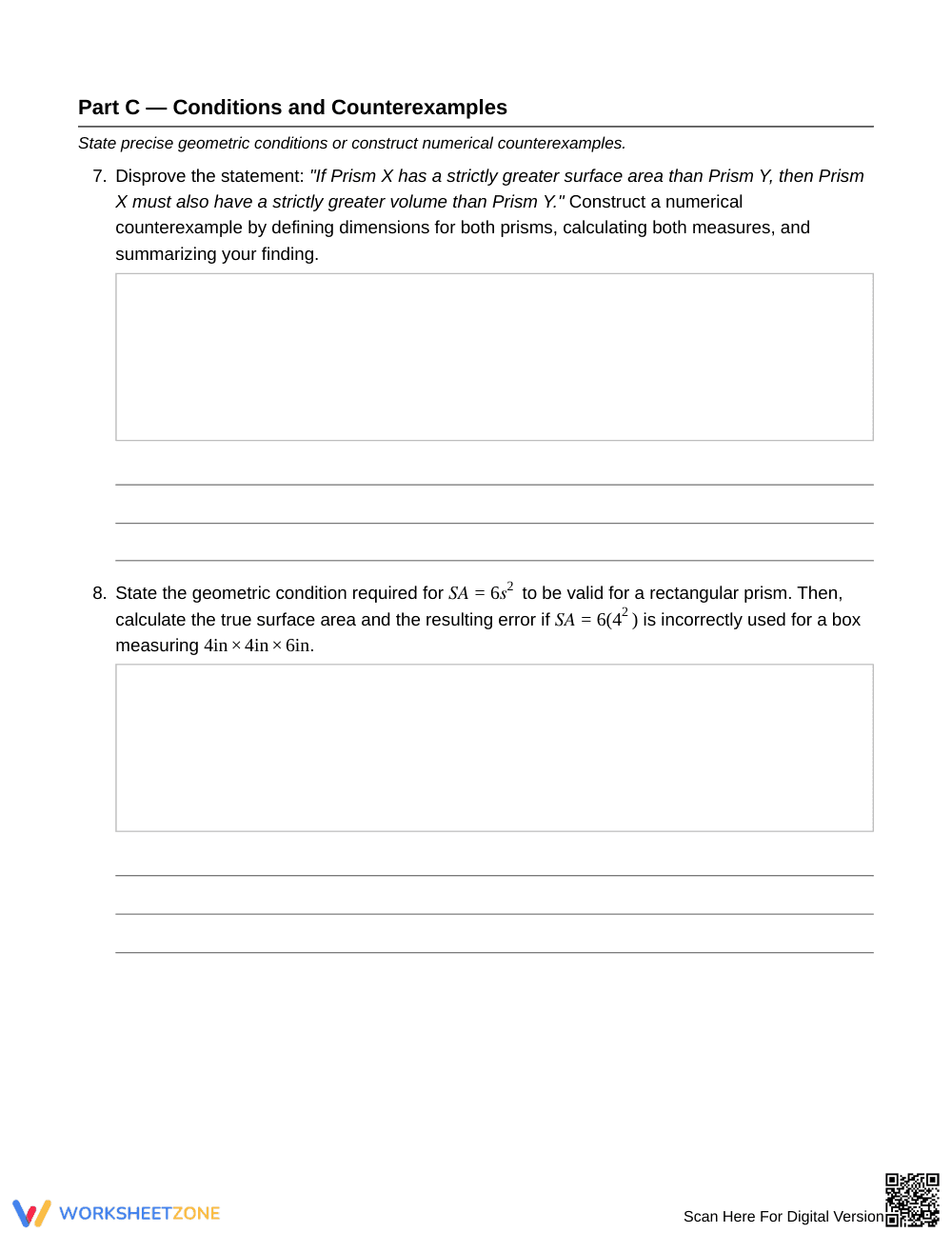
This rigorous Grade 6 geometry worksheet guides students to justify three-dimensional measurement calculations through mathematical discourse, algebraic modeling, and counterexamples. Rather than passively calculating surface area and volume, learners evaluate real-world claims, defend computational formulas using geometric nets, and test measurement limits across 8 multi-step reasoning tasks.
At a Glance
- Grade: 6 · Subject: Mathematics
- Standard: Three-Dimensional Geometry — Represent three-dimensional rectangular prisms using nets and justify volume and surface area formulas
- Skill Focus: Justify a Three-Dimensional Measure
- Format: 5 pages · 8 complex problems · Full answer key included · Printable PDF
- Best For: Conceptual geometry reasoning and formal proof practice
- Time: 45–60 instructional minutes
This 5-page packet delivers 8 structured analytical tasks supported by a reference box outlining prism definitions and formulas. Across 3 student pages, learners encounter net diagrams, fractional dimension modeling with unit cubes, and algebraic justifications. A 2-page answer key provides complete step-by-step mathematical proofs and counterexamples for immediate evaluation.
Skill Progression
- Guided Practice (Part A): Students evaluate 2 real-world mathematical claims regarding dimension scaling and volume-to-surface-area ratios, calculating exact values to verify validity.
- Supported Practice (Part B): Learners tackle 4 justification problems using nets, unit cubes, and algebraic manipulations to explain formula derivations and surface area modifications.
- Independent Practice (Part C): Students independently generate numerical counterexamples and establish precise geometric constraints to disprove false generalizations across 2 rigorous proof prompts.
This sequence follows a gradual-release instructional model, transitioning students from scaffolded claim evaluation to self-directed mathematical proof and counterexample generation.
Standards Alignment
This resource aligns with Grade 6 geometry standards requiring students to solve problems involving area, surface area, and volume. Students represent three-dimensional prisms using nets to determine surface area, and pack prisms with fractional unit cubes to justify volume. Both standard codes can be copied directly into lesson plans, IEP goals, or district curriculum mapping tools.
How to Use It
Deploy this worksheet after direct instruction on surface area nets and volume calculations to deepen conceptual understanding. During partner work, have students complete Part A and Part B collaboratively, observing whether learners use distributive properties or simply memorize procedural formulas. Part C works well as an independent exit ticket or summative checkpoint. Expected completion time ranges from 45 to 60 minutes.
Who It's For
This activity is designed for Grade 6 math classrooms transitioning from procedural calculation to mathematical justification. It provides extension opportunities for advanced learners through algebraic proofs while offering visual net scaffolds for students requiring concrete spatial support. Pair this resource with a hands-on nets manipulatives lesson or three-dimensional geometric solids demonstration.
Developing mathematical justification skills in three-dimensional geometry enables middle school students to move beyond rote formula memorization toward conceptual mastery. This Grade 6 mathematics resource targets justifying three-dimensional measures by requiring learners to defend surface area derivations, analyze packing volumes with fractional unit cubes, and construct numerical counterexamples. According to findings highlighted by Fisher & Frey (2014), structured instructional sequences that guide students from collaborative claim analysis to independent justification significantly strengthen conceptual retention and mathematical reasoning. By evaluating false assertions and articulating geometric properties with formal algebraic arguments, students cultivate analytical precision and spatial reasoning. The 8-task progression equips educators with targeted formative evidence to diagnose procedural gaps versus structural misunderstandings. Consequently, this instructional material provides a rigorous framework for mastering three-dimensional measurement principles, ensuring middle school mathematicians can articulate why geometric formulas function across diverse rectangular prism dimensions.


