































Complete Juneteenth Word Search | Grades 6–7 Social Studies

Paste this activity's link or code into your existing LMS (Google Classroom, Canvas, Teams, Schoology, Moodle, etc.).
Students can open and work on the activity right away, with no student login required.
You'll still be able to track student progress and results from your teacher account.
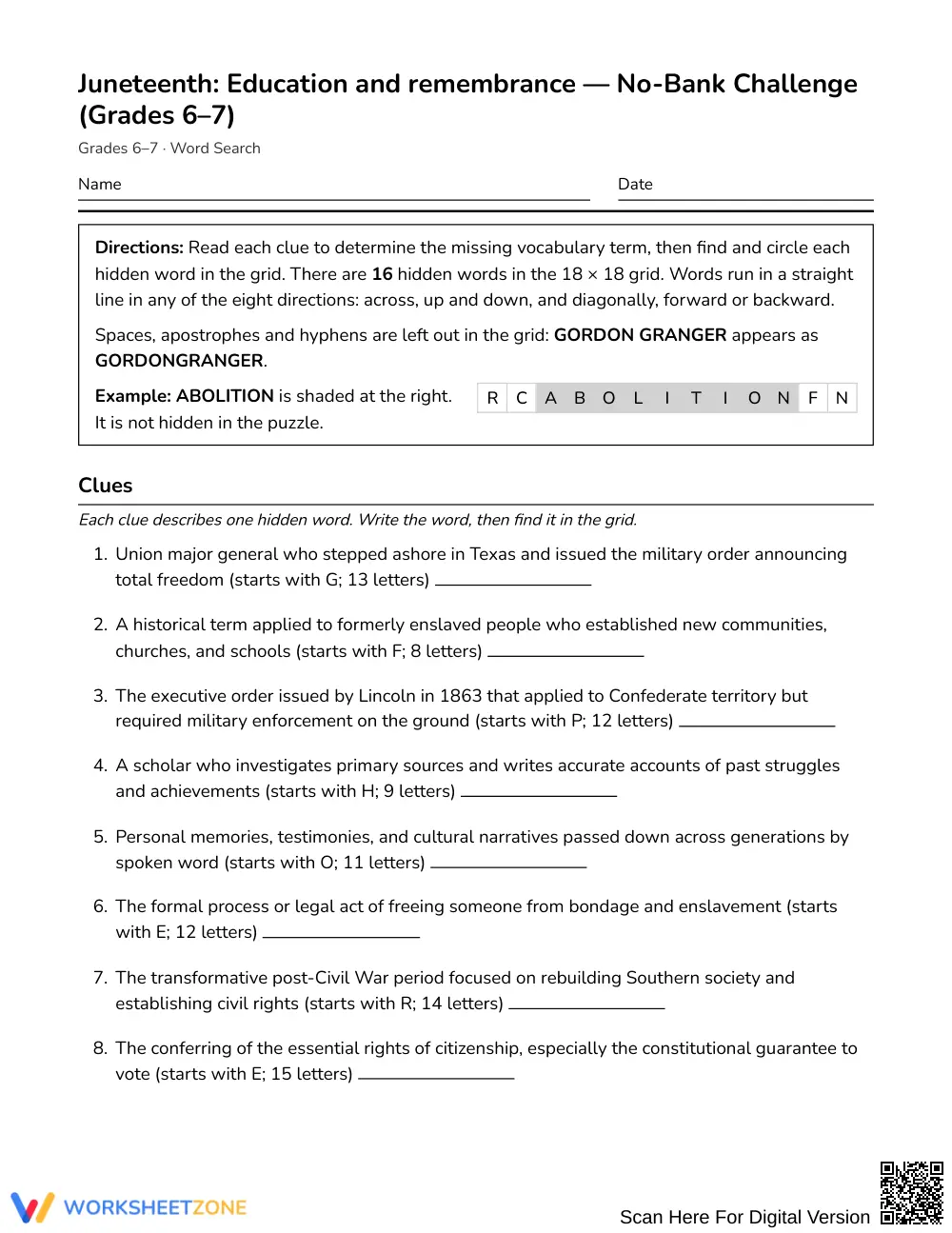
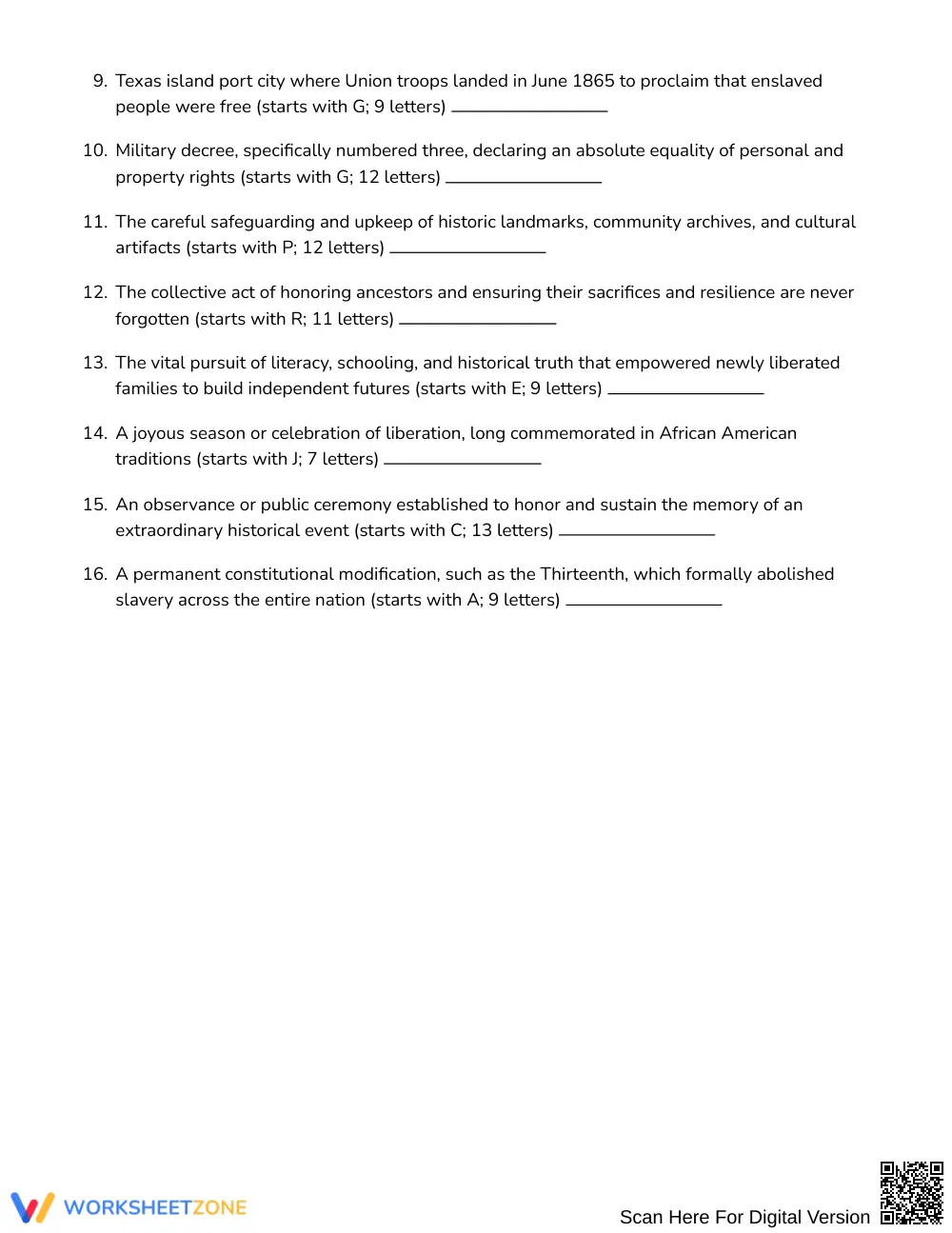
This Grades 6–7 social studies word search reinforces critical African American history vocabulary through a clue-driven discovery puzzle. Students analyze 16 distinct historical definitions to identify key terms related to Juneteenth, education, and remembrance before locating each word within the letter grid, deepening conceptual retention through active recall.
At a Glance
- Grade: Grades 6–7 · Subject: Social Studies
- Standard: Not standards-assessed — vocabulary enrichment
- Skill Focus: Education and remembrance
- Format: 3 pages · 16 words · Answer key included · PDF
- Best For: Juneteenth unit vocabulary enrichment
- Time: 25–35 minutes
What's Inside
This 3-page printable activity challenges learners with 16 essential historical terms connected to liberation, constitutional amendments, and cultural preservation. Rather than relying on a passive word bank, students must read thorough contextual clues to deduce each term before searching the puzzle. The resource includes a full 4-page answer key showing completed grid coordinates and verified solutions for rapid grading or self-checking.
Puzzle Mechanics
- Grid Dimensions: Built on an 18 x 18 letter matrix designed to challenge middle school search strategies.
- Search Trajectories: Words run in all 8 possible directions: north, northeast, east, southeast, south, southwest, west, and northwest.
- Clue-Based Identification: Contains no pre-listed word bank, requiring students to synthesize historical clues to determine every hidden target term.
Standards Alignment
This activity serves as dedicated vocabulary enrichment and is not aligned to a specific state or national standard. It provides supplementary historical literacy support to anchor thematic units on Reconstruction, emancipation, and civil rights history.
How to Use It
Deploy this puzzle as an engaging introductory task before direct instruction on General Order Number 3, or use it after reading primary sources to consolidate content vocabulary. During independent work, walk the room to observe which clues prompt reference checks in textbooks, noting terms like enfranchisement or emancipation that may require clarification. Expect learners to finish in 25 to 35 minutes.
Who It's For
Designed for middle school learners in Grades 6–7 exploring African American history, this no-bank challenge offers rigorous enrichment for general classrooms and social studies clubs. Pair it directly with an anchor reading on Union General Gordon Granger's arrival in Galveston or a timeline analysis of post-Civil War Reconstruction.
Content-area vocabulary acquisition relies heavily on spaced exposure and contextual definition analysis. According to Fisher & Frey (2014), intentional word study integrated into historical inquiry enhances domain-specific reading comprehension and long-term semantic memory. This puzzle requires middle school learners to retrieve key concepts through substantive clues—spanning pivotal historical terms such as emancipation, Jubilee, and oral history—rather than merely copying pre-printed spelling lists. By eliminating the word bank, the activity transforms routine pattern recognition into an evidence-based vocabulary exercise that reinforces the historical significance of Juneteenth and cultural remembrance across the curriculum.


