































Complete Joint Types Word Search | Grades 4–5 Science

Paste this activity's link or code into your existing LMS (Google Classroom, Canvas, Teams, Schoology, Moodle, etc.).
Students can open and work on the activity right away, with no student login required.
You'll still be able to track student progress and results from your teacher account.
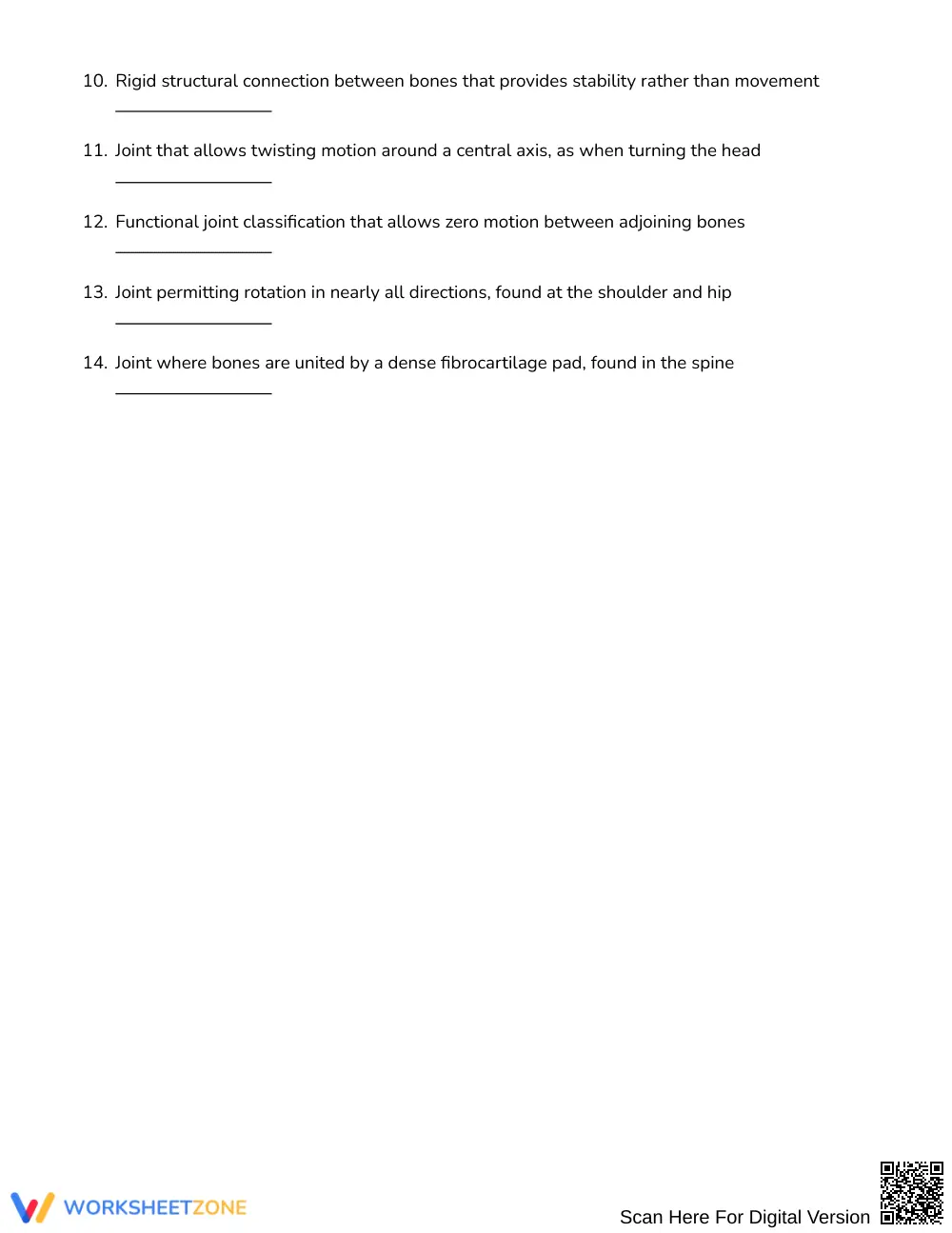
This skeletal system word search reinforces fundamental human anatomy terminology by challenging students to identify key joint classifications. Upper elementary learners read descriptive structural clues, match functional definitions to anatomical terms, and locate 14 vocabulary words within the puzzle grid, building scientific literacy and retention across your biology unit.
At a Glance
- Grade: Grades 4–5 · Subject: Science
- Standard: Not standards-assessed — vocabulary enrichment
- Skill Focus: Joint types
- Format: 3 pages · 14 words · Answer key included · PDF
- Best For: Vocabulary review and early finisher stations
- Time: 20–30 minutes
What's Inside: The printable PDF activity features a 3-page student packet centered on skeletal anatomy. Rather than a simple list, the activity incorporates a clue detective format where learners analyze 14 anatomical clues to deduce target vocabulary words. The package includes a full 3-page solution key displaying highlighted word paths for rapid verification.
Puzzle Mechanics
The puzzle is structured on a 16 × 16 letter grid containing 14 hidden vocabulary words. Terms run in four specific orientations: northeast, east, southeast, and south. Students encounter a shuffled word bank alongside descriptive anatomical clues that connect joint names—such as hinge, synovial, suture, and ball and socket—to their biomechanical functions in the human body.
Standards Alignment
This resource serves as targeted vocabulary enrichment and is not formally aligned to an individual state or national science standard. Instead, it supports foundational life science units on human body systems by strengthening domain-specific scientific vocabulary through active contextual recall and spelling reinforcement.
How to Use It
Deploy this word search during mid-unit review after direct instruction on skeletal articulations, or assign it as an independent science center task. For formative assessment, observe whether students identify joints using the functional clues before checking the letter grid, which demonstrates genuine conceptual mastery rather than passive letter scanning. Most learners complete the activity in 20 to 30 minutes.
Who It's For
This activity is designed for Grades 4–5 science students studying human organ systems and musculoskeletal mechanics. Teachers can support developing readers by reading the anatomical clues aloud or pairing this worksheet with a labeled human skeleton anchor chart and joint movement diagram to reinforce spatial and physical associations.
Domain-specific vocabulary acquisition forms the cornerstone of elementary science comprehension, providing the linguistic foundation necessary for understanding complex biological mechanisms. As highlighted by Fisher & Frey (2014), intentional vocabulary exposure that pairs conceptual definitions with active orthographic retrieval strengthens long-term memory retention and reading fluency across informational texts. Word puzzles that utilize context clues rather than isolated word lists require upper elementary learners to synthesize anatomical descriptions before locating terms, transforming passive search routines into purposeful cognitive processing. In this Grades 4–5 science word search focusing on joint types, students repeatedly process 14 anatomical terms through multiple sensory modalities—reading descriptive functional clues, recognizing spelling patterns across a 16 by 16 letter grid, and evaluating joint movements. This dual focus on structural definitions and word morphology deepens scientific literacy, equips students to engage in rigorous disciplinary discourse, and supports sustained mastery throughout elementary life science curricula.


