




























Views
Downloads



Complete Heat vs Cold Flow Worksheet | Grade 6 Science

Paste this activity's link or code into your existing LMS (Google Classroom, Canvas, Teams, Schoology, Moodle, etc.).
Students can open and work on the activity right away, with no student login required.
You'll still be able to track student progress and results from your teacher account.
This five-page worksheet targets a persistent misconception in middle-school physical science: the idea that cold is a substance that flows into warm objects. Through 15 sequenced tasks built around four demonstration data sets, students practice diagnosing flawed claims, applying particle-level explanations, and distinguishing conduction, convection, and radiation.
At a Glance
- Grade: 6 · Subject: Science
- Topic: Thermal Energy and Heat Transfer
- Skill Focus: Correcting heat vs. cold flow misconceptions using particle motion
- Format: 5 pages · 15 problems · Answer key included · PDF
- Best For: Formative practice after direct instruction
- Time: 35–50 minutes
What's Inside
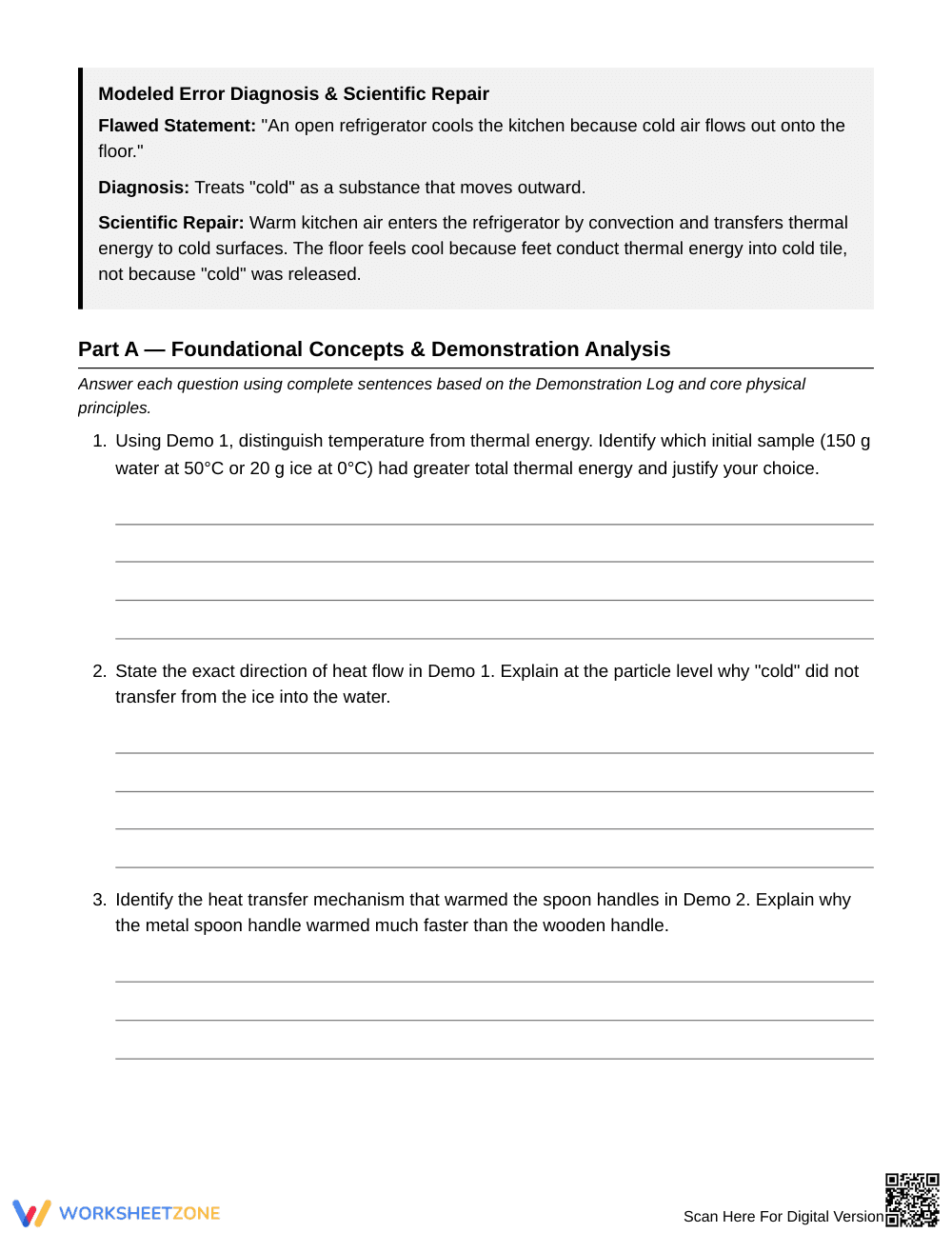
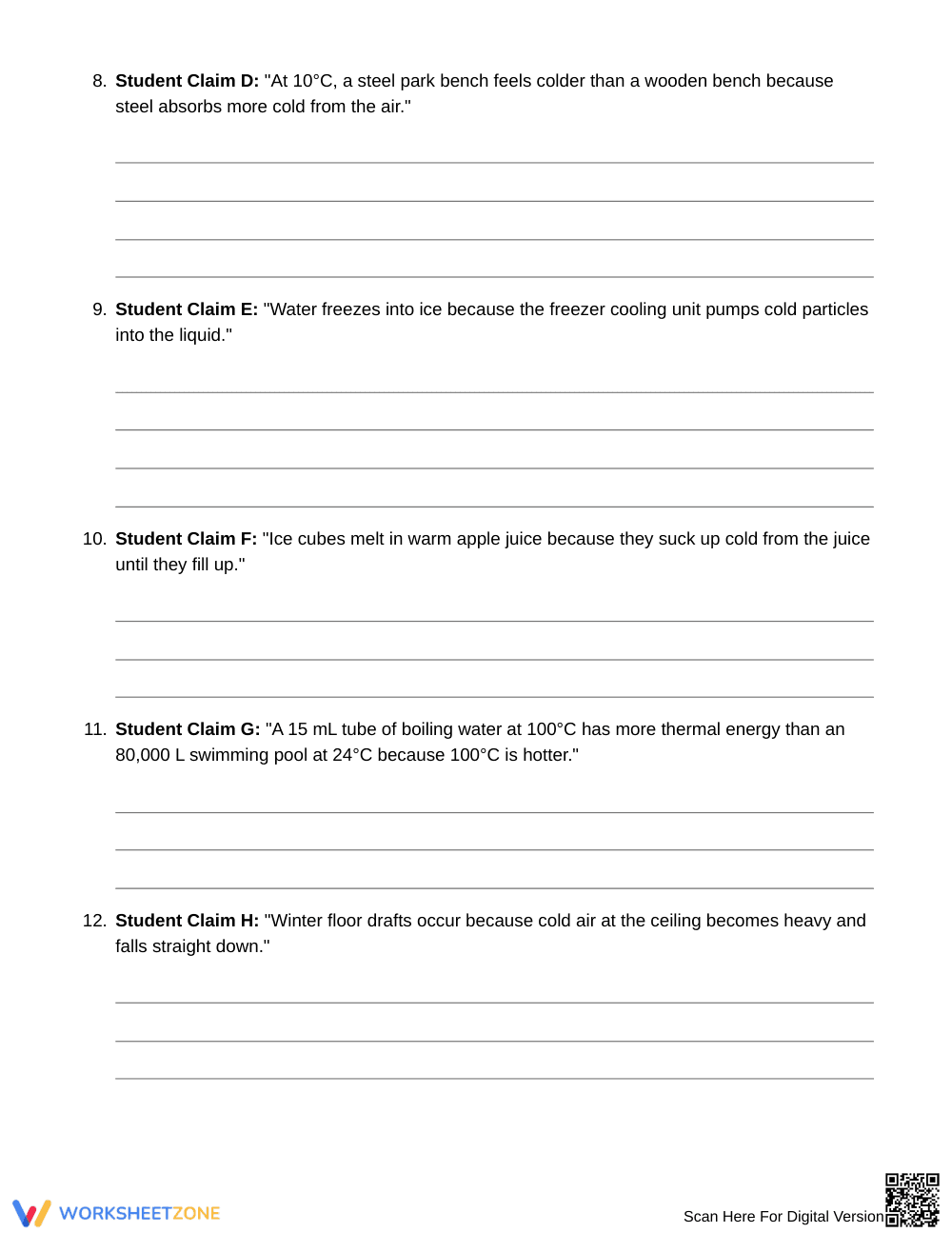
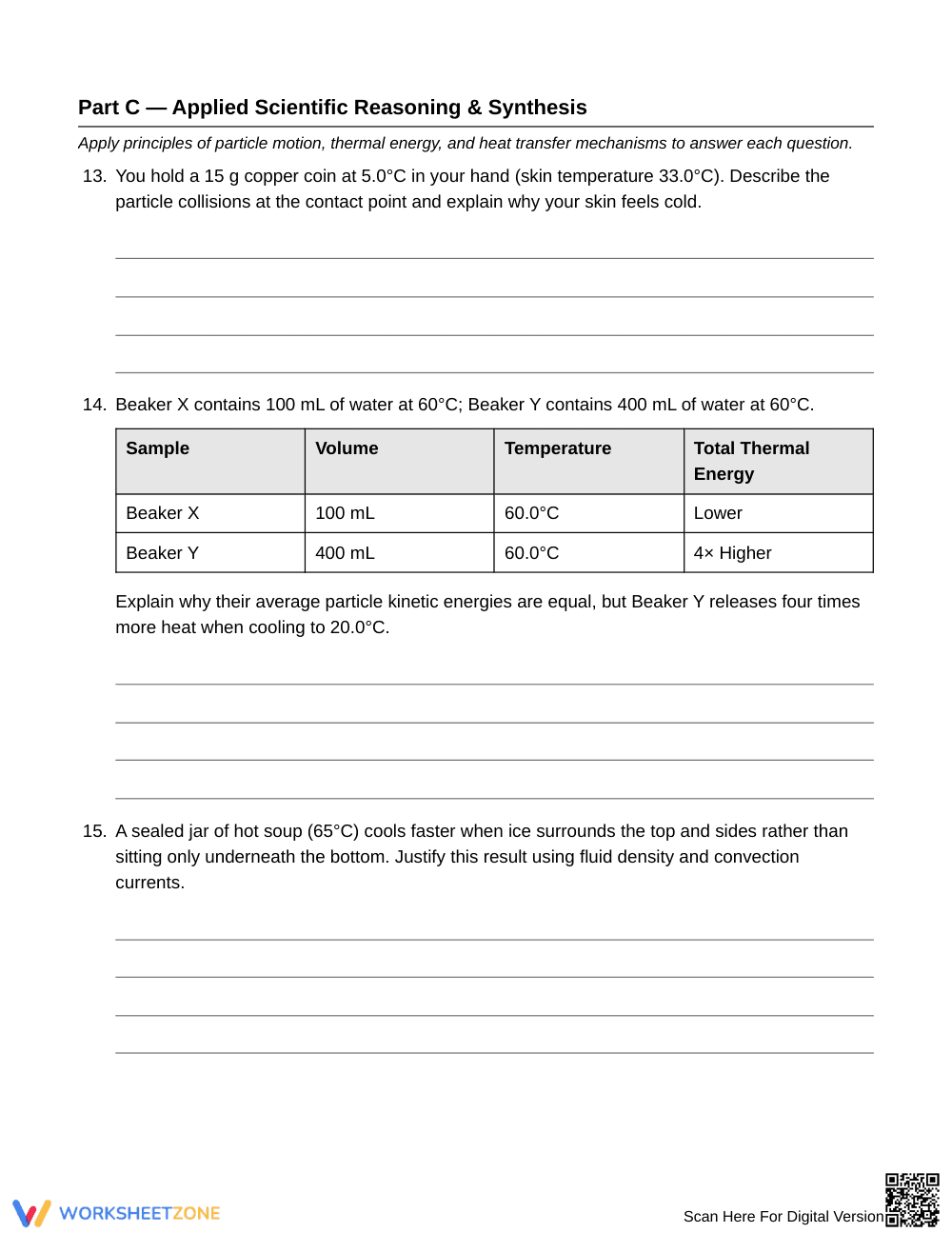
The worksheet opens with a concise reference box covering core principles: temperature versus thermal energy, heat transfer direction, and the three transfer mechanisms. Next, a demonstration log provides four data sets: ice in warm water, spoon conduction, fluid convection, and lamp radiation. A modeled example shows students how to identify flawed reasoning and write corrected explanations using particle motion. Part A (4 questions) analyzes demonstration data, Part B (8 questions) diagnoses student misconceptions, and Part C (3 questions) requires applied synthesis.
Skill Progression
- Guided Practice (Part A, 4 problems): Students analyze demonstration data using the reference box to verify heat transfer directions.
- Supported Practice (Part B, 8 problems): Students diagnose realistic misconceptions and rewrite each claim using particle collisions.
- Independent Practice (Part C, 3 problems): Students synthesize concepts across thermal mechanisms and evaluate energy differences across unequal volumes.
How to Use It
Assign Part A immediately following direct instruction to verify student comprehension of thermal definitions. Use Part B during partner work as a diagnostic checkpoint to identify students who still treat cold as a moving substance. Parts A through C easily fit a 35–50 minute class period, with Part C serving as an independent exit ticket.
This Grade 6 thermal energy worksheet gives students 15 structured opportunities to identify and correct the common misconception that cold flows from cooler objects to warmer ones. The target skill of explaining heat transfer direction using particle kinetic energy is recognized as a foundational milestone for physical science proficiency at the middle-school level. Students move systematically through demonstration analysis, error diagnosis of eight flawed student claims, and applied synthesis problems that require distinguishing conduction, convection, and radiation. The gradual-release instructional design aligns directly with research from Fisher and Frey (2014), who found that structured practice with progressive removal of scaffolds produces significantly stronger conceptual retention than unguided independent work. With a complete answer key spanning three pages and a print-ready PDF format, this five-page resource is ideally suited for in-class practice, small-group intervention, or formative review.


