




























Views
Downloads



Complete Heat Transfer Worksheet | Grade 6 Science

Paste this activity's link or code into your existing LMS (Google Classroom, Canvas, Teams, Schoology, Moodle, etc.).
Students can open and work on the activity right away, with no student login required.
You'll still be able to track student progress and results from your teacher account.
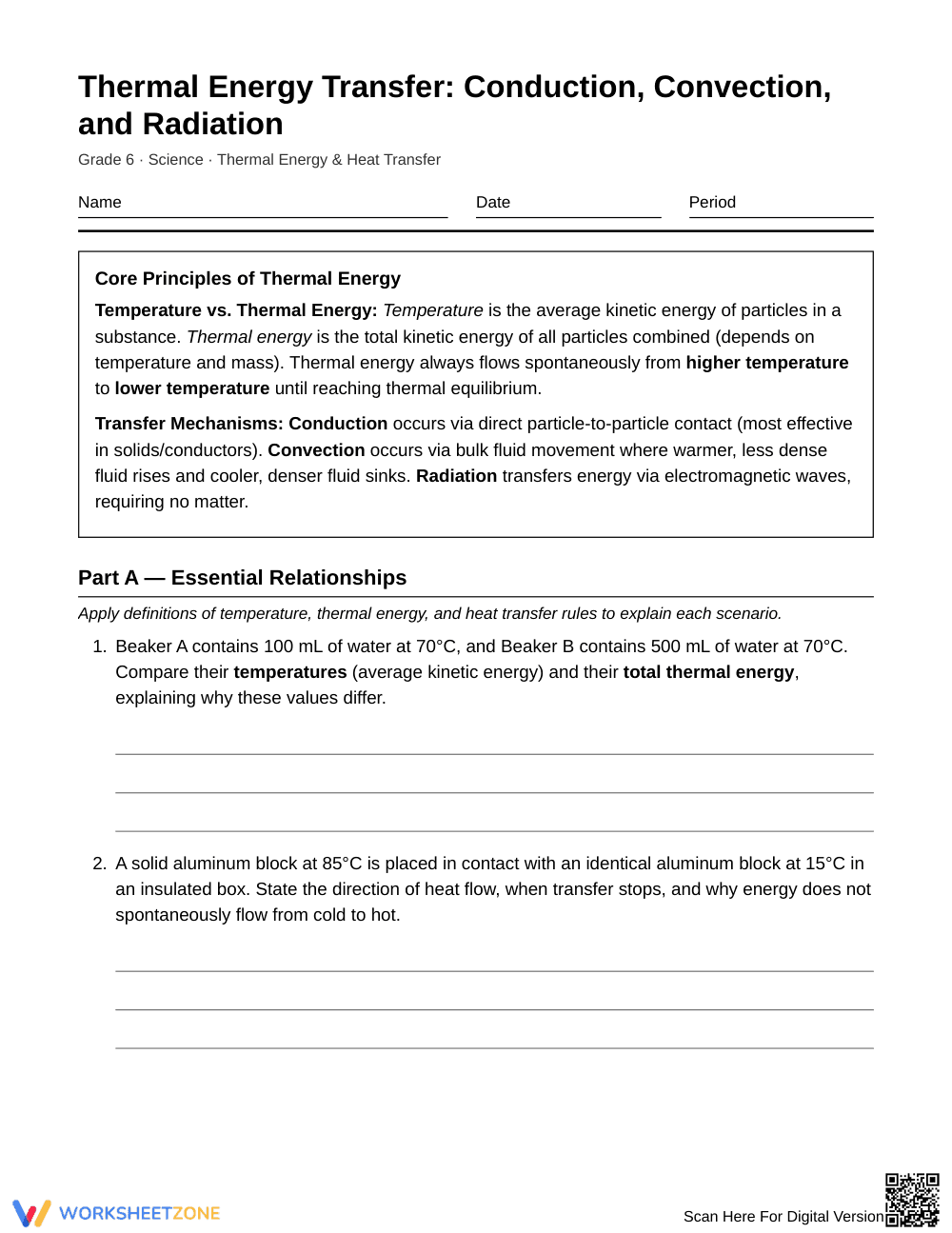
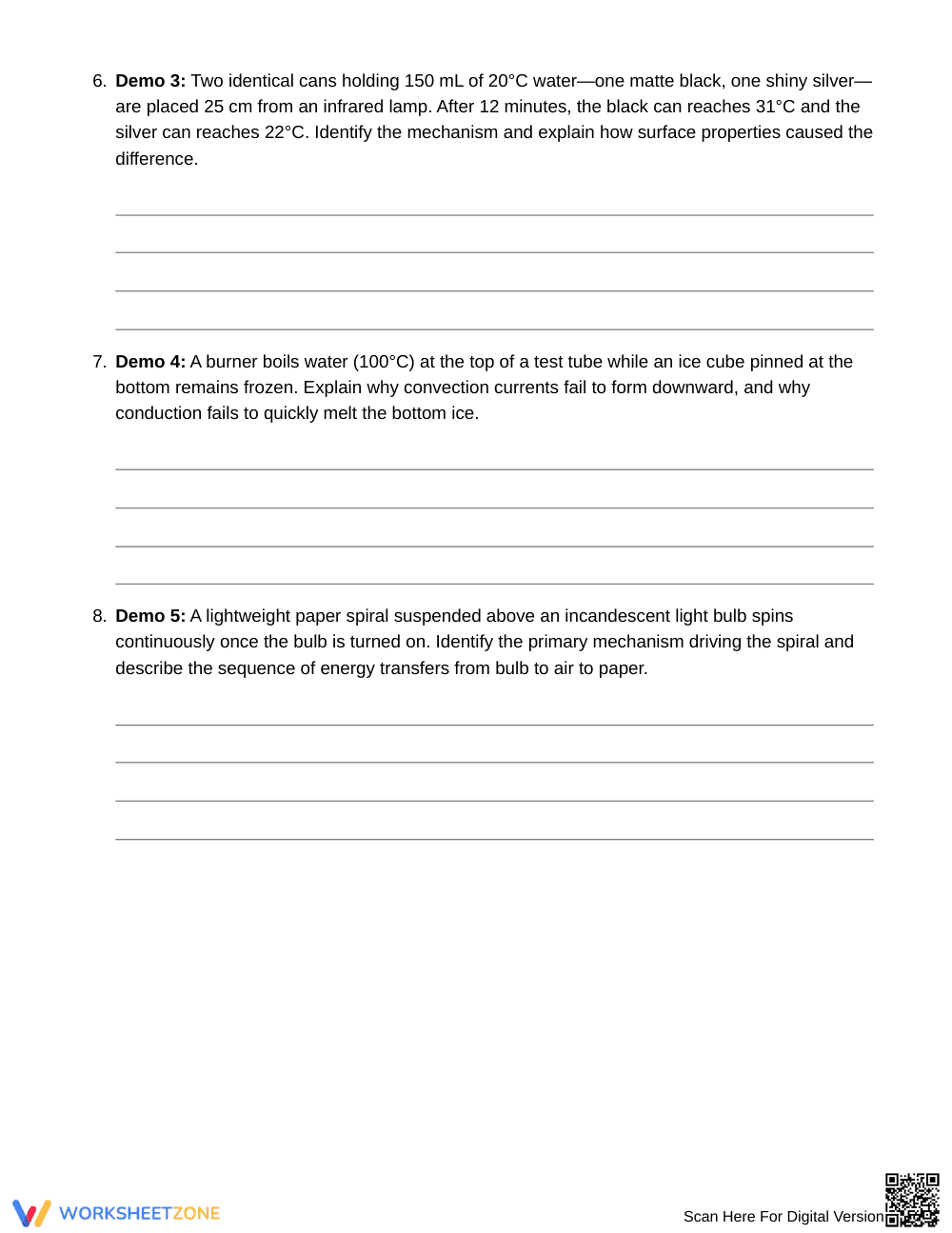
This five-page worksheet builds Grade 6 students' ability to distinguish conduction, convection, and radiation in real-world and laboratory scenarios. Through 12 carefully sequenced problems, learners move from foundational definitions of temperature and thermal energy to analyzing synthetic lab demonstrations and making predictions grounded in particle dynamics. A complete three-page answer key is included so teachers can review student reasoning efficiently.
At a Glance
- Grade: 6 · Subject: Science
- Skill Focus: Distinguishing conduction, convection, and radiation in everyday cases
- Format: 5 pages · 12 problems · Answer key included · PDF
- Best For: Practice after direct instruction on heat
- Time: 30–45 minutes
What's Inside
The worksheet opens with a concise rule box that defines temperature versus thermal energy, summarizes all three transfer mechanisms, and states the direction-of-flow rule. Students then work through three distinct parts: Part A (3 essential-relationship questions), Part B (6 demonstration-analysis tasks with quantitative data), and Part C (3 prediction-and-reasoning problems). Each task requires students to identify the mechanism, cite evidence from the scenario, and explain the underlying particle or wave behavior.
Skill Progression
- Guided practice (Part A, 3 problems): Students apply definitions directly, comparing thermal energy in beakers of different mass and tracing heat flow to thermal equilibrium.
- Supported practice (Part B, 6 problems): Synthetic lab data require students to interpret numerical observations before selecting a mechanism, grounding claims in physical evidence.
- Independent practice (Part C, 3 problems): Students predict thermal outcomes for novel engineering scenarios, applying principles without scaffolding.
How to Use It
Assign Parts A and B immediately after direct instruction on heat transfer; students can complete them in roughly 20 minutes as a formative check. Use Part C the following day as a warm-up or exit ticket to assess transfer of reasoning. Designed for on-grade sixth-grade physical science classes, this resource also supports partner discussions and small-group review.
This Grade 6 science worksheet supports middle school physical science curricula, asking students to distinguish conduction, convection, and radiation across 12 progressively complex scenarios. Research from the RAND AIRS 2024 report on science instructional materials confirms that students retain transfer-mechanism concepts more effectively when practice moves from definition recall to data interpretation to open-ended prediction, which reflects the three-part progression used here. The resource includes a rule box defining temperature, thermal energy, and all three mechanisms; six synthetic lab demonstrations with quantitative data points; three design-evaluation predictions; and a detailed three-page answer key. Educators can implement this print-and-go resource for direct instruction follow-up, partner investigations, or targeted formative evaluation. Covering five pages and requiring 30 to 45 minutes, the worksheet fits neatly within a single class period and provides clear evidence of student mastery for gradebook entry or long-term academic progress monitoring.


