




























Views
Downloads




Complete Heat Transfer Cooling Worksheet | Grade 6 Science

Paste this activity's link or code into your existing LMS (Google Classroom, Canvas, Teams, Schoology, Moodle, etc.).
Students can open and work on the activity right away, with no student login required.
You'll still be able to track student progress and results from your teacher account.
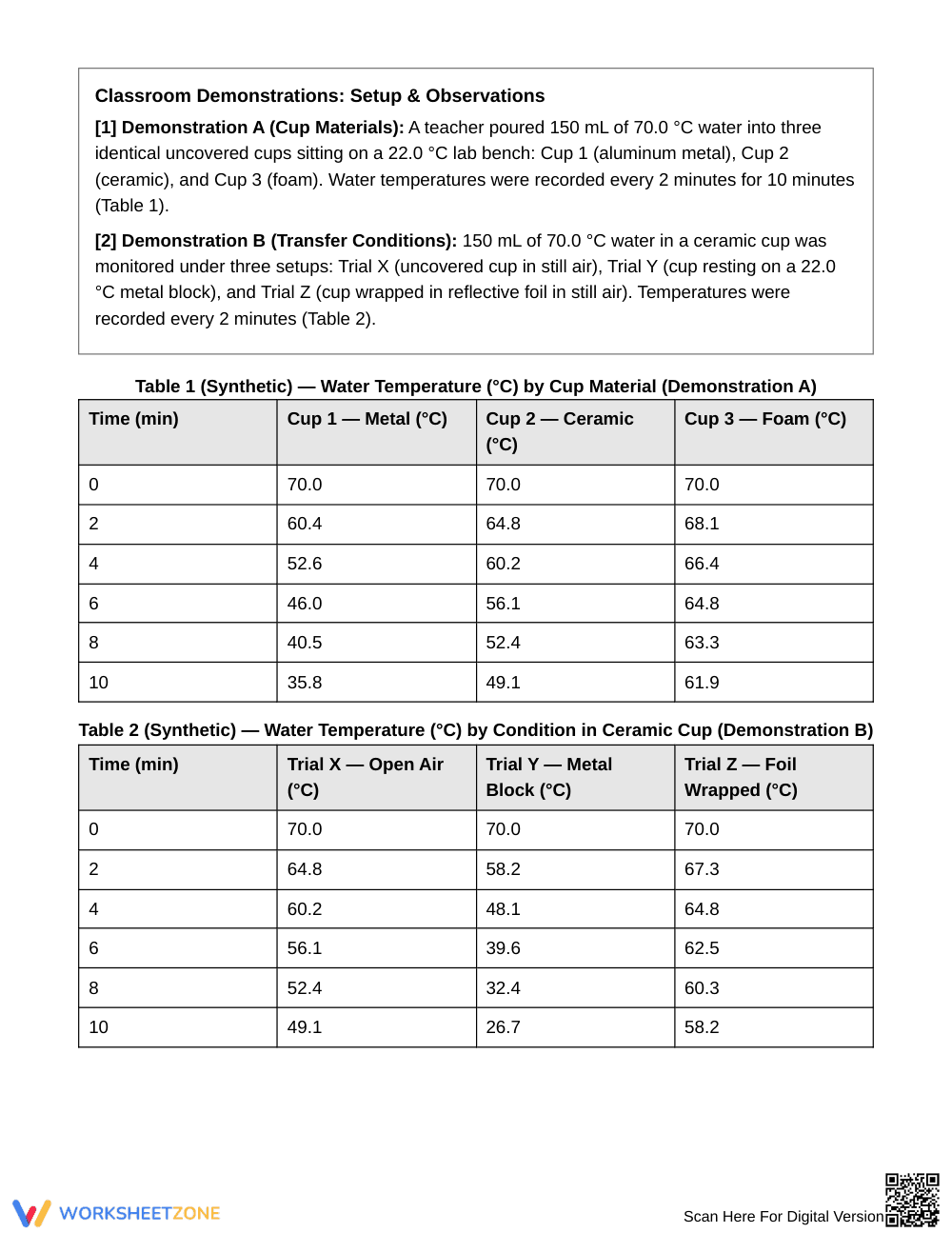
This Grade 6 thermal energy worksheet trains students to analyze heat transfer by interpreting cooling-time measurements across conduction, convection, and radiation setups. Students extract tabular values, calculate temperature drops, evaluate insulation materials, and identify experimental limitations to master physical science data literacy.
At a Glance
- Grade: 6 · Subject: Science
- Standard: Heat Transfer — Interpret laboratory temperature data to track heat transfer via conduction, convection, and radiation
- Skill Focus: Conduction, Convection, and Radiation Data Analysis
- Format: 5 pages · 10 problems · Answer key included · PDF
- Best For: Independent practice following classroom demonstrations
- Time: 35–45 minutes
What's Inside
This 5-page resource includes two synthetic laboratory datasets, core concept definitions, and 10 student tasks across three sequential parts. The student worksheet spans 2 pages of active prompts, supported by a 3-page teacher answer key providing particle-level explanations, mathematical calculations, and model critiques for experimental evaluation items.
Skill Progression
- Guided practice (Tasks 1–2): Students read exact temperatures from data tables with correct units, establishing baseline values under direct structure.
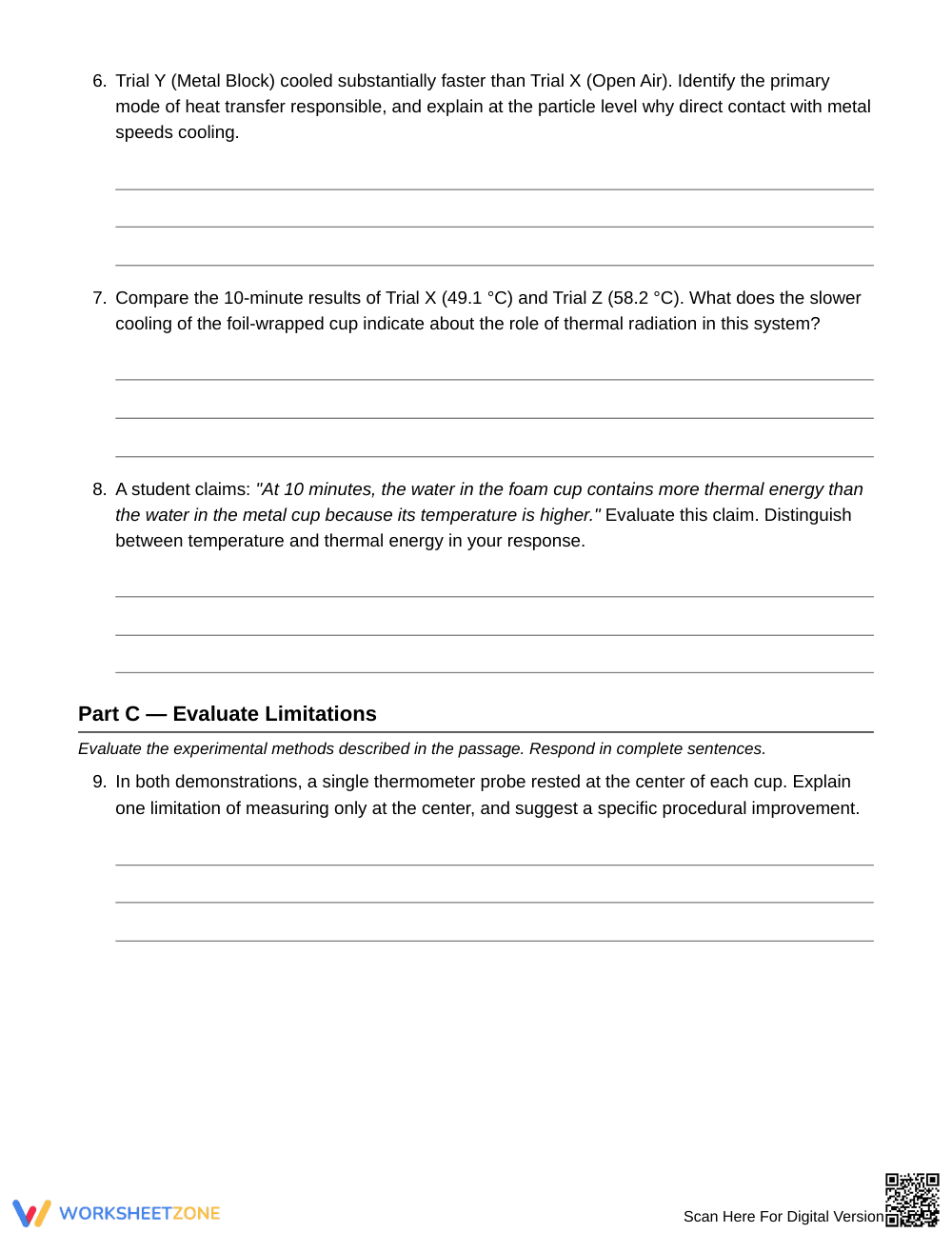
- Supported practice (Tasks 3–8): Students calculate cooling rates, identify heat transfer modes, distinguish temperature from thermal energy, and connect particle contact to cooling speed.
- Independent practice (Tasks 9–10): Students evaluate procedural limits, identifying thermometer placement bias and uncontrolled environmental variables.
This sequence follows the gradual-release framework, guiding learners from simple data retrieval to higher-order scientific evaluation.
Standards Alignment
This worksheet aligns with middle school physical science requirements for thermal energy transfer, asking students to analyze data to determine how different materials and surface conditions affect cooling rates. Supporting standards address evidence-based scientific explanations and procedural critique. Both standard codes can be copied directly into lesson plans, IEP goals, or district curriculum mapping tools.
How to Use It
Use this activity following direct instruction on conduction, convection, and radiation. During classwork, have students complete Parts A and B to analyze material conductivity and radiant barriers. As you circulate during the 35 to 45 minutes of work time, check Task 8 to confirm students differentiate temperature from total thermal energy. Alternatively, use Part C as a formative exit ticket on experimental design.
Who It's For
This worksheet serves Grade 6 science classes exploring thermal physics and experimental design. The tabular layout and scaffolded tasks support English language learners and students receiving resource support, while the experimental critique in Part C extends advanced learners. Pair this printable with a physical calorimeter demonstration or heat transfer anchor chart.
Fisher & Frey (2014) demonstrate that structured gradual-release frameworks significantly enhance student competence in complex data interpretation and scientific reasoning. By transitioning Grade 6 students from direct tabular extraction to multi-step comparative analysis and independent experimental evaluation, this worksheet operationalizes thermal energy standards with targeted rigor. The curriculum design directly addresses foundational misconceptions between heat, temperature, and kinetic particle motion through grounded empirical measurements. Structured analysis of conduction, convection, and radiation promotes verifiable cognitive gains when middle school students articulate physical mechanisms rather than memorizing surface definitions. Furthermore, embedding procedural critique tasks mirrors authentic laboratory practice, building robust metacognitive awareness of uncontrolled experimental variables, measurement constraints, and sensor placement. Implementing systematic thermal energy problem sets with complete analytical solutions ensures measurable academic growth and prepares young scientists for rigorous secondary physical science investigations.


