


























Views
Downloads




Complete Geometric Modeling Worksheet | Grade 10 Geometry
Paste this activity's link or code into your existing LMS (Google Classroom, Canvas, Teams, Schoology, Moodle, etc.).
Students can open and work on the activity right away, with no student login required.
You'll still be able to track student progress and results from your teacher account.
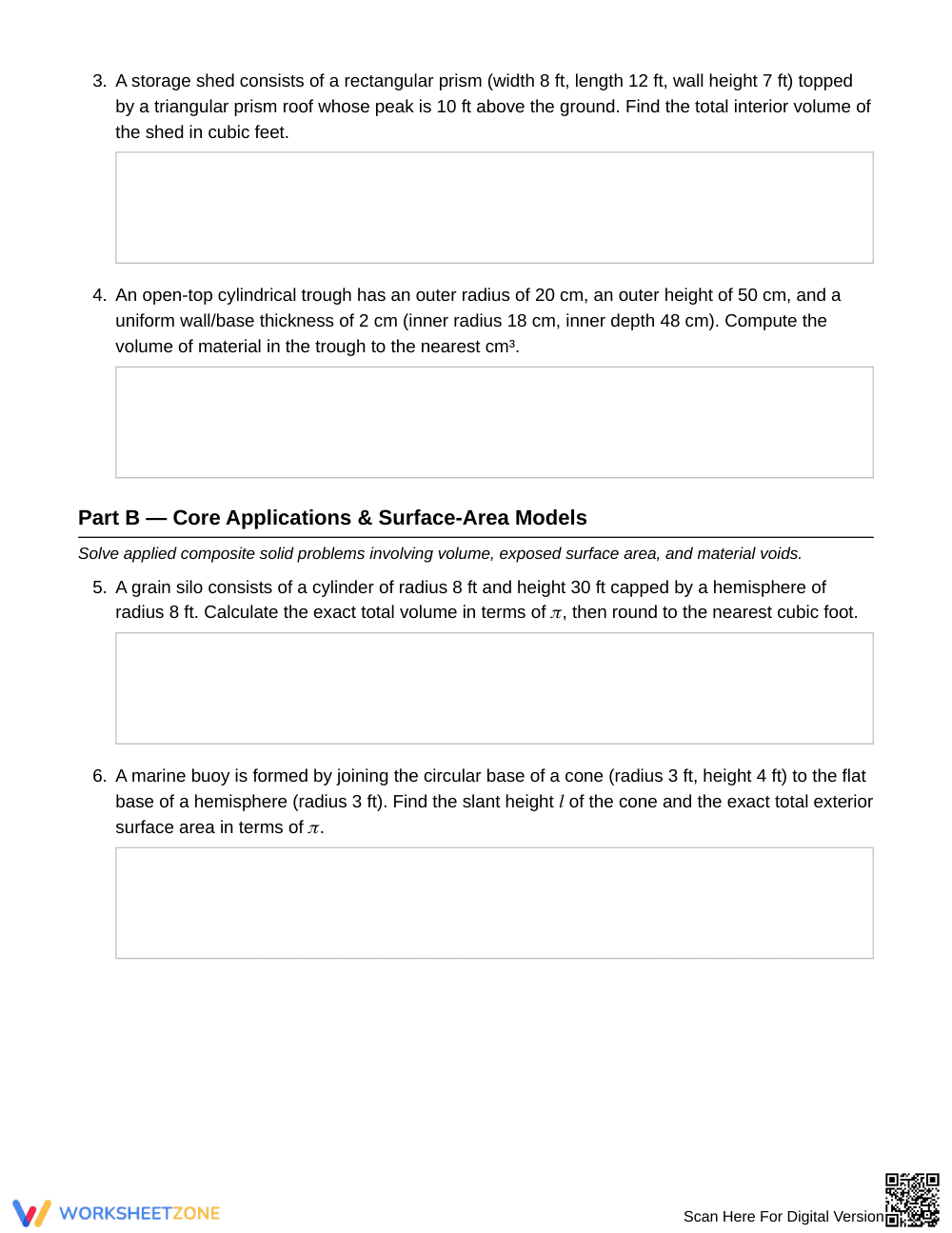
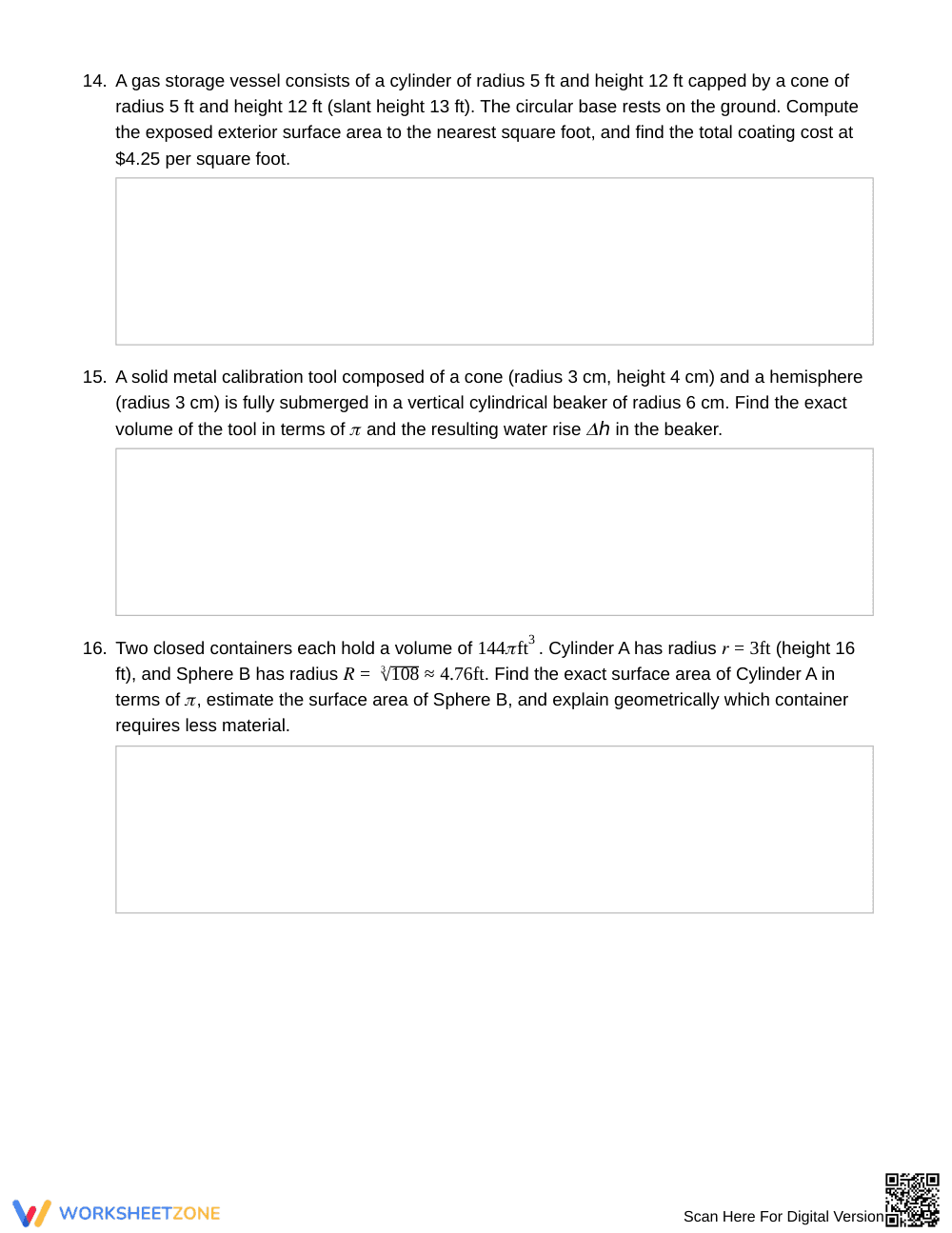
This 5-page geometry worksheet strengthens high school students' ability to model real-world scenarios using volume and surface area formulas. Through 16 multi-step problems, learners calculate exact values, spot algebraic errors, analyze composite 3D solids, and evaluate fluid displacement, fostering geometric modeling mastery.
At a Glance
- Grade: 10 · Subject: Geometry
- Standard:
HSG-MG.A.1— Use geometric shapes and volume formulas to model design objects- Skill Focus: Geometric Modeling with Composite Solids
- Format: 5 pages · 16 problems · Answer key included · PDF
- Best For: High school geometry unit review
- Time: 45–60 minutes
What's Inside
This resource features 16 structured modeling problems across 5 pages, supported by a 2-page answer key. Students use reference formulas for cylinders, cones, and spheres to complete error-analysis prompts, exact-value calculations in terms of pi, hollow-void subtractions, and real-world modeling involving silos, buoys, culverts, and submerged calibration tools.
Skill Progression
- Guided practice (Part A, 4 tasks): Covers core modeling principles, calculating water tower volume, finding surface area formula errors, and solving hollow cylindrical troughs.
- Supported practice (Part B, 8 tasks): Tackles applied composite solids, including silos, medicine capsules, drilled blocks, funnels, and gable greenhouses.
- Independent practice (Part C, 4 tasks): Challenges learners with density-mass problems, coating costs, fluid displacement, and container optimization.
This progression follows the gradual-release framework, guiding students from foundational modeling to autonomous application.
Standards Alignment
This worksheet aligns with HSG-MG.A.1: Use geometric shapes, their measures, and their properties to describe objects. The problems also support high school standards for applying volume formulas to solve design problems. Both standard codes can be copied directly into lesson plans, IEP goals, or district curriculum mapping tools.
How to Use It
Use this worksheet after direct instruction on 3D solids or as an end-of-unit review. Assign Part A during class, then have students complete Parts B and C independently. For formative assessment, observe whether students correctly exclude joined interior faces when computing total surface area. Expected completion time is 45 to 60 minutes.
Who It's For
Designed for Grade 10 Geometry students, this worksheet suits general classes, honors preparation, and intervention groups requiring structured practice. Pair it with a 3D solid reference sheet or a lesson on composite nets for added scaffolding.
According to EdReports 2024 evaluations of high school mathematics curricula, rigorous standards alignment requires secondary students to apply geometric concepts beyond routine drills by engaging in mathematical modeling. This Grade 10 geometry resource addresses standard HSG-MG.A.1 by requiring learners to model real-world composite objects, determine interior voids, and compute density-based mass. Rather than isolating single shapes, the 16 tasks demand synthesis across cylinders, cones, prisms, and spheres to model physical structures such as silos, water towers, and culvert pipes. Research synthesized by EdReports 2024 highlights that deliberate progression from foundational error analysis to multi-step displacement modeling builds conceptual understanding and prepares learners for STEM coursework. Teachers can deploy this verified 5-page worksheet to ensure students demonstrate mastery of spatial visualization, unit conversions, and algebraic representation under current standards.


